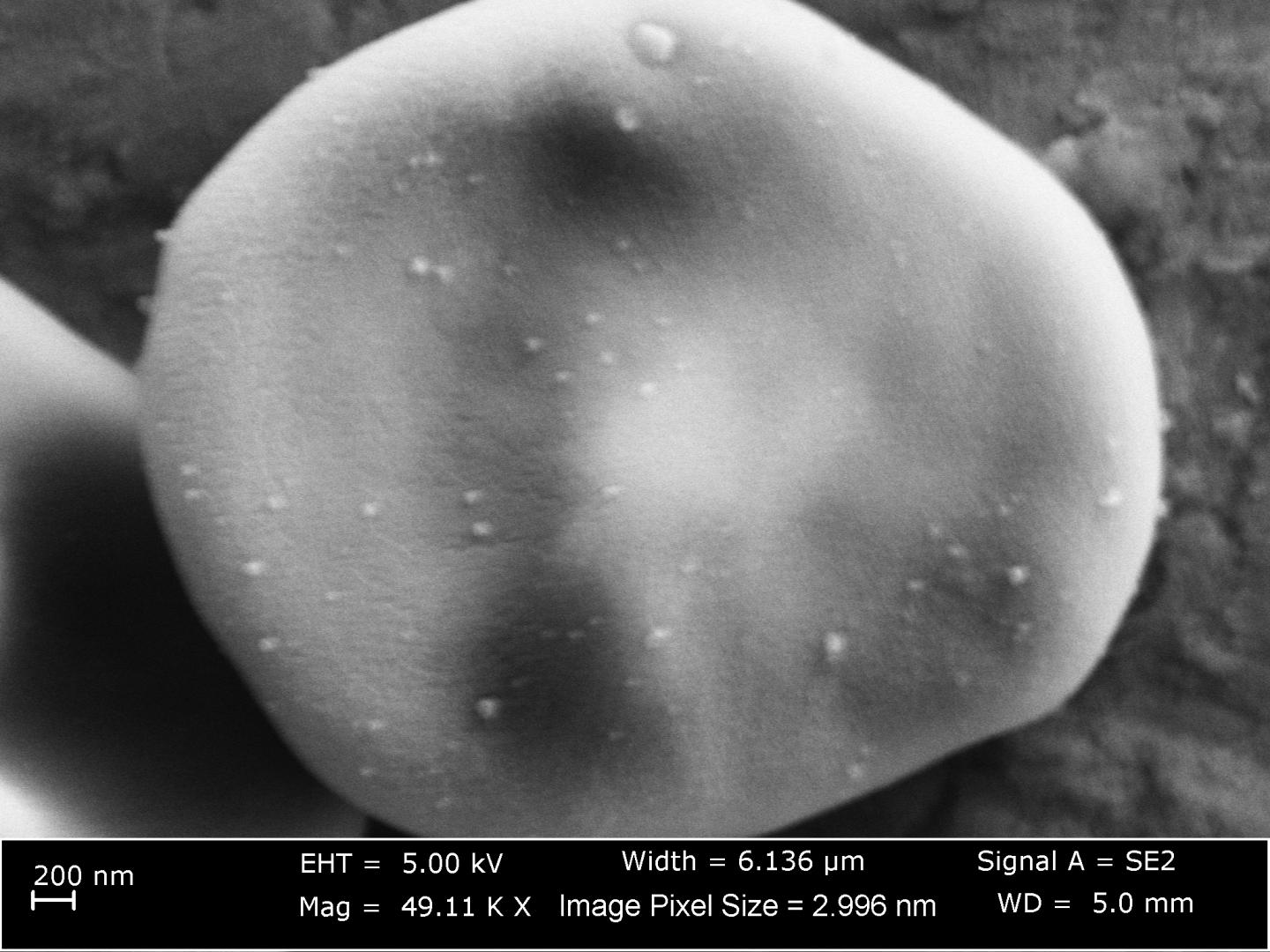
Nanoparticles are promising drug delivery tools, offering the ability to administer drugs directly to a specific part of the body and avoid the awful side effects so often seen with chemotherapeutics.
But there's a problem. Nanoparticles struggle to get past the immune system's first line of defense: proteins in the blood serum that tag potential invaders. Because of this, only about 1 percent of nanoparticles reach their intended target.
"No one escapes the wrath of the serum proteins," said Eden Tanner, a former postdoctoral fellow in bioengineering at the Harvard John A. Paulson School of Engineering and Applied Sciences (SEAS).
Now, Tanner and a team of researchers led by Samir Mitragotri, the Hiller Professor of Bioengineering and Hansjorg Wyss Professor of Biologically Inspired Engineering at SEAS, have developed an ionic forcefield that prevents proteins from binding to and tagging nanoparticles.
In mouse experiments, nanoparticles coated with the ionic liquid survived significantly longer in the body than uncoated particles and, surprisingly, 50 percent of the nanoparticles made it to the lungs. It's the first time that ionic liquids have been used to protect nanoparticles in the blood stream.
"The fact that this coating allows the nanoparticles to slip past serum proteins and hitch a ride on red blood cells is really quite amazing because once you are able to fight the immune system effectively, lots of opportunities open up," said Mitragotri, who is also a Core Faculty Member of Harvard's Wyss Institute for Biologically Inspired Engineering
The research is published in Science Advances.
Ionic liquids, essentially liquid salts, are highly tunable materials that can hold a charge.
"We knew that serum proteins clear out nanoparticles in the bloodstream by attaching to the surface of the particle and we knew that certain ionic liquids can either stabilize or destabilize proteins," said Tanner, who is now an Assistant Professor of Chemistry & Biochemistry at the University of Mississippi. "The question was, could we leverage the properties of ionic liquids to allow nanoparticles to slip past proteins unseen."
"The great thing about ionic liquids is that every small change you make to their chemistry results in a big change in their properties," said Christine Hamadani, a former graduate student at SEAS and first author of the paper. "By changing one carbon bond, you can change whether or not it attracts or repels proteins."
Hamadani is currently a graduate student at Tanner's lab at the University of Mississippi.
The researchers coated their nanoparticles with the ionic liquid choline hexenoate, which has an aversion to serum proteins. Once in the body, these ionic-liquid coated nanoparticles appeared to spontaneously attach to the surface of red-blood cells and circulate until they reached the dense capillary system of the lungs, where the particles sheared off into the lung tissue.
"This hitchhiking phenomenon was a really unexpected discovery," said Mitragotri. "Previous methods of hitchhiking required special treatment for the nanoparticles to attach to red blood cells and even then, they only stayed at a target location for about six hours. Here, we showed 50 percent of the injected dose still in the lungs after 24 hours."
The research team still needs to understand the exact mechanism that explains why these particles travel so well to lung tissue, but the research demonstrates just how precise the system can be.
"This is such a modular technology," said Tanner, who plans to continue the research in her lab at University of Mississippi. "Any nanoparticle with a surface change can be coated with ionic liquids and there are millions of ionic liquids that can be tuned to have different properties. You could tune the nanoparticle and the liquid to target specific locations in the body."
"We as a field need as many tools as we can to fight the immune system and get drugs where they need to go," said Mitragotri. "Ionic liquids are the latest tool on that front."
Contact
Eden E. L. Tanner
School of Engineering and Applied Sciences
Harvard University
eetanner@olemiss.edu
Reference
Protein-avoidant ionic liquid (PAIL)–coated nanoparticles to increase bloodstream circulation and drive biodistribution
Christine M. Hamadani, Morgan J. Goetz, Samir Mitragotri, and Eden E. L. Tanner
DOI: 10.1126/sciadv.abd7563
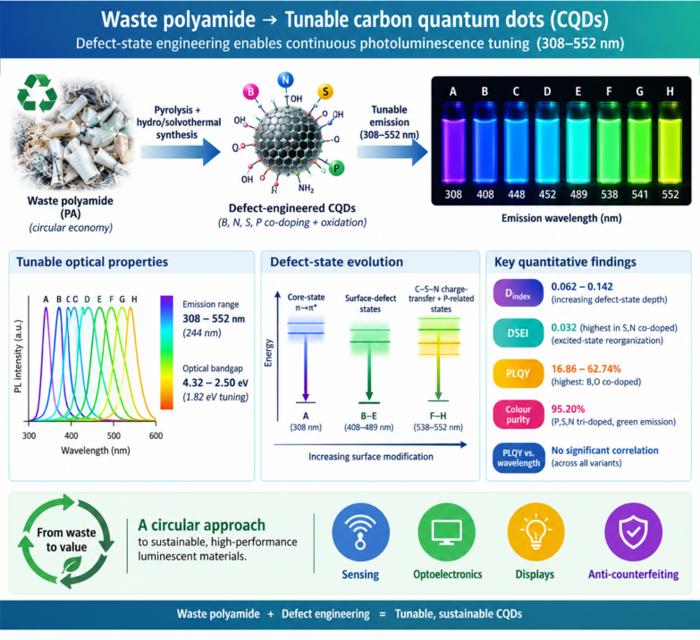
Waste polyamide-derived CQDs show continuous photoluminescence tuning from 308 to 552 nm through sequential defect-state engineering, with optical transition energies decreasing from 4.32 to 2.50 eV. @Christian Ebere Enyoh from Saitama University Carbon quantum dots (CQDs) are fluorescent carbon nanomaterials with potential applications in sensing, optoelectronics, displays, anti-counterfeiting, and environmental technologies. Their optical properties can be adjusted by modifying the carbon...

The researchers used circularly polarized light at normal incidence and found that helicity-dependent photocurrents appeared perpendicular to the crystal’s polarization but vanished when measured parallel to it, supporting a bulk origin of CPGE. @Institute of Science Tokyo The circular photogalvanic effect (CPGE), a phenomenon that generates helicity-dependent photocurrents in noncentrosymmetric materials, can originate purely from a crystal's internal structure without contribution from the...
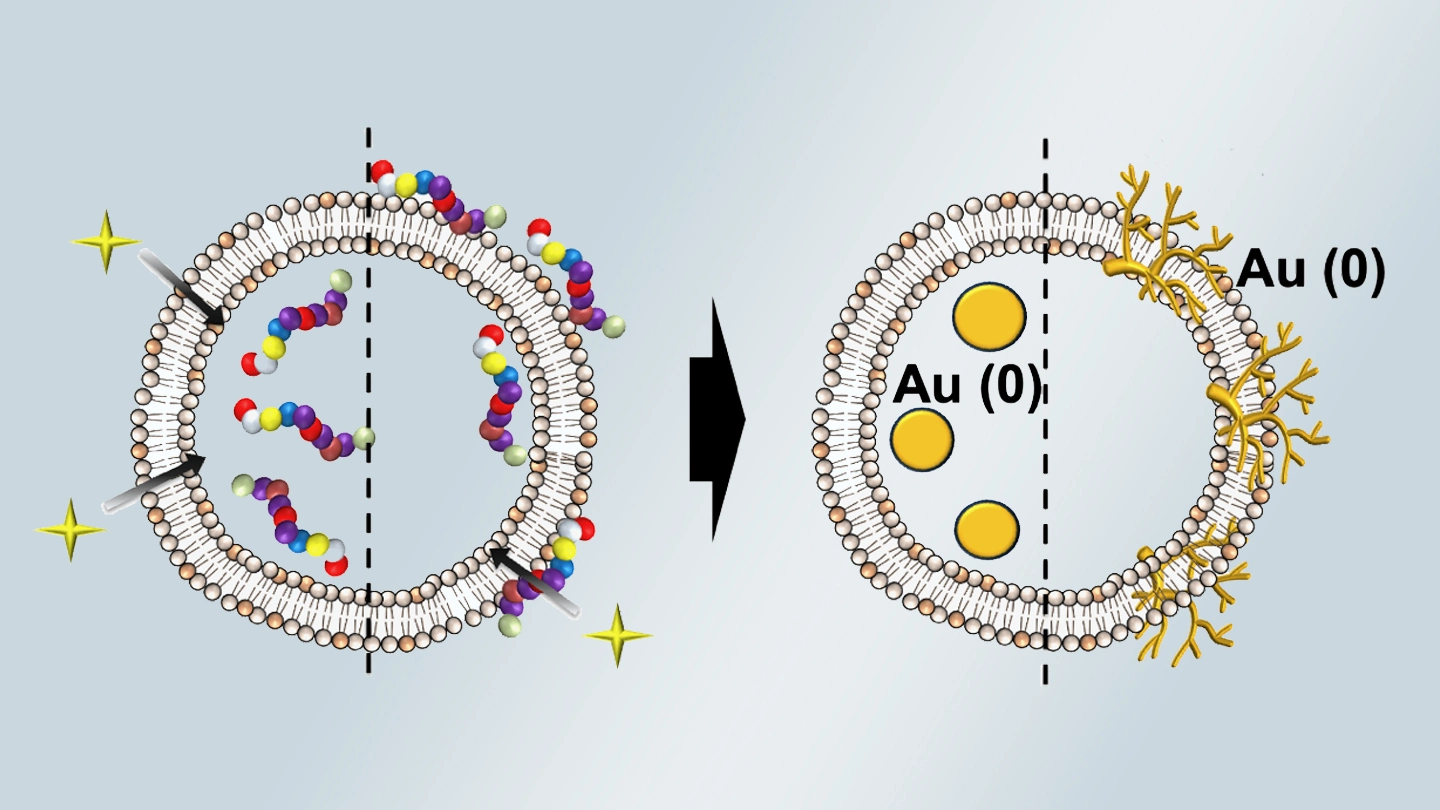
Summary of gold nanoparticle growth programming in liposome based on localization of biomineralization peptide The position of biomineralization peptides within liposomes can influence how gold nanoparticles grow, reports a research team from Institute of Science Tokyo. Peptides localized at the membrane interface promote branched structures, while those confined to the liposome interior favor spherical nanoparticles. The findings offer a new strategy for controlling nanoscale reaction...
