Max Planck Institute of Colloids and Interfaces
Counterfeiting of electronics, certificates or medicines causes billions of dollars in economic losses worldwide every year. The World Health Organisation (WHO) estimates that counterfeit medicines account for 73 billion euros in annual sales. According to the WHO, 50 percent of counterfeit medicines are obtained through unauthorised online mail-order companies. To combat this, medicine packaging will be marked with security features across the EU from 2019. Current counterfeit detection materials, such as those used in fluorescent holograms, typically contain toxic inorganic components. In addition, most of these techniques can be copied within 18 months of decoding the fluorescent compound.
The team led by Dr Felix Löffler from the Department of Biomolecular Systems has come up with a completely new approach to non-copyable nanopatterns in a paper published in the journal Nature Nanotechnology: First, a thin sugar film consisting of simple monosaccharides is bombarded with a laser. In this flash synthesis, the sugar "caramelises" in milliseconds, and at the same time the laser prints random "caramel patterns" on a desired surface. These are unique and fluoresce in different colours under the scanner. Junfang Zhang, first author of the study, says: "The exciting thing here is that you can create any pattern you want, which we have shown using the example of artificial fingerprints. The resulting micro- and nanostructures are completely random. We cannot control them; there will be no pattern". Dr Felix Löffler adds: "Each sugar pattern has a unique topography, and depending on the laser parameters and additives, we get unique colour gradations of red, green or blue".
In their experiments, the team created a nanofilm library of about 2,000 nanopatterns. Two scanning methods can be used to quickly and independently read the microstructure of these sugar patterns, which cannot be copied: Fluorescence scanning and topography scanning. Both methods demonstrate almost ideal bit equality, high uniqueness and reliability of the patterns produced. This means that the patterns have a very high degree of randomness, which is important for their function as copy protection. The combination of both methods improves the protection against counterfeiting (PUF = physically unclonable function). "In addition, with our method we can generate up to 10 to the power of 63000 different variants on 1 mm². For comparison, the number of atoms in the universe is about 10 to the power of 89," says group leader Dr Felix Löffler.
Reference
An all-in-one nanoprinting approach for the synthesis of a nanofilm library for unclonable anti-counterfeiting applications
Junfang Zhang, Yuxin Liu, Christian Njel, Sebastian Ronneberger, Nadezda V. Tarakina & Felix F. Loeffler
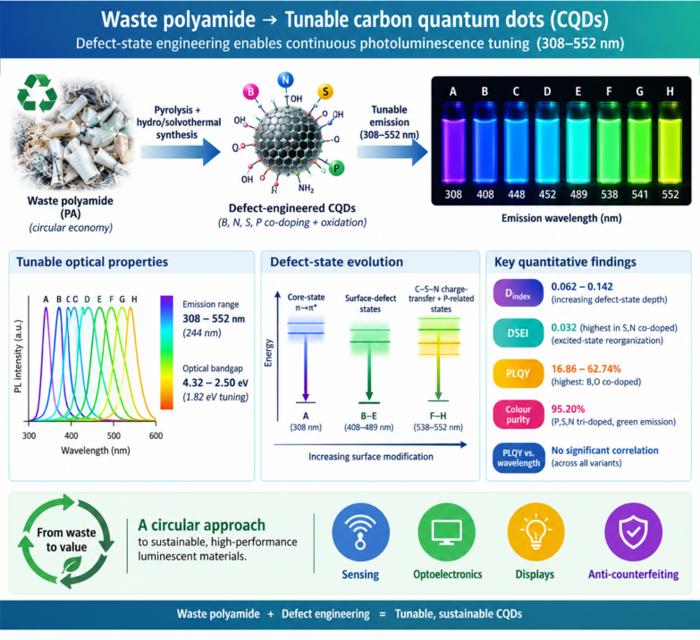
Waste polyamide-derived CQDs show continuous photoluminescence tuning from 308 to 552 nm through sequential defect-state engineering, with optical transition energies decreasing from 4.32 to 2.50 eV. @Christian Ebere Enyoh from Saitama University Carbon quantum dots (CQDs) are fluorescent carbon nanomaterials with potential applications in sensing, optoelectronics, displays, anti-counterfeiting, and environmental technologies. Their optical properties can be adjusted by modifying the carbon...
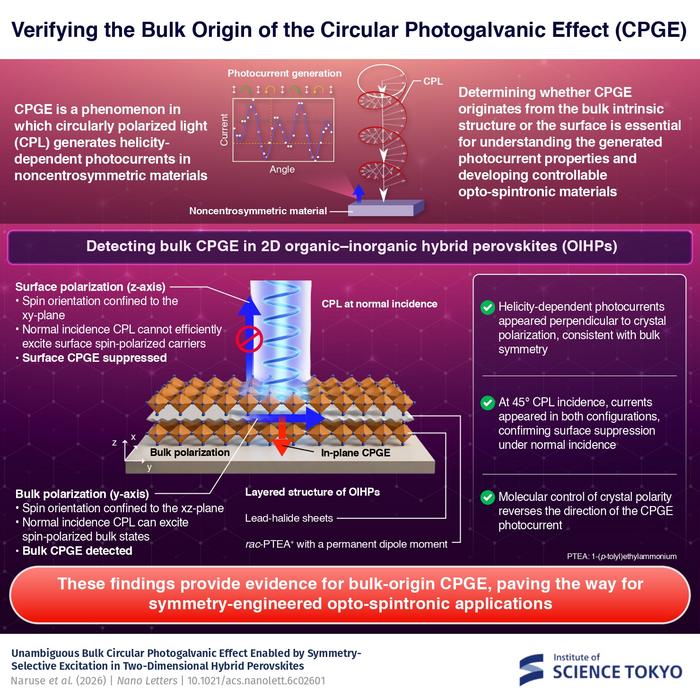
The researchers used circularly polarized light at normal incidence and found that helicity-dependent photocurrents appeared perpendicular to the crystal’s polarization but vanished when measured parallel to it, supporting a bulk origin of CPGE. @Institute of Science Tokyo The circular photogalvanic effect (CPGE), a phenomenon that generates helicity-dependent photocurrents in noncentrosymmetric materials, can originate purely from a crystal's internal structure without contribution from the...
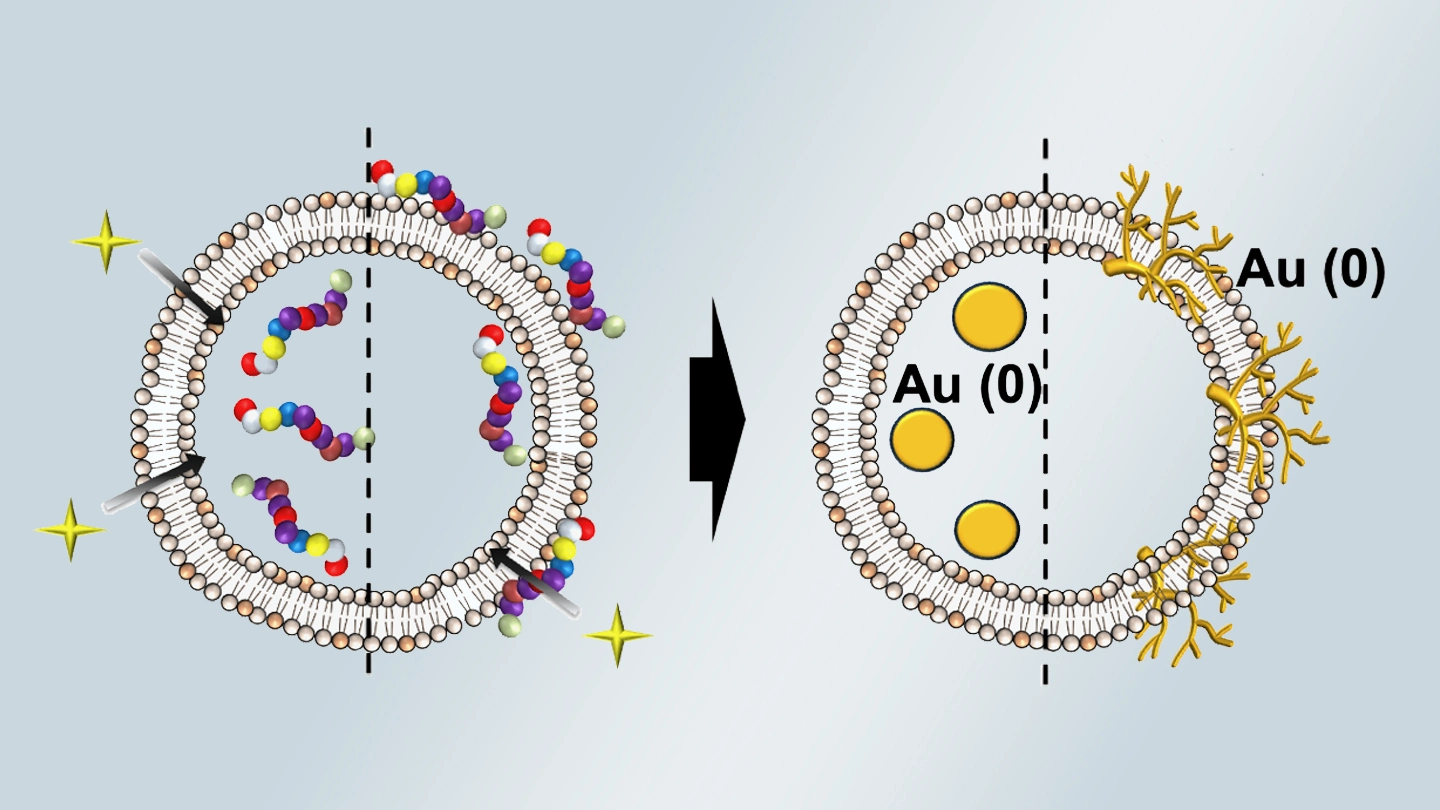
Summary of gold nanoparticle growth programming in liposome based on localization of biomineralization peptide The position of biomineralization peptides within liposomes can influence how gold nanoparticles grow, reports a research team from Institute of Science Tokyo. Peptides localized at the membrane interface promote branched structures, while those confined to the liposome interior favor spherical nanoparticles. The findings offer a new strategy for controlling nanoscale reaction...
