The University of Texas at Austin
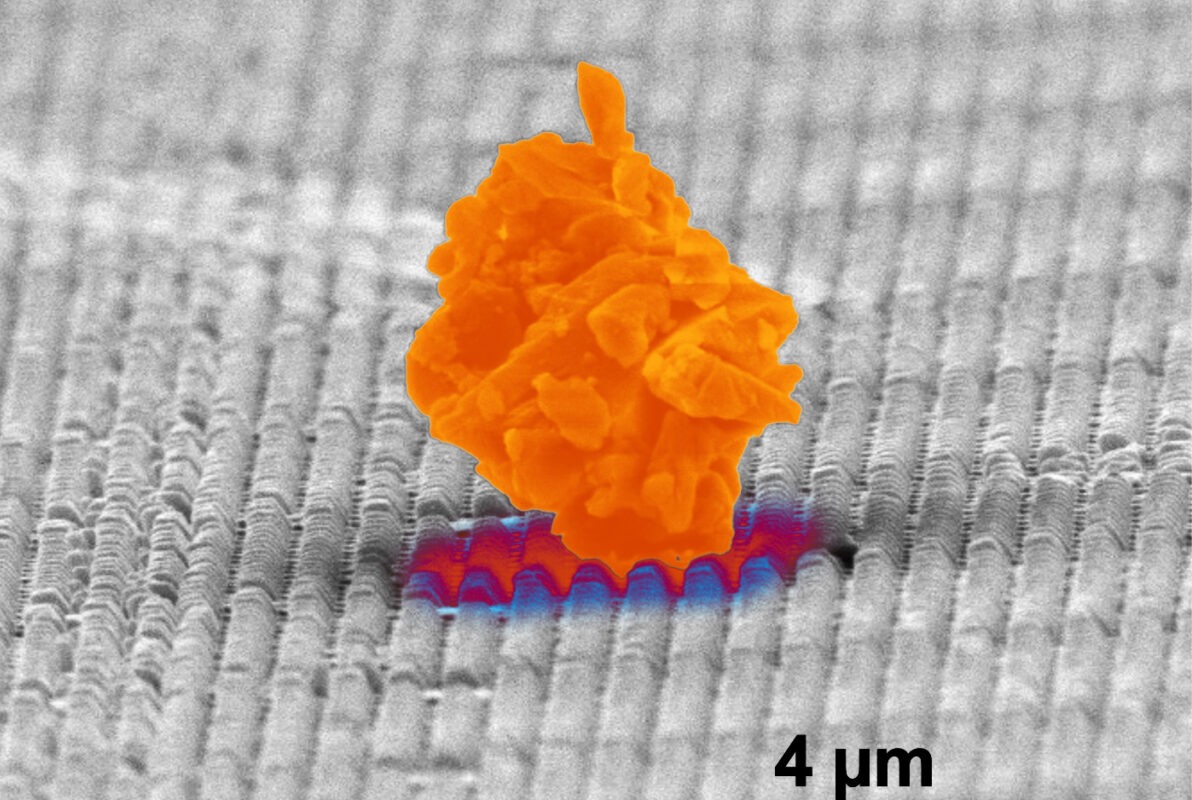
Dust is a common fact of life, and it’s more than just a daily nuisance – it can get into machinery and equipment, causing loss of efficiency or breakdowns.
Researchers at The University of Texas at Austin partnered with North Carolina-based company Smart Material Solutions Inc. to develop a new method to keep dust from sticking to surfaces. The result is the ability to make many types of materials dust resistant, from spacecraft to solar panels to household windows.
The research is published in ACS Applied Materials & Interfaces.
@ The University of Texas at Austin
“What we’ve demonstrated here is a surface that can clean itself,” said Chih-Hao Chang, an associate professor in the Cockrell School of Engineering’s Walker Department of Mechanical Engineering and a lead author of the study. “Particulates aren’t able to stick to the surface, so they come off using just the force of gravity.”
In tests, the researchers piled lunar dust on top of their engineered surfaces and then turned each surface on its side. The result: Only about 2% of the surface remained dusty, compared with more than 35% of a similar but smooth surface.
The researchers said the discovery boils down to things the human eye can’t detect. In the experiments, the team altered the geometry of flat surfaces to create a tightly packed nanoscale network of pyramid-shaped structures. These sharp, angular structures make it difficult for the dust particles to stick to the material, instead sticking to one another and rolling off the material via gravity.
These structures provide a passive solution, meaning they don’t require any extra energy or materials to remove dust. Compare that with more active solutions such as a car windshield that requires the use of windshield wipers and wiper fluid to clean off dust.
The research was funded via a grant from NASA’s Small Business Innovation Research program, so the first applications focus on space technology. Space dust is especially pesky because of how high-risk everything becomes in that environment, and the conditions make cleaning off dust challenging. Dust wreaked havoc on the Apollo missions and has caused Mars rovers to fail.
“There’s not much you can do about lunar dust in space – it sticks to everything and there’s no real way to wipe it off or spray it off,” said Samuel Lee, a lead author who was an undergraduate researcher in Chang’s group. “Dust on solar panels of Mars rovers can cause them to fail.”
This technology also could have tremendous impact on Earth. It could prevent solar panels from collecting dust and losing efficiency over time. It could protect glass windows and someday even digital screens such as phones and TVs.
Anti-dust technology has been around for decades, but it has not gained much traction outside of the lab because of scaling challenges. The researchers used fabrication concepts called nanocoining and nanoimprinting, which prints patterns on objects in a modernized version of the way newspapers and photographs were mass produced during the 1800s.
Reference
Engineering Large-Area Antidust Surfaces by Harnessing Interparticle Forces
Samuel S. Lee, Lauren Micklow, Andrew Tunell, Kun-Chieh Chien, Saurav Mohanty, Nichole Cates, Stephen Furst, and Chih-Hao Chang
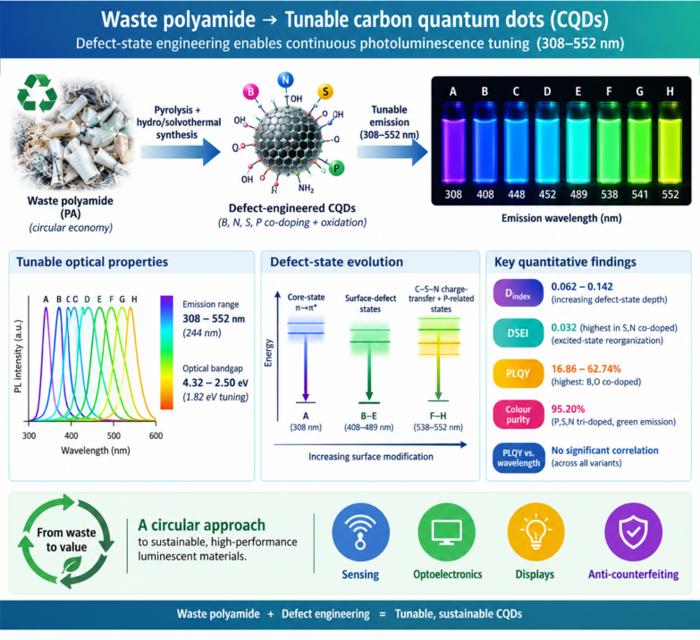
Waste polyamide-derived CQDs show continuous photoluminescence tuning from 308 to 552 nm through sequential defect-state engineering, with optical transition energies decreasing from 4.32 to 2.50 eV. @Christian Ebere Enyoh from Saitama University Carbon quantum dots (CQDs) are fluorescent carbon nanomaterials with potential applications in sensing, optoelectronics, displays, anti-counterfeiting, and environmental technologies. Their optical properties can be adjusted by modifying the carbon...
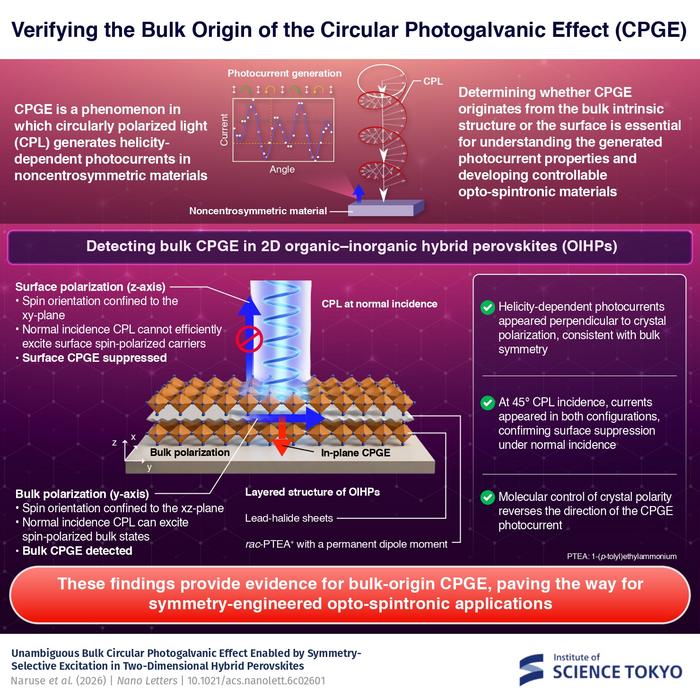
The researchers used circularly polarized light at normal incidence and found that helicity-dependent photocurrents appeared perpendicular to the crystal’s polarization but vanished when measured parallel to it, supporting a bulk origin of CPGE. @Institute of Science Tokyo The circular photogalvanic effect (CPGE), a phenomenon that generates helicity-dependent photocurrents in noncentrosymmetric materials, can originate purely from a crystal's internal structure without contribution from the...
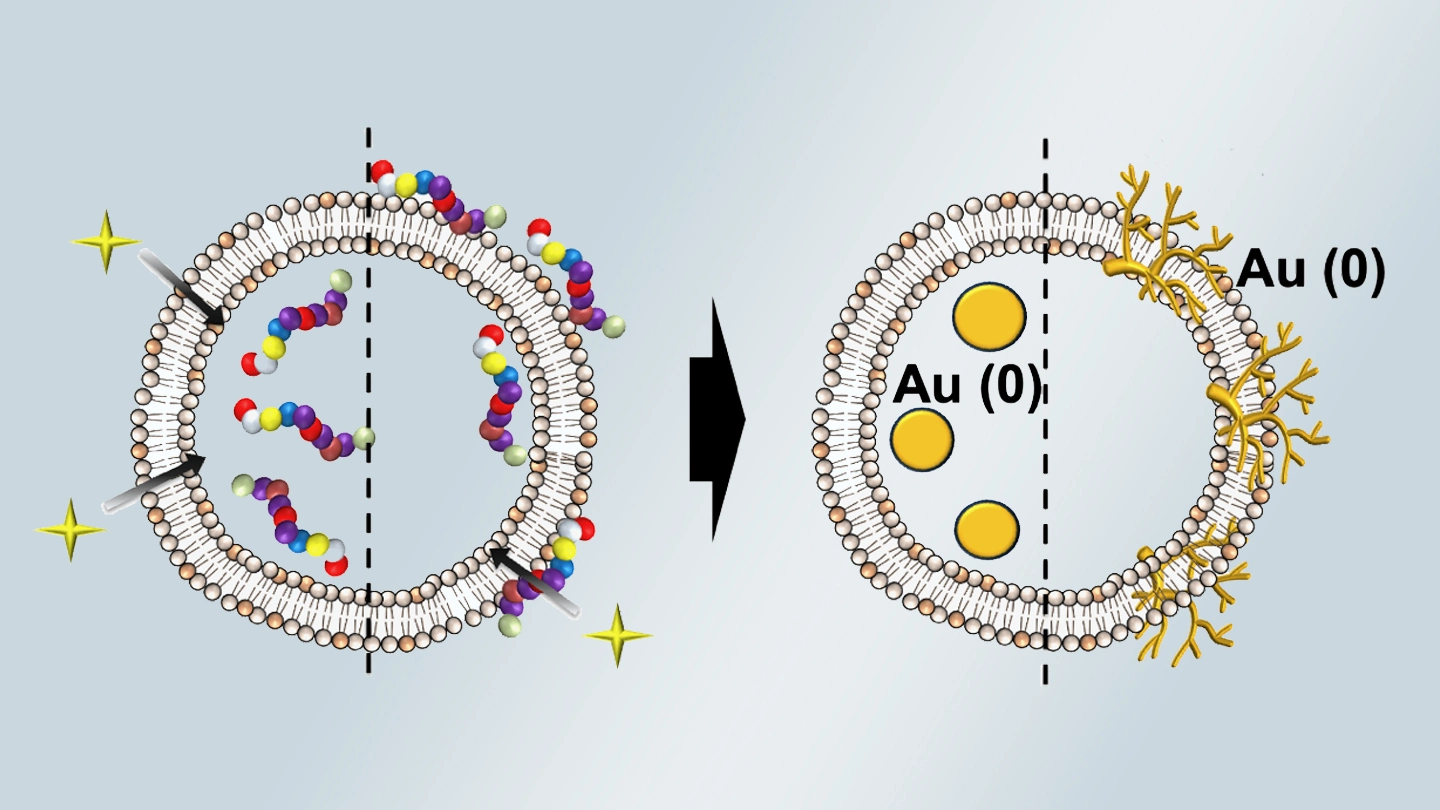
Summary of gold nanoparticle growth programming in liposome based on localization of biomineralization peptide The position of biomineralization peptides within liposomes can influence how gold nanoparticles grow, reports a research team from Institute of Science Tokyo. Peptides localized at the membrane interface promote branched structures, while those confined to the liposome interior favor spherical nanoparticles. The findings offer a new strategy for controlling nanoscale reaction...
