
For decades, quantum mechanics assumed that all observable particles fall into two categories: fermions, which repel each other, and bosons, which clump together. Now, this dichotomous view of particles is being questioned. Researchers from the Max Planck Institute of Quantum Optics and Rice University have investigated the intricacies of particle exchange statistics and shown that a third category — paraparticles — can exist under specific physical conditions, obeying exotic "parastatistics" markedly different from those of fermions and bosons. Using a second quantization framework, they mathematically demonstrated that paraparticles emerge as quasiparticle excitations in quantum spin models, challenging long-standing assumptions in condensed matter and particle physics. Their discovery was published last week in Nature.
Quantum mechanics distinguishes between two types of particle statistics: fermions, with half-integer spin (the building blocks of matter, such as electrons), and bosons, with integer spin (force carriers like photons and gluons). Fermions obey the Pauli exclusion principle, meaning they cannot occupy the same quantum state. Bosons, however, can, which leads to phenomena such as Bose-Einstein condensates, observed in superfluids. This distinction between the two classes has profound implications for the structure of atoms and the behavior of different phases of matter.
It was long believed that there is nothing beyond or between these two categories — except for anyons, which can exist only in two-dimensional materials. A second potential exception, known as paraparticles, has been consistently defined in any spatial dimension and was first proposed in the 1950s. Although extensively studied by the high-energy physics community, by the 1970s mathematical studies appeared to show that paraparticles were simply bosons or fermions in disguise. Consequently, it became widely accepted that in our three-dimensional world, only fermions and bosons are possible. However, this long-standing view is now being challenged.
A recent study by theorists Zhiyuan Wang, former PhD candidate at Rice University and now postdoctoral researcher at the Max Planck Institute of Quantum Optics, and Kaden Hazzard, Professor at Rice University, mathematically proves for the first time that nontrivial parastatistics can emerge in certain exotic topological phases of matter. This finding points to novel physical phenomena beyond those predicted by ordinary particle statistics.
“This discovery may open a new frontier in condensed matter physics by expanding our understanding of topological phases and quasiparticle statistics. More speculatively, it also suggests the possibility of a new type of elementary particle in nature,” says Zhiyuan Wang, first author of the paper.
Paraparticles display exotic exchange statistics
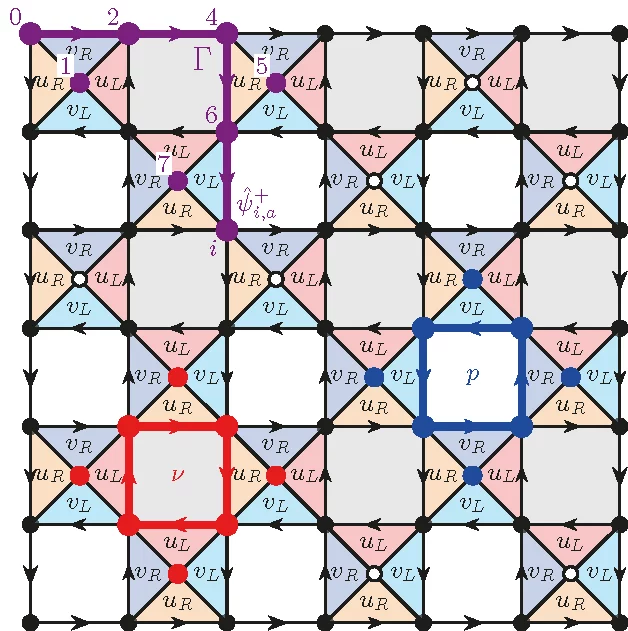
Using advanced mathematics – including Lie algebra, Hopf algebra, and representation theory – combined with tensor network methods for visualizing abstract concepts, the researchers performed complex algebraic calculations. These efforts led to models of condensed matter systems where paraparticles naturally emerge.
Paraparticles in these models display exotic exchange statistics unlike those of fermions or bosons. For example, when two bosons swap positions, the system’s wavefunction remains unchanged. The same is true for fermions except that their overall wavefunction takes on a minus sign. Paraparticles on the opposite have additional internal properties with a degree of freedom that take on different values when two of them are swapped.
The team also analyzed the thermodynamic properties of non-interacting paraparticles. Unlike ordinary fermions and bosons, paraparticles exhibit unique single-mode exclusion statistics, hinting at exotic free-particle thermodynamics.
Parastatistics could enable long-distance secret communication
This newly discovered exchange behavior of paraparticles not only enriches the theoretical landscape of particle physics but also has potential real-world applications in material science and quantum information. One particularly intriguing possibility is the use of parastatistics in secure communication:
“Using their exotic exchange statistics, two parties with paraparticles could communicate by swapping their positions without ever coming close to each other and without leaving any trace detectable by a third party,” explain the researchers.
The next steps in this research include developing a broader classification framework for paraparticles using mathematical tools like tensor categories and creating more realistic theoretical models to guide experimental discovery. “This will help identify practical applications for paraparticles in the future,” Wang adds.
Additionally, the researchers note that the new mathematical models developed for paraparticle studies could lead to the discovery of novel quantum phases, such as chiral or gapless topological phases, which are challenging to investigate using current theoretical and computational techniques.
Reference
Particle exchange statistics beyond fermions and bosons
Zhiyuan Wang & Kaden R. A. Hazzard
https://www.nature.com/articles/s41586-024-08262-7
Max Planck Society
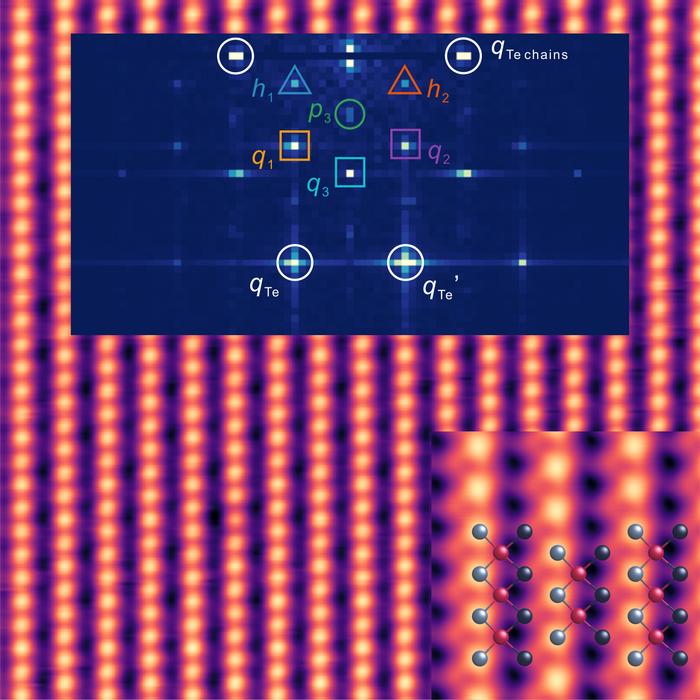
A Fourier transform revealing spatial patterns on the surface at 300 millikelvins. A charge density wave signals the presence of the pair density wave. The background is tellurium atoms on the surface of uranium ditelluride. @University of Illinois Urbana-Champaign’s Grainger College of Engineering Physicists with the University of Illinois Urbana-Champaign’s Grainger College of Engineering have identified a new form of superconducting behavior. Experiments on the metal uranium ditelluride...
Stack two atomically thin layers, rotate one slightly against the other, and a new material emerges. The resulting moiré pattern can slow electrons down so much that their interactions take over. This produces superconductivity, magnetism and exotic fractional quantum states that neither layer shows on its own. This field, known as twistronics, has become one of the most active frontiers in condensed matter physics. So far, however, it has been built on only a handful of materials, mainly...
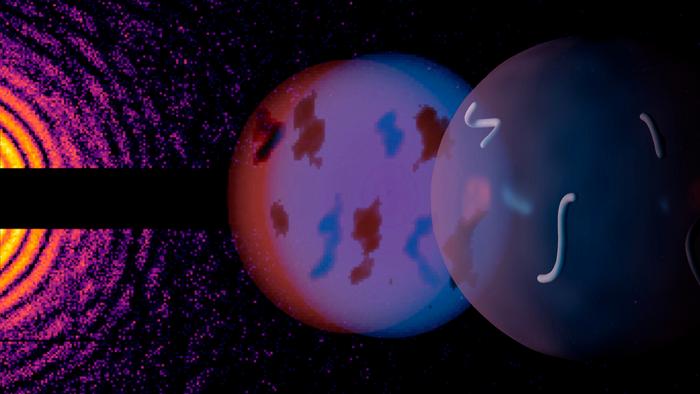
From a two-colour diffraction pattern (left), two snapshots of a helium droplet doped with xenon nanoparticles can be reconstructed (centre). These images can inform a potential 3D rendering of a xenon-doped helium nanodroplet (right). An overarching goal of ultrafast science is to enable researchers to watch structural changes in matter on their natural timescale. Experimentally, this translates into taking two snapshots of the same nanoscale object that are only femtoseconds apart to...
