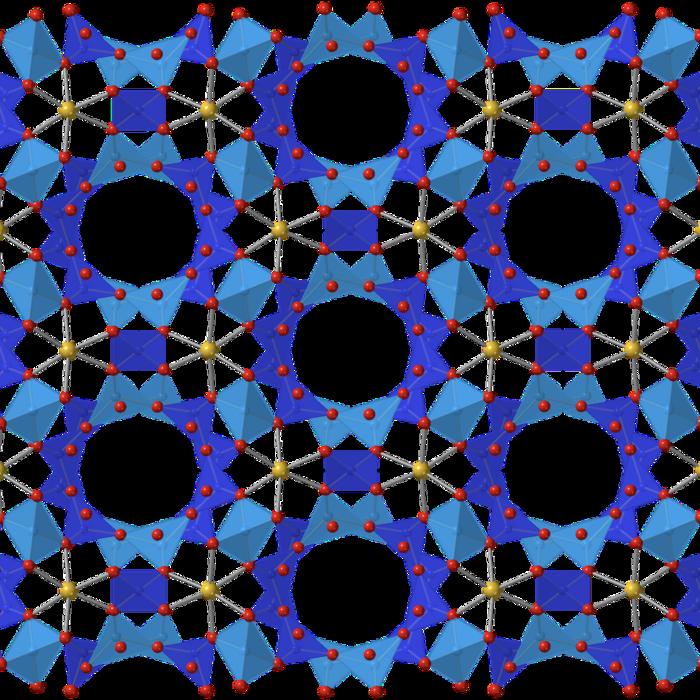
Cordierite, a remarkable mineral familiar to many as the material behind heat-resistant pizza stones, exhibits an unusual ability to resist changes in size despite significant temperature fluctuations. While widely used in diverse applications from automotive catalytic converters to high-temperature industrial processes, the fundamental reasons behind this anomalous thermal behaviour have remained largely unexplained. A new study, led by researchers at Queen Mary University of London and published in Matter, now provides the first comprehensive explanation, with profound implications for the design and development of advanced materials.
"Modern society demands materials that exhibit minimal dimensional changes with temperature fluctuations, unlike most materials that expand and contract significantly," explained Professor Martin Dove, lead researcher and Professor of Condensed Matter and Materials at Queen Mary University of London. "Examples of such materials include Pyrex, used for oven-safe dishes, and the glass-ceramic employed in cooking hobs."
Unlike most materials, cordierite displays an unusual combination of thermal expansions: low positive expansion along two perpendicular axes and negative expansion along the third. This unique behaviour has made cordierite invaluable in applications requiring exceptional thermal stability. However, the precise mechanisms underlying these properties have remained enigmatic.
To address this, the research team employed advanced lattice dynamics and molecular dynamics simulations, utilizing transferable force fields to model the atomic structure of cordierite under varying thermal conditions. The simulations accurately reproduced experimental data, providing insights into the mineral's behaviour at both low and high temperatures.
"Our research demonstrates that the anomalous thermal expansion of cordierite originates from a surprising interplay between atomic vibrations and elasticity," stated Professor Dove.
At lower temperatures, the researchers observed that lower-frequency vibrations favour negative thermal expansion (NTE) along all three axes. At higher temperatures, higher-frequency vibrations dominate, leading to the more typical positive expansion. Crucially, these contributions are counterbalanced by the material's elastic properties, which act like a three-dimensional hinge, effectively cancelling out many of the thermal effects.
"This cancellation mechanism explains why cordierite exhibits small positive expansion in two directions and small negative expansion in the third. It is an unexpected outcome that challenges conventional understanding in this field," added Professor Dove.
These findings open new avenues for the discovery and design of materials with tailored thermal properties. The methodology developed in this study, combining simulations of atomic vibrations with elasticity models, can be directly applied to other anisotropic materials, offering a cost-effective approach for screening potential candidates for specific applications.
"Anisotropic materials like cordierite hold immense potential for developing high-performance materials with unique thermal behaviours," stated Professor Dove. "Our approach can rapidly predict these properties, significantly reducing the reliance on expensive and time-consuming experimental procedures."
The study also underscores the importance of challenging established assumptions. "Initially, I was sceptical of the results," confessed Professor Dove. "The initial data suggested uniform expansion behaviour at both high and low temperatures, but the final results revealed a delicate balance of forces. It was a moment of scientific serendipity."
Cordierite belongs to a family of silicate minerals with promising thermal properties. Understanding its behaviour paves the way for innovations in various fields, including automotive engineering, electronics, and materials utilised in extreme environments. The study also contributes to the growing body of research on negative thermal expansion in anisotropic systems – an area that has historically been under-explored.
This research marks a significant advancement in the study of anisotropic materials and their thermal behaviours. With the established methodology, the team plans to investigate other silicate minerals and extend their findings to synthetic materials. "The possibilities are vast," stated Professor Dove. "This work provides a roadmap for uncovering new materials that could revolutionise industries reliant on thermal stability."
Reference
Anomalous thermal expansion of cordierite, Mg2Al4Si5O18, understood through lattice simulations
Martin T. Dove, Li Li
https://www.cell.com/matter/abstract/S2590-2385(24)00636-2
Queen Mary University of London
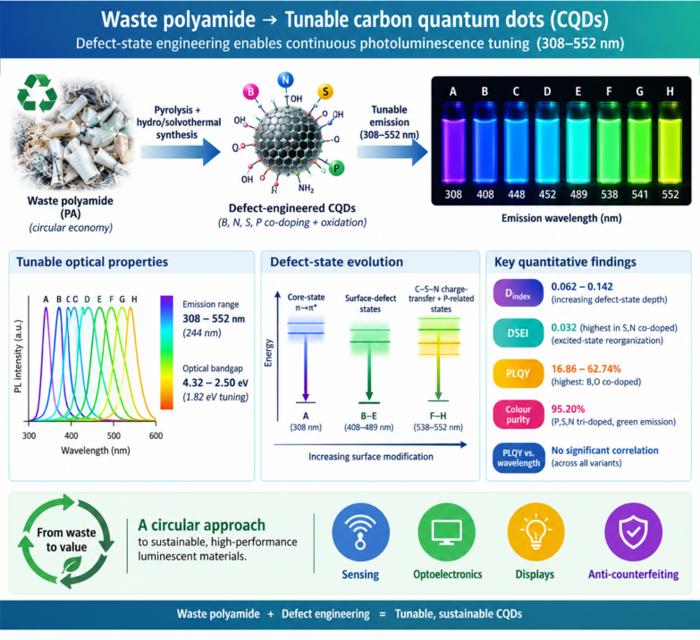
Waste polyamide-derived CQDs show continuous photoluminescence tuning from 308 to 552 nm through sequential defect-state engineering, with optical transition energies decreasing from 4.32 to 2.50 eV. @Christian Ebere Enyoh from Saitama University Carbon quantum dots (CQDs) are fluorescent carbon nanomaterials with potential applications in sensing, optoelectronics, displays, anti-counterfeiting, and environmental technologies. Their optical properties can be adjusted by modifying the carbon...
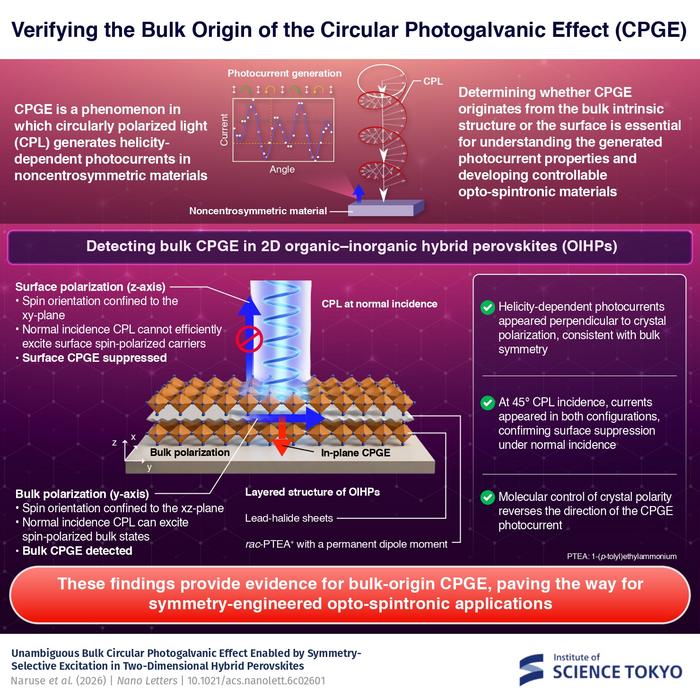
The researchers used circularly polarized light at normal incidence and found that helicity-dependent photocurrents appeared perpendicular to the crystal’s polarization but vanished when measured parallel to it, supporting a bulk origin of CPGE. @Institute of Science Tokyo The circular photogalvanic effect (CPGE), a phenomenon that generates helicity-dependent photocurrents in noncentrosymmetric materials, can originate purely from a crystal's internal structure without contribution from the...
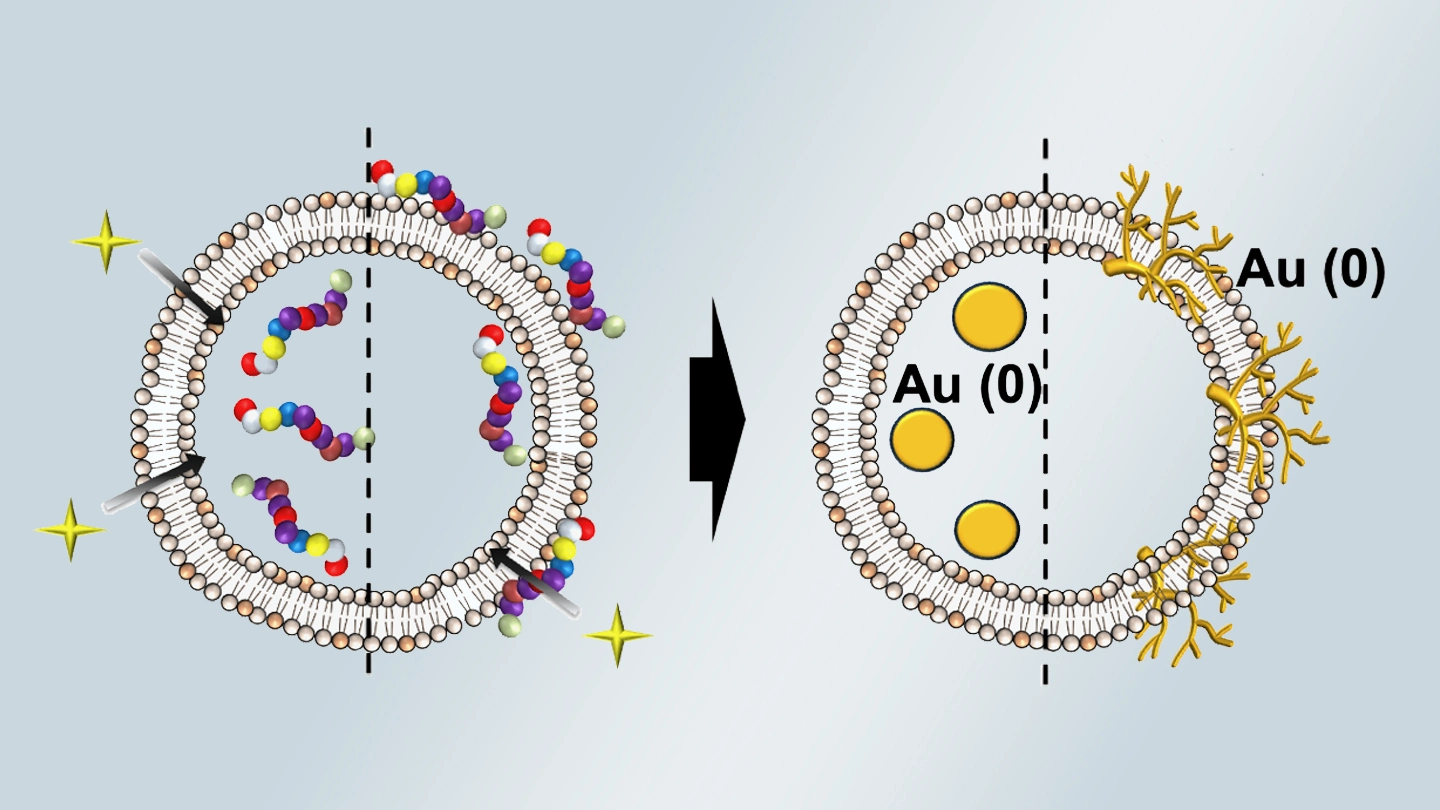
Summary of gold nanoparticle growth programming in liposome based on localization of biomineralization peptide The position of biomineralization peptides within liposomes can influence how gold nanoparticles grow, reports a research team from Institute of Science Tokyo. Peptides localized at the membrane interface promote branched structures, while those confined to the liposome interior favor spherical nanoparticles. The findings offer a new strategy for controlling nanoscale reaction...
