Dalian Institute of Chemical Physics, Chinese Academy Sciences
The growing demand for clean energy and the environmental costs of fossilfuel use have intensified interest in solar hydrogen production. Photocatalytic water splitting can convert light energy directly into chemical fuel, but practical performance is often limited by rapid electron-hole recombination and photocorrosion in sulfide semiconductors. Polyoxometalates can efficiently accept and transfer electrons, yet their high solubility and possible leaching can limit recovery and stability. Combining these materials in a well-designed heterostructure offers a route to exploit their complementary strengths.
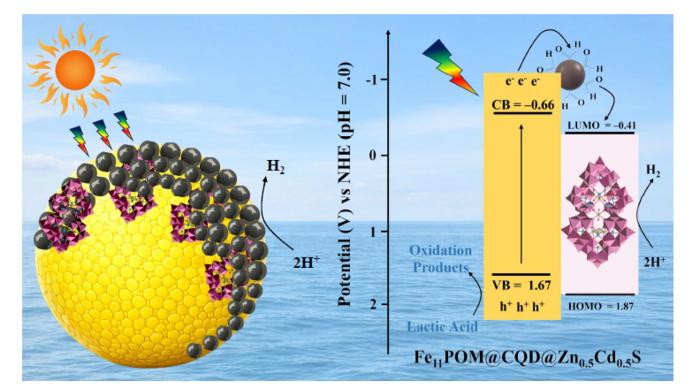
A research team at Lanzhou University, under guidance ofProfessor Yong Ding as corresponding author, designed the threecomponent Fe11POM@CQD@Zn0.5Cd0.5S photocatalyst to integrate light harvesting, charge relay and protonreduction functions. Surfacecharge analysisand XPS study support strong electrostatic interactions between negatively charged Fe11POM and positively charged CQD@Zn0.5Cd0.5S. In the composite, Zn0.5Cd0.5S serves as the visible1light1absorbing semiconductor, carbon quantum dots act as electron relayersand Fe11POM functions as the reduction co-catalyst.The results were published in Chinese Journal of Catalysis (DOI: 10.1016/S187212067(26)6507111).
Under visible1light excitation, Zn0.5Cd0.5S absorbs photons across its 2.33 eV band gap and promotes electrons from a valenceband potential of about +1.67 V to a conductionband potential of about -0.66 V versus NHE. The carbon quantum dots capture these photoexcited electrons and transfer them toward the LUMO of Fe11POM at about -0.41 V, enriching electrons at the polyoxometalate co-catalyst where protons are reduced to H2. Meanwhile, lactic acid scavenges photogenerated holes. Photocurrent, impedance, photoluminescence, time1resolved fluorescence and in-situ KPFM measurements collectively support faster interfacial charge transfer and more effective charge separation in the ternary composite.
The optimized Fe11POM@CQD@Zn0.5Cd0.5S system reaches a hydrogen evolution rate of 32.18 mmol·g-1·h-1, compared with for other single and two component catalysts used in the study. At 5% Fe11POM loading, the composite delivers a turnover number of 32,394 and a turnover frequency of 10,798 h-1. The apparent quantum yield reaches approximately 40% at 420 nm and reported solartohydrogen efficiency is 1.69%. The catalyst also maintains its activity through five consecutive cycles, while postreaction FTIR, XRD, XPS and SEM analyses show little structural or morphological change. The results demonstrate how carbon quantum dots can bridge a visible1light semiconductor and a molecular POM co-catalyst, providing a practical design strategy for improving charge utilization and photocatalytic hydrogen evolution.
Reference
Carbon quantum dot-mediated Fe11 polyoxometalate enrichment for accelerated photocatalytic H2 evolution in a Zn0.5Cd0.5S system
Khalid Umer, Xiao Fang, Khuram Hasnain, Hira Shahid, Weize Sun, Chenyu Shi, Junhan Xie, Baochun Ma, and Yong Ding
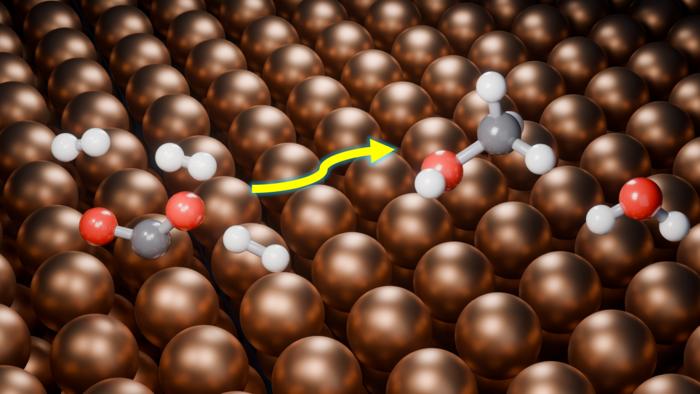
A data-driven framework from Indian Institute of Science researchers mapped nearly 10,000 elementary reactions in CO2 hydrogenation over copper, using quantum-mechanical simulations to train machine learning models that predict activation energy barriers and automated tools to enumerate reactions among 105 surface species.
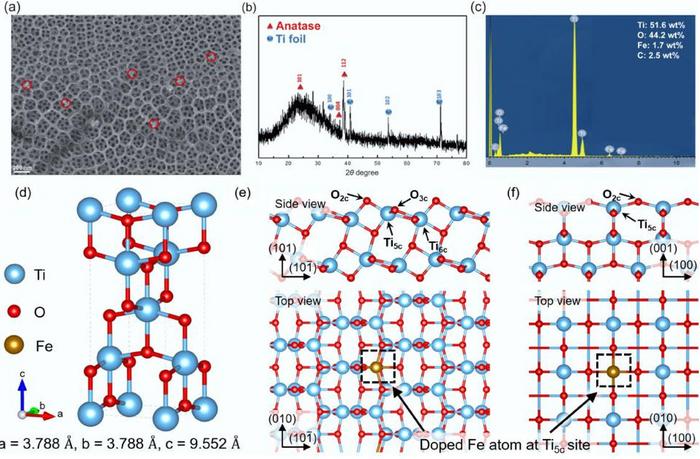
Iron-modified titanium dioxide nanotube electrodes removed 92.1% of nitrobenzene from water within two hours when combined with heat, electricity and ultraviolet light, versus 7.5% for electrical treatment alone. Nitrate-based estimates put mineralization at 62.4%, and intermediate products pointed to a shorter degradation pathway.
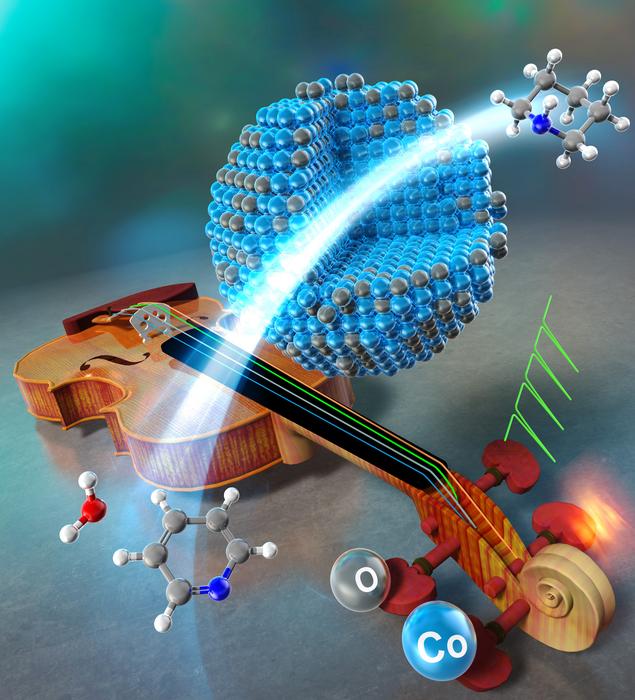
Yokohama National University researchers show that an earth-abundant cobalt catalyst can selectively hydrogenate nitrogen-containing compounds when the ratio between metallic cobalt and cobalt oxide is carefully tuned. The optimized catalyst converted pyridine to piperidine with over 99% yield under ambient electrolysis, and intermittent electrolysis maintained that balance for gram-scale synthesis.






