
We've all experienced the moment of panic when a glass slips from our hands, shattering into pieces upon hitting the ground. What if this common mishap could become a thing of the past?
Now, a new discovery by researchers at Tohoku University has offered insights into how glass resists breakage, potentially paving the way for highly durable, break-resistant materials. The breakthrough has wide ranging implications for glass-related industries.
Details of their findings were published in the journal Acta Maeterialia on December 2, 2024.
"Glass, while strong, is prone to breaking when stress exceeds its tolerance, but interestingly, the movement of atoms and molecules within glass can relax internal stress, making the material more resistant to fractures," points out Makina Saito, an associate professor at Tohoku University's Graduate School of Science. "Although we know that some atoms 'jump' into nearby empty spaces, how this process alleviates stress has long been a mystery."
Saito and his colleagues, who comprised researchers from Kyoto University, Shimane University, the National Institute for Materials Science, and the Japan Synchrotron Radiation Research Institute, uncovered a previously unknown mechanism of stress relaxation in ionic glass, a model system of glass.
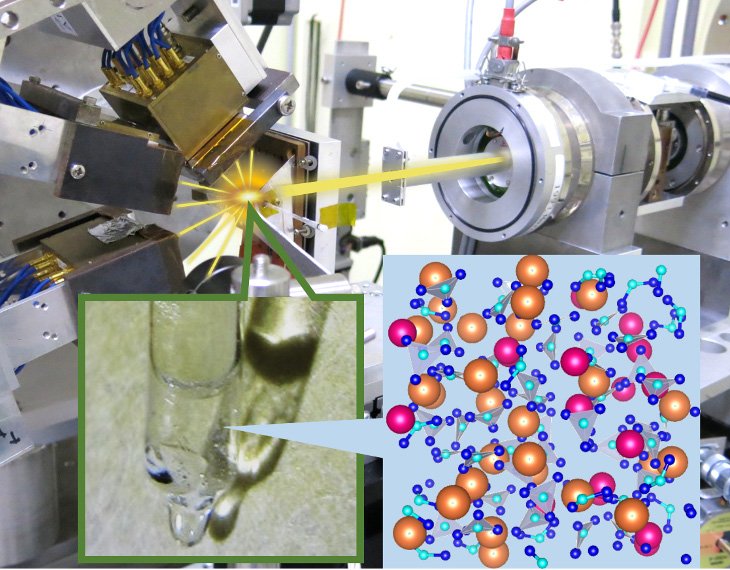
Their research utilized state-of-the-art synchrotron radiation experiments and computer simulations to observe atomic motions in glass on a nanosecond-to-microsecond timescale.
The team discovered that when some atoms within the glass 'jump' into nearby empty spaces, surrounding groups of atoms slowly move together to fill the void. This interplay of atomic jumps and collective motion reduces internal stress, protecting the glass from breaking under external force.
"Our results have far-reaching implications for industries such as consumer electronics, construction, and automotive manufacturing, where break-resistant glass is essential," adds Saito.
Looking ahead, the research team plans to explore whether similar atomic mechanisms operate in other types of glass. Their ultimate goal is to establish universal guidelines for designing glass with superior impact resistance, which could revolutionize applications requiring durable materials.
Reference
Discovery of collective nonjumping motions leading to Johari–Goldstein process of stress relaxation in model ionic glass
Makina Saito, Takeaki Araki, Yohei Onodera, Koji Ohara, Makoto Seto, Yoshitaka Yoda, Yusuke Wakabayashi
https://www.sciencedirect.com/science/article/pii/S1359645424008851
Tohoku University
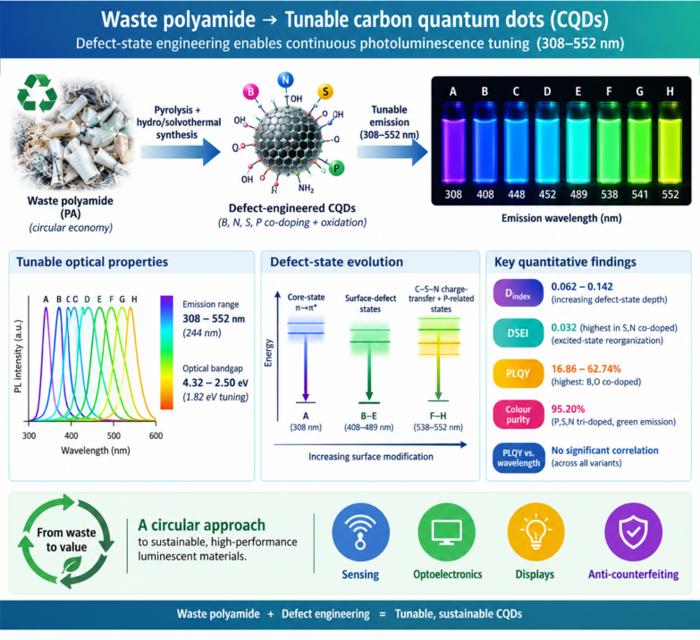
Waste polyamide-derived CQDs show continuous photoluminescence tuning from 308 to 552 nm through sequential defect-state engineering, with optical transition energies decreasing from 4.32 to 2.50 eV. @Christian Ebere Enyoh from Saitama University Carbon quantum dots (CQDs) are fluorescent carbon nanomaterials with potential applications in sensing, optoelectronics, displays, anti-counterfeiting, and environmental technologies. Their optical properties can be adjusted by modifying the carbon...

The researchers used circularly polarized light at normal incidence and found that helicity-dependent photocurrents appeared perpendicular to the crystal’s polarization but vanished when measured parallel to it, supporting a bulk origin of CPGE. @Institute of Science Tokyo The circular photogalvanic effect (CPGE), a phenomenon that generates helicity-dependent photocurrents in noncentrosymmetric materials, can originate purely from a crystal's internal structure without contribution from the...
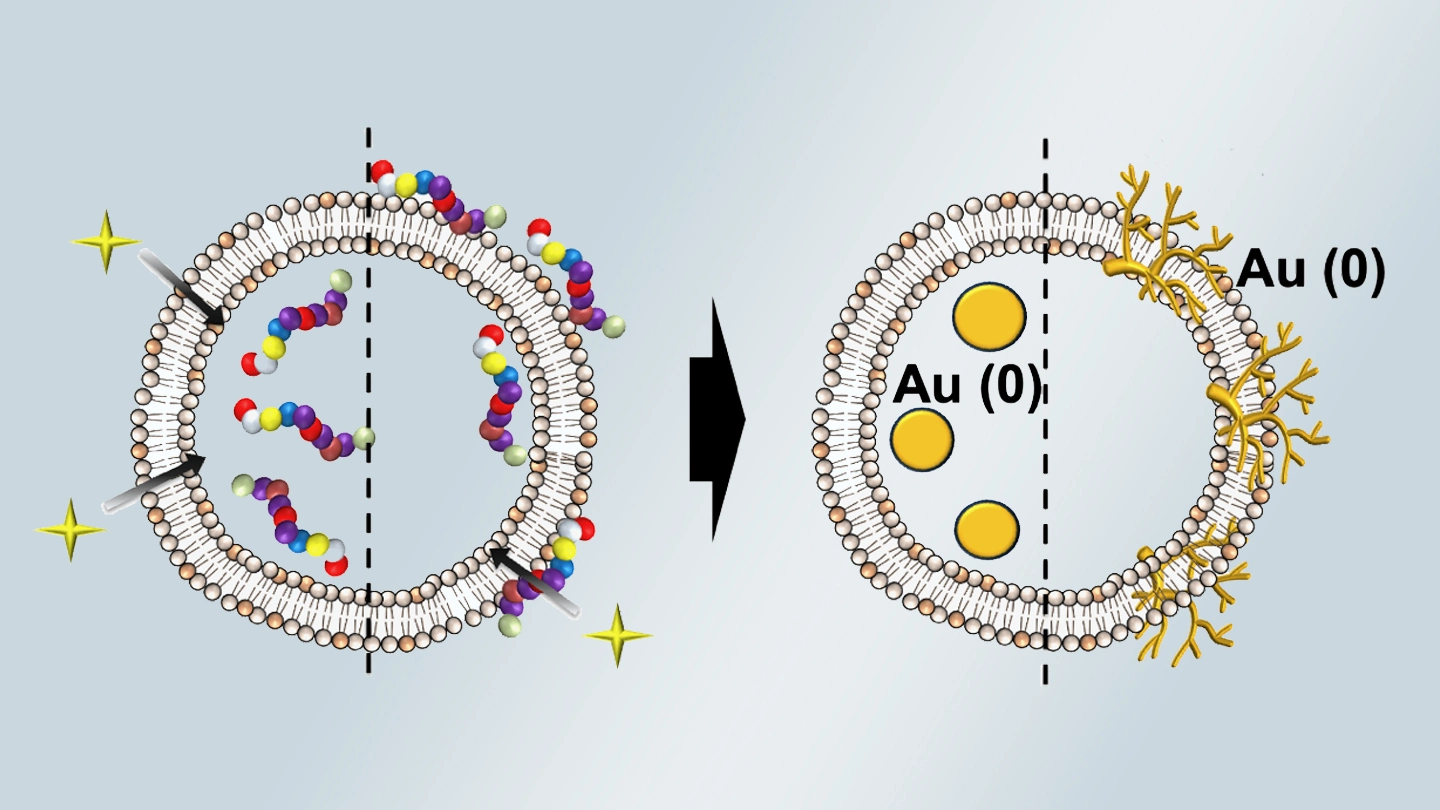
Summary of gold nanoparticle growth programming in liposome based on localization of biomineralization peptide The position of biomineralization peptides within liposomes can influence how gold nanoparticles grow, reports a research team from Institute of Science Tokyo. Peptides localized at the membrane interface promote branched structures, while those confined to the liposome interior favor spherical nanoparticles. The findings offer a new strategy for controlling nanoscale reaction...
