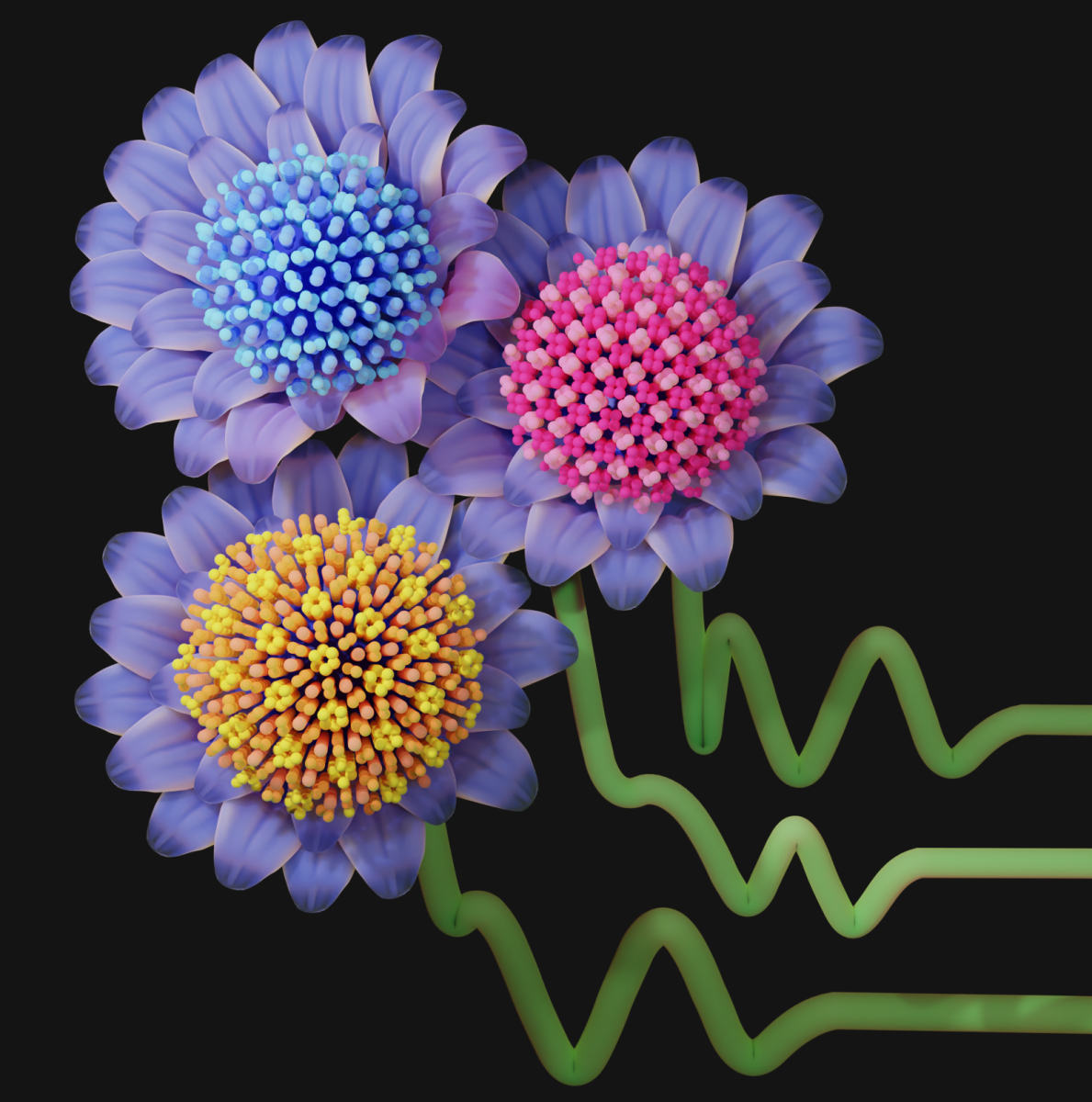
Using a targeted computational approach, researchers in the Department of Materials Science and Engineering at Cornell have found more than 20 new self-assembled crystal structures, none of which had been observed previously.
The research, published in the journal ACS Nano is authored by Ph.D. student Hillary Pan and her advisor Julia Dshemuchadse, assistant professor of materials science and engineering.
“Essentially we were trying to figure out what kinds of new crystal structure configurations we can self-assemble in simulation,” Pan said. “The most exciting thing was that we found new structures that weren’t previously listed in any crystal structure database; these particles are actually assembling into something that nobody had ever seen before.”
The team conducted a targeted search for previously unknown low-coordinated assemblies within a vast parameter space spanned by particles interacting via isotropic pair potentials, the paper states. “Low-coordinated structures have anisotropic local environments, meaning that the geometries are highly directional, so it’s incredible that we’re able to see such a variety of these types of structures using purely non-directional interactions,” said Pan.
Low particle coordination is a structural characteristic key to the functional properties of many technologically important materials including framework structures such as metal–organic frameworks, clathrates, and zeolites as well as photonic crystals such as diamond.
The researchers developed a new functional form for particle interactions in which all features can be tuned independently. By systematically changing pairs of parameters in simulation, the researchers were able to control various features of the particles’ interaction landscape. Despite limiting the search to a small region of the vast parameter space of possible particle interactions, the paper states, a wealth of complexity and symmetry is apparent within these crystal structures, which include clathrates with empty cages and low-symmetry structures, which had also not been observed previously in simulation.
The work demonstrates that complicated structures can develop from simple interactions and adds new theoretical structures for others working in the field. The team’s flexible and intuitive interaction potential design serves as an important step towards determining the characteristics of particle interactions that lead to certain structural properties, useful for establishing synthetic rules to make target structures.
The team’s findings suggest that there are potentially limitless new and exotic materials configurations possible through controlled self-assembly. “This is the first time that we're quantifying the relationship of this isotropic pair potential with the crystal structures that result,” Dshemuchadse said. “These new crystal structures can now serve as design targets for researchers who actually make nanoparticles and colloids.”
Reference
Targeted Discovery of Low-Coordinated Crystal Structures via Tunable Particle Interactions
Hillary Pan and Julia Dshemuchadse
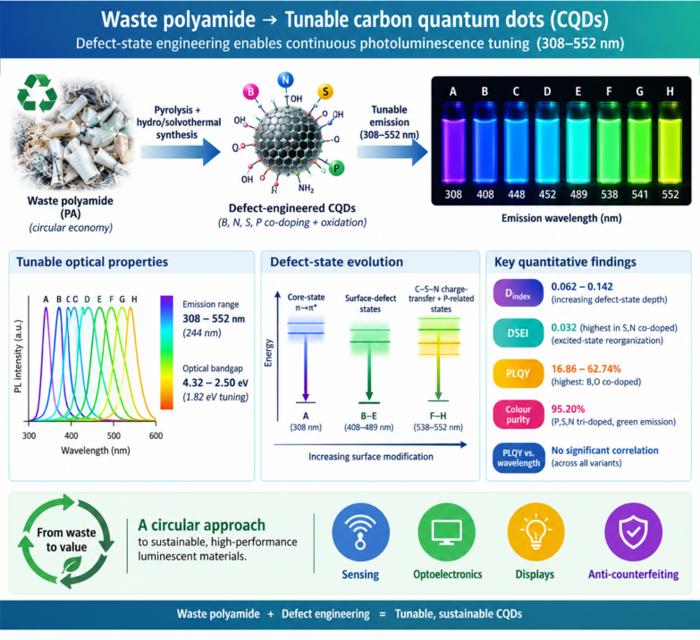
Waste polyamide-derived CQDs show continuous photoluminescence tuning from 308 to 552 nm through sequential defect-state engineering, with optical transition energies decreasing from 4.32 to 2.50 eV. @Christian Ebere Enyoh from Saitama University Carbon quantum dots (CQDs) are fluorescent carbon nanomaterials with potential applications in sensing, optoelectronics, displays, anti-counterfeiting, and environmental technologies. Their optical properties can be adjusted by modifying the carbon...
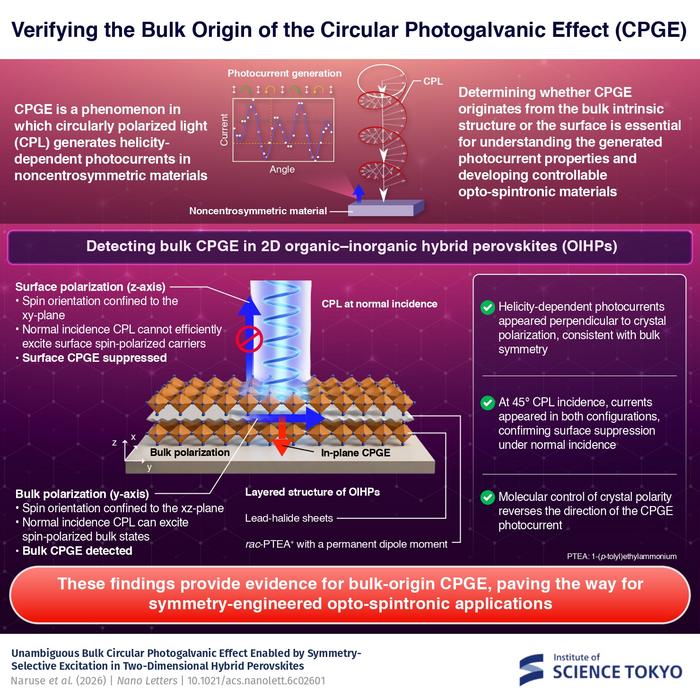
The researchers used circularly polarized light at normal incidence and found that helicity-dependent photocurrents appeared perpendicular to the crystal’s polarization but vanished when measured parallel to it, supporting a bulk origin of CPGE. @Institute of Science Tokyo The circular photogalvanic effect (CPGE), a phenomenon that generates helicity-dependent photocurrents in noncentrosymmetric materials, can originate purely from a crystal's internal structure without contribution from the...
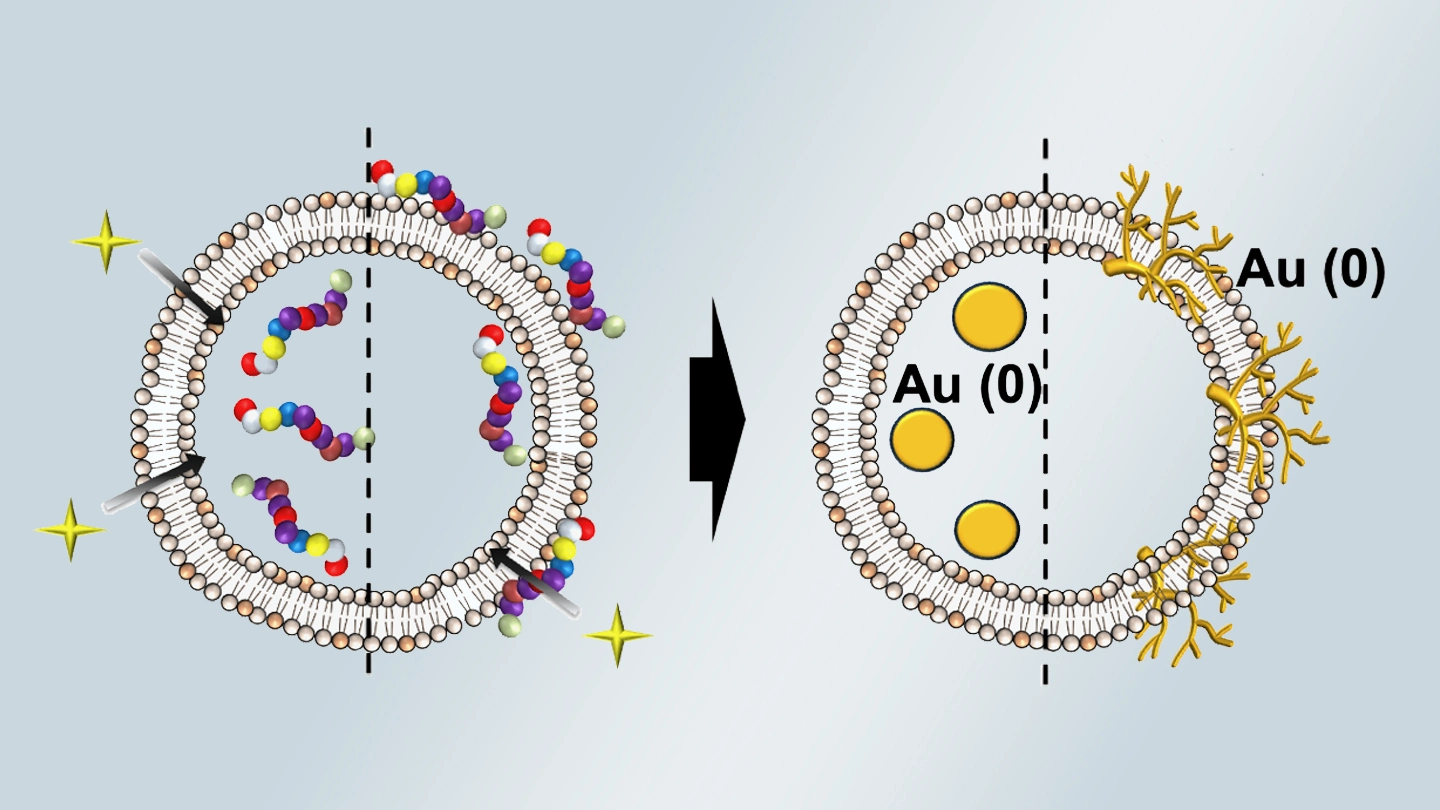
Summary of gold nanoparticle growth programming in liposome based on localization of biomineralization peptide The position of biomineralization peptides within liposomes can influence how gold nanoparticles grow, reports a research team from Institute of Science Tokyo. Peptides localized at the membrane interface promote branched structures, while those confined to the liposome interior favor spherical nanoparticles. The findings offer a new strategy for controlling nanoscale reaction...
