2 November 2026. Denton Vacuum has outlined its range of in situ monitoring tools for thin film deposition and etch processes. The company said real time monitoring can improve yield and speed production, reducing total cost of ownership (TCO). It said this is especially true for low-volume, low-yield processes, where each finished piece represents a relatively large investment in time, materials, and economic value-add. Denton noted that not every application needs real-time monitoring, and that high-volume, high-yield processes are often better served by post-production QA using statistical sampling.
The Residual Gas Analysis (RGA) system identifies molecules present in vacuum systems during and after pump down. Denton said RGA is less about monitoring deposition progress than about isolating leaks and confirming a clean vacuum. Because many films only require removal of contaminants such as oxygen, nitrogen or other gases found in air, RGA can reduce pump down time, which Denton said can save hours when vacuum is broken frequently.
Plasma Emission Monitoring (PEM) is a closed-loop magnetron sputtering control system for transition mode, high-rate reactive sputtering of metal oxides and nitrides. It manages reactive gas flow by monitoring plasma characteristics during deposition. Denton said PEM prevents target poisoning by holding reactive gas concentration at a constant setpoint and enables up to ten times higher deposition rates compared to RF sputtering.
Quartz Crystal Monitoring (QCM) monitors a separate witness chip rather than the actual substrate, so it requires calibration based on its position within the tool. Denton said QCM measurements are accurate within 3% and that the method is standard for e-beam evaporation systems. The Optical Monitoring System (OMS) measures optical thickness during deposition and is accurate to 0.3%, ten times more precise than QMS, according to the company. Denton said OMS is suited to anti-reflectance and high-reflectance coatings, laser facets and filters.
Secondary Ion Mass Spectroscopy (SIMS) monitors the etching process in Denton's Infinity FA whole-chip delayering system. The Kaufman-type broad ion beam etch can etch extremely large areas quickly, and SIMS tracks compositional changes in sputtered ions as the beam etches through each layer. This signals the transition from one layer to the next and allows the etch to be ended automatically or manually at the layer of interest.
Denton said selection of the right in situ control depends on process sensitivity, required precision, rate, vacuum condition or endpoint control. The company also published a technical paper, "Considerations and Examples for Determining Precision of Indirect Optical Monitoring", covering a small study on precision variation using a fully automated OMS.
Source: Denton Vacuum news
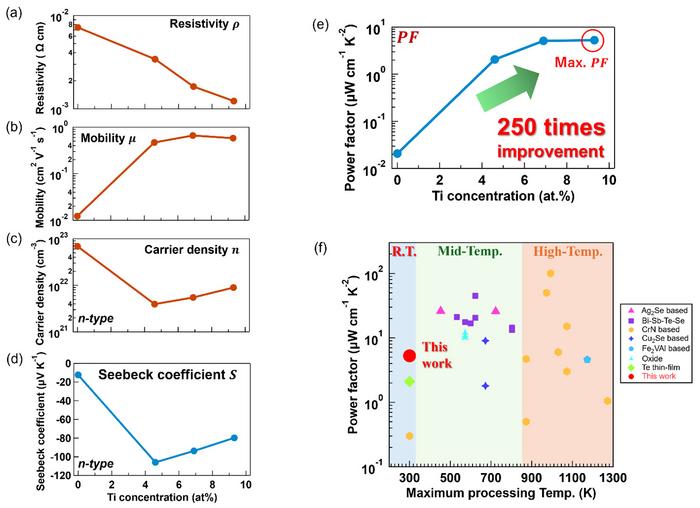
Researchers at Tohoku University have raised the power factor of chromium nitride thin films 250-fold by doping them with small amounts of titanium, reaching 5.26 µW cm⁻¹ K⁻². Titanium's stronger affinity for nitrogen suppresses nitrogen vacancies, cutting carrier concentration while boosting electron mobility by roughly two orders of magnitude.

Cornell engineers have created a semiconductor with a record bandgap exceeding 7 electron volts, using silicon-doped aluminum gallium oxide grown by suboxide molecular-beam epitaxy on sapphire substrates. The films show room-temperature conductivity more than 100 million times higher than previously reported materials in the colossal bandgap range, and the team built a working diode and field-effect transistor.
Elethron plans a UK manufacturing capability for aluminium nitride substrates, starting with 2-inch wafers for customer evaluation and qualification, and a pathway towards 4-inch production.
This week in nanotech
$13.6M raised
2 funding rounds · 22 deals tracked
New products
 Ti-WCMBN Nanomaterialia Featured
 DLS-1 Mass Spectrometer for Fusion Gas AnalysisHiden Analytical Featured
 GiiiGii
Market insights
Last 30 days: Quantum Technologies was the busiest vertical: 63 of 197 events (32%).
Money raised per month