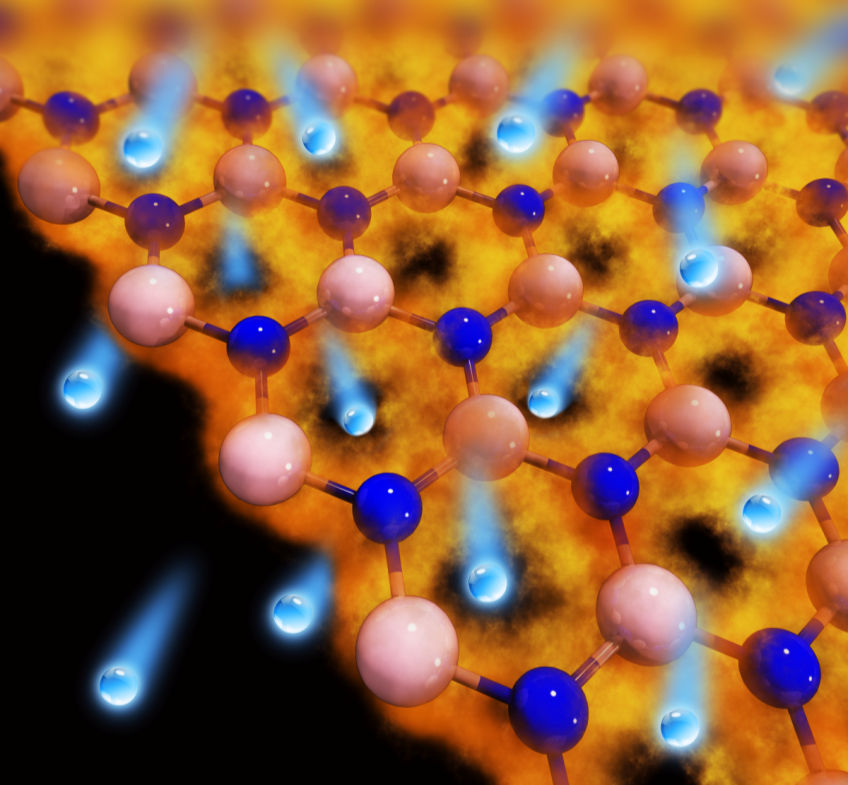
Researchers at the National Graphene Institute have made a groundbreaking discovery that could revolutionise energy harnessing and information computing. Their study, published in Nature, reveals how electric field effects can selectively accelerate coupled electrochemical processes in graphene.
Electrochemical processes are essential in renewable energy technologies like batteries, fuel cells, and electrolysers. However, their efficiency is often hindered by slow reactions and unwanted side effects. Traditional approaches have focused on new materials, yet significant challenges remain.
The Manchester team, led by Dr Marcelo Lozada-Hidalgo, has taken a novel approach. They have successfully decoupled the inseparable link between charge and electric field within graphene electrodes, enabling unprecedented control over electrochemical processes in this material. The breakthrough challenges previous assumptions and opens new avenues for energy technologies.
Dr Marcelo Lozada-Hidalgo sees this discovery as transformative, “We’ve managed to open up a previously inaccessible parameter space. A way to visualise this is to imagine a field in the countryside with hills and valleys. Classically, for a given system and a given catalyst, an electrochemical process would run through a set path through this field. If the path goes through a high hill or a deep valley – bad luck. Our work shows that, at least for the processes we investigated here, we have access to the whole field. If there is a hill or valley we do not want to go to, we can avoid it.”
The study focuses on proton-related processes fundamental for hydrogen catalysts and electronic devices. Specifically, the team examined two proton processes in graphene:
Proton Transmission: This process is important for developing new hydrogen catalysts and fuel cell membranes.
Proton Adsorption (Hydrogenation): Important for electronic devices like transistors, this process switches graphene’s conductivity on and off.
Traditionally, these processes were coupled in graphene devices, making it challenging to control one without impacting the other. The researchers managed to decouple these processes, finding that electric field effects could significantly accelerate proton transmission while independently driving hydrogenation. This selective acceleration was unexpected and presents a new method to drive electrochemical processes.
Highlighting the broader implication in energy applications, Dr Jincheng Tong, first author of the paper, said “We demonstrate that electric field effects can disentangle and accelerate electrochemical processes in 2D crystals. This could be combined with state-of-the-art catalysts to efficiently drive complex processes like CO2 reduction, which remain enormous societal challenges.”
Dr Yangming Fu, co-first author, pointed to potential applications in computing: “Control of these process gives our graphene devices dual functionality as both memory and logic gate. This paves the way for new computing networks that operate with protons. This could enable compact, low-energy analogue computing devices.”
Reference
Control of proton transport and hydrogenation in double-gated graphene
J. Tong, Y. Fu, D. Domaretskiy, F. Della Pia, P. Dagar, L. Powell, D. Bahamon, S. Huang, B. Xin, R. N. Costa Filho, L. F. Vega, I. V. Grigorieva, F. M. Peeters, A. Michaelides & M. Lozada-Hidalgo
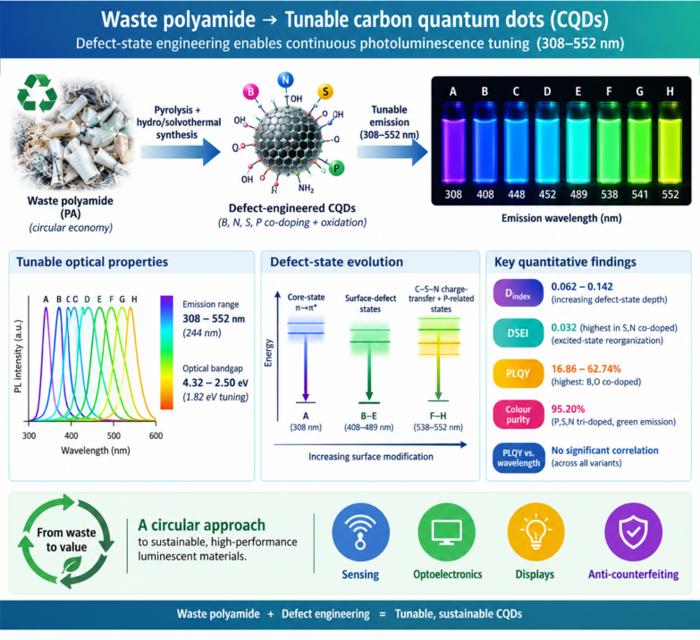
Waste polyamide-derived CQDs show continuous photoluminescence tuning from 308 to 552 nm through sequential defect-state engineering, with optical transition energies decreasing from 4.32 to 2.50 eV. @Christian Ebere Enyoh from Saitama University Carbon quantum dots (CQDs) are fluorescent carbon nanomaterials with potential applications in sensing, optoelectronics, displays, anti-counterfeiting, and environmental technologies. Their optical properties can be adjusted by modifying the carbon...
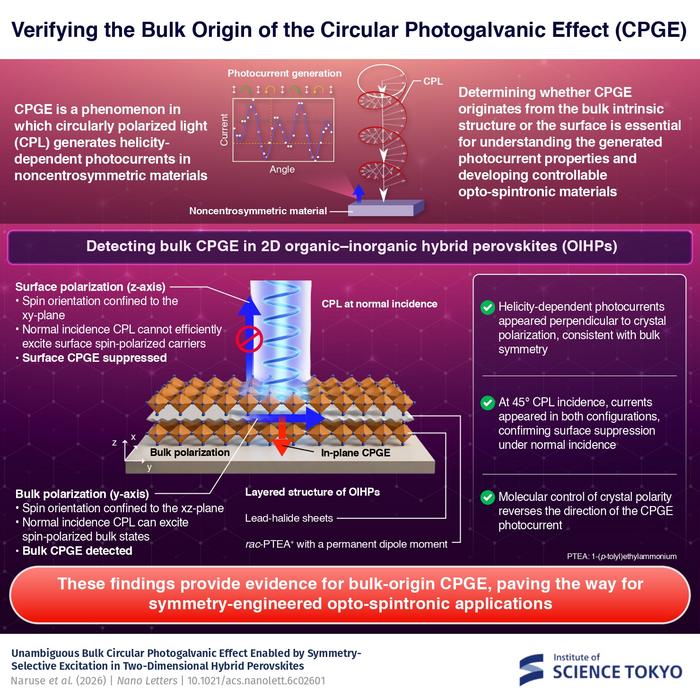
The researchers used circularly polarized light at normal incidence and found that helicity-dependent photocurrents appeared perpendicular to the crystal’s polarization but vanished when measured parallel to it, supporting a bulk origin of CPGE. @Institute of Science Tokyo The circular photogalvanic effect (CPGE), a phenomenon that generates helicity-dependent photocurrents in noncentrosymmetric materials, can originate purely from a crystal's internal structure without contribution from the...
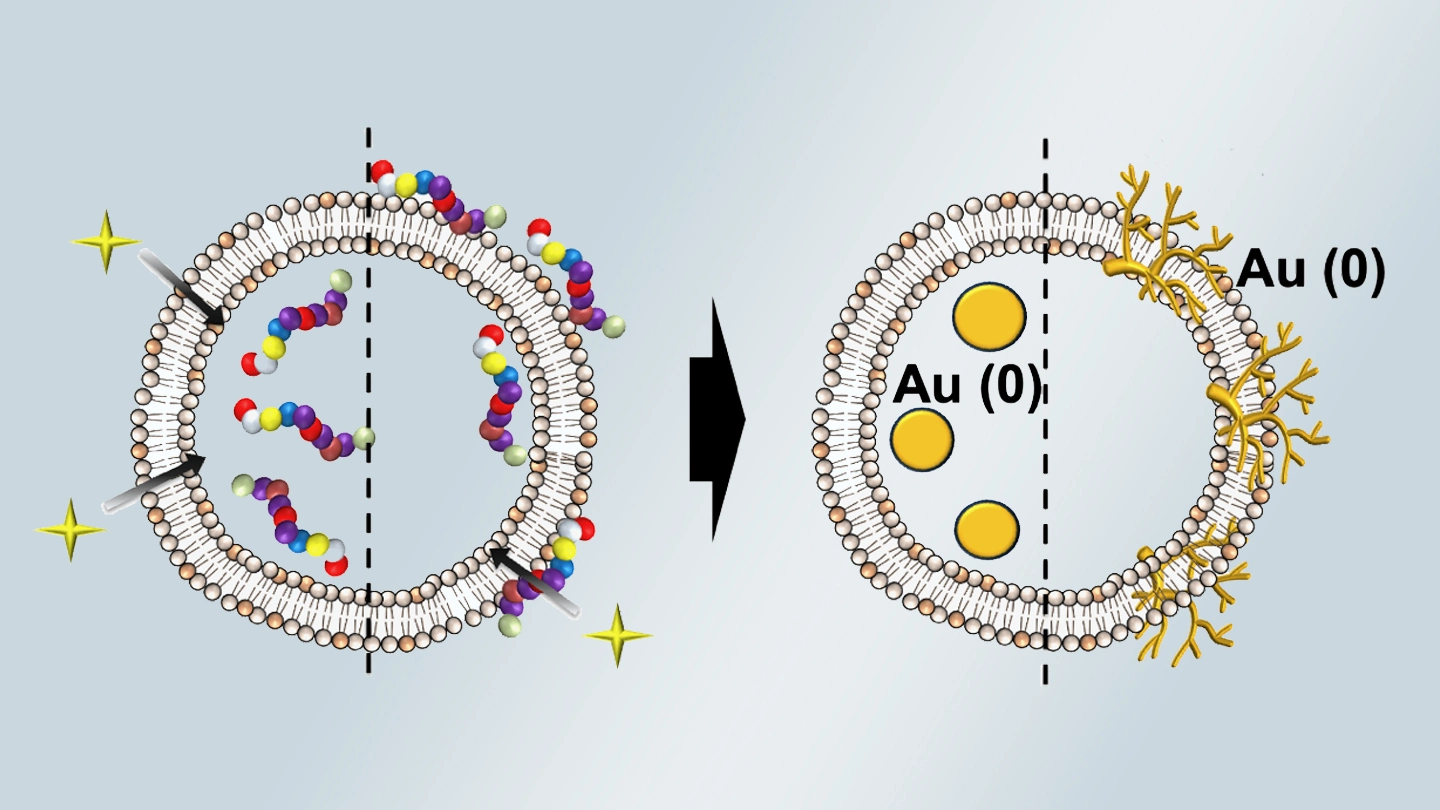
Summary of gold nanoparticle growth programming in liposome based on localization of biomineralization peptide The position of biomineralization peptides within liposomes can influence how gold nanoparticles grow, reports a research team from Institute of Science Tokyo. Peptides localized at the membrane interface promote branched structures, while those confined to the liposome interior favor spherical nanoparticles. The findings offer a new strategy for controlling nanoscale reaction...
