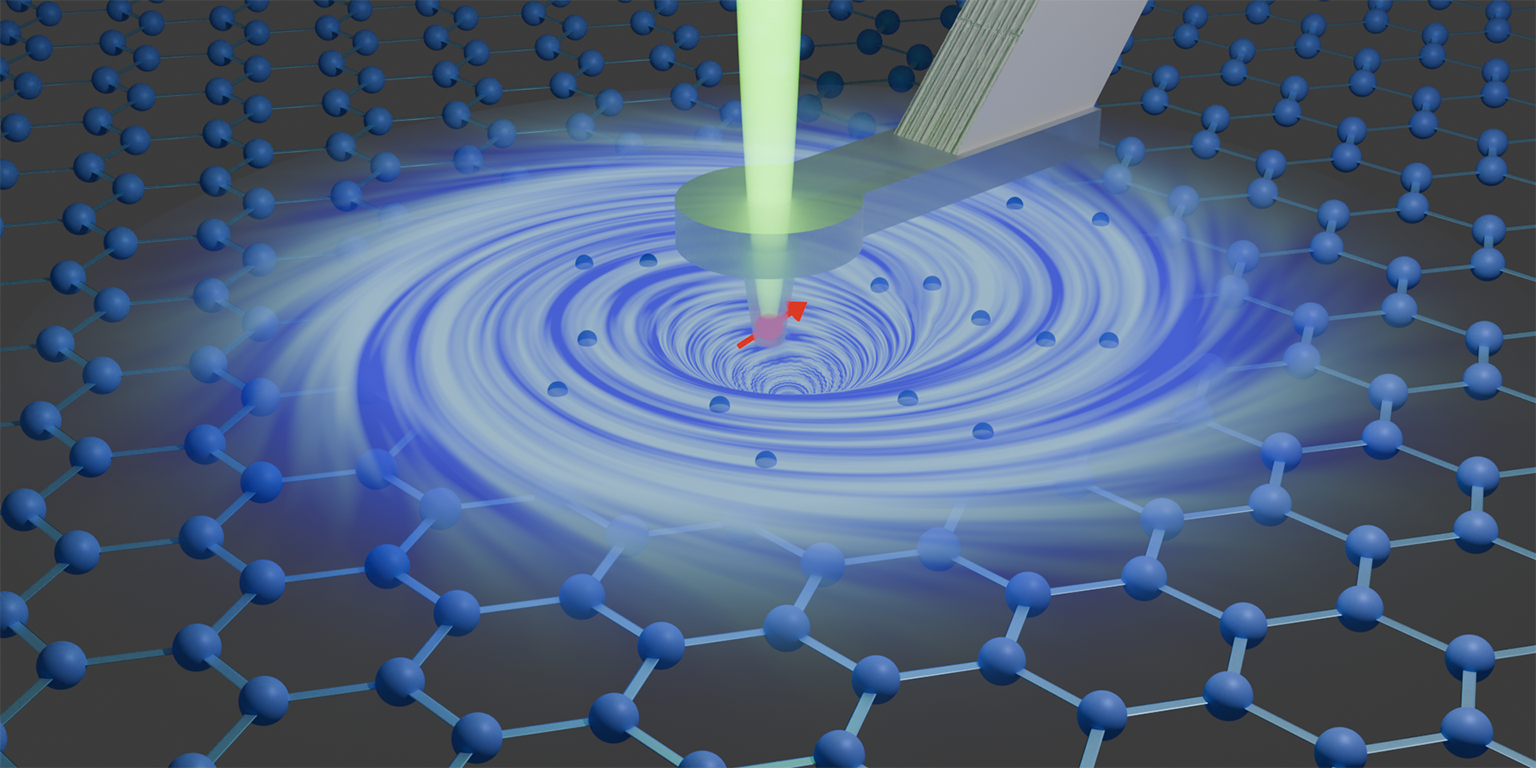
When an ordinary electrical conductor – such as a metal wire – is connected to a battery, the electrons in the conductor are accelerated by the electric field created by the battery. While moving, electrons frequently collide with impurity atoms or vacancies in the crystal lattice of the wire, and convert part of their motional energy into lattice vibrations. The energy lost in this process is converted into heat that can be felt, for example, by touching an incandescent light bulb.
While collisions with lattice impurities happen frequently, collisions between electrons are much rarer. The situation changes, however, when graphene, a single layer of carbon atoms arranged in a honeycomb lattice, is used instead of a common iron or copper wire. In graphene, impurity collisions are rare and collisions between electrons play the leading role. In this case, the electrons behave more like a viscous liquid. Therefore, well-known flow phenomena such as vortices should occur in the graphene layer.
Reporting in the scientific journal Science, researchers at ETH Zurich in the group of Christian Degen have now managed to directly detect electron vortices in graphene for the first time, using a high-resolution magnetic field sensor.
Highly sensitive quantum sensing microscope
The vortices formed in small circular disks that Degen and his co-workers had attached during the fabrication process to a conducting graphene strip only one micrometre wide. The disks had different diameters between 1.2 and 3 micrometres. Theoretical calculations suggested that electron vortices should form in the smaller, but not in the larger disks.
To make the vortices visible the researchers measured the tiny magnetic fields produced by the electrons flowing inside the graphene. For this purpose, they used a quantum magnetic field sensor consisting of a so-called nitrogen-vacancy (NV) centre embedded in the tip of a diamond needle. Being an atomic defect, the NV centre behaves like a quantum object whose energy levels depend on an external magnetic field. Using laser beams and microwave pulses, the quantum states of the centre can be prepared in such a way as to be maximally sensitive to magnetic fields. By reading out the quantum states with a laser, the researchers could determine the strength of those fields very precisely.
“Because of the tiny dimensions of the diamond needle and the small distance from the graphene layer – only around 70 nanometres – we were able to make the electron currents visible with a resolution of less than a hundred nanometres”, says Marius Palm, a former PhD student in Degen’s group. This resolution is sufficient for seeing the vortices.
Inverted flow direction
In their measurements, the researchers observed a characteristic sign of the expected vortices in the smaller discs: a reversal of the flow direction. While in normal (diffusive) electron transport, the electrons in strip and disc flow in the same direction, in the case of a vortex, the flow direction inside the disc is inverted. As predicted by the calculations, no vortices could be observed in the larger discs.
“Thanks to our extremely sensitive sensor and high spatial resolution, we didn’t even need to cool down the graphene and were able to conduct the experiments at room temperature”, says Palm. Moreover, he and his colleagues not only detected electron vortices, but also vortices formed by hole carriers. By applying an electric voltage from below the graphene, they changed the number of free electrons in such a way that the current flow was no longer carried by electrons, but rather by missing electrons, also called holes. Only at the charge neutrality point, where there is a small and balanced concentration of both electrons and holes, the vortices disappeared completely.
“At this moment, the detection of electron vortices is basic research, and there are still lots of open questions”, says Palm. For instance, researchers still need to figure out how collisions of the electrons with the graphene’s borders influence the flow pattern, and what effects are occurring in even smaller structures. The new detection method used by the ETH researchers also permits taking a closer look at many other exotic electron transport effects in mesoscopic structures – phenomena that occur on length scales from several tens of nanometres up to a few micrometres.
Reference
Observation of current whirlpools in graphene at room temperature
Marius L. Palm, Chaoxin Ding, William S. Huxter, Takashi Taniguchi, Kenji Watanabe, Christian L. Degen
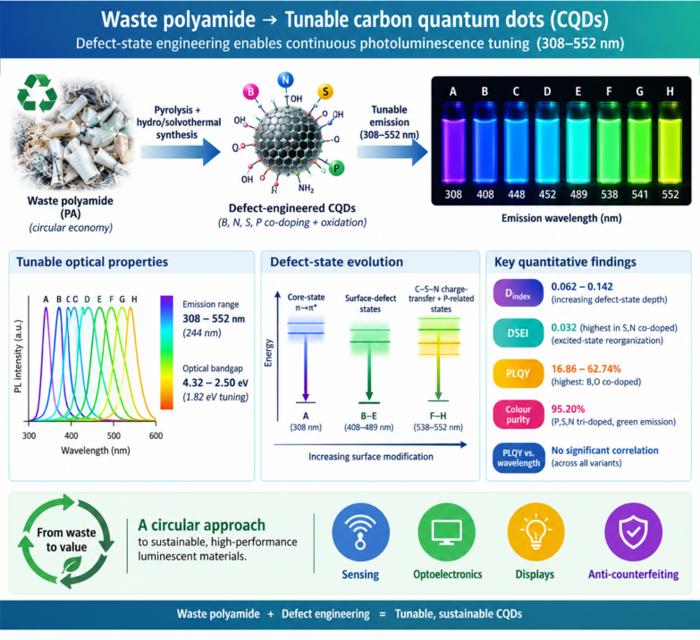
Waste polyamide-derived CQDs show continuous photoluminescence tuning from 308 to 552 nm through sequential defect-state engineering, with optical transition energies decreasing from 4.32 to 2.50 eV. @Christian Ebere Enyoh from Saitama University Carbon quantum dots (CQDs) are fluorescent carbon nanomaterials with potential applications in sensing, optoelectronics, displays, anti-counterfeiting, and environmental technologies. Their optical properties can be adjusted by modifying the carbon...
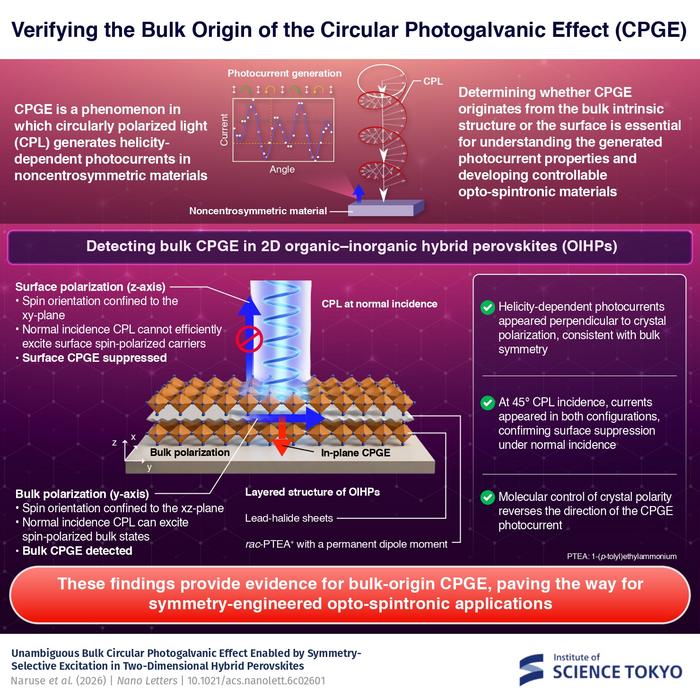
The researchers used circularly polarized light at normal incidence and found that helicity-dependent photocurrents appeared perpendicular to the crystal’s polarization but vanished when measured parallel to it, supporting a bulk origin of CPGE. @Institute of Science Tokyo The circular photogalvanic effect (CPGE), a phenomenon that generates helicity-dependent photocurrents in noncentrosymmetric materials, can originate purely from a crystal's internal structure without contribution from the...
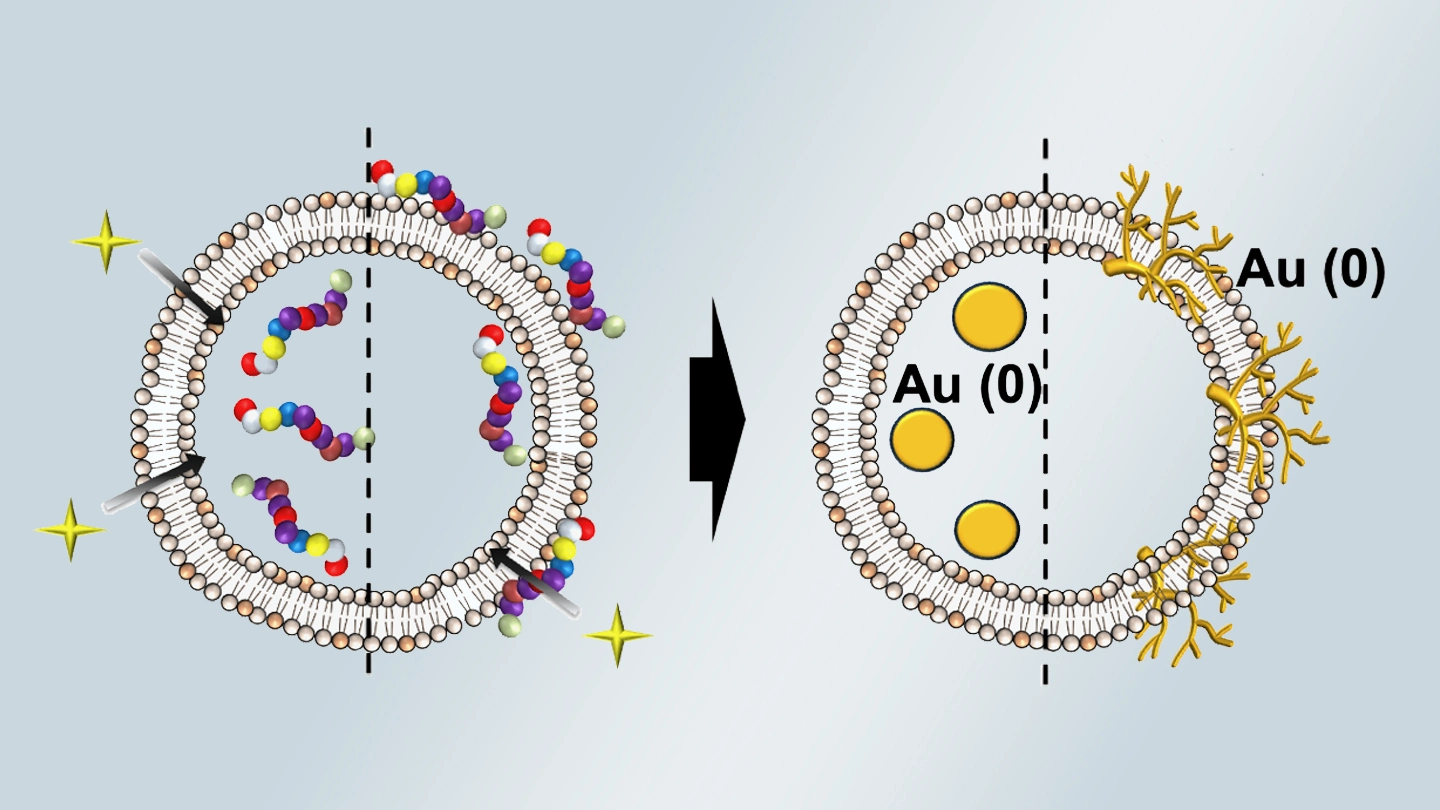
Summary of gold nanoparticle growth programming in liposome based on localization of biomineralization peptide The position of biomineralization peptides within liposomes can influence how gold nanoparticles grow, reports a research team from Institute of Science Tokyo. Peptides localized at the membrane interface promote branched structures, while those confined to the liposome interior favor spherical nanoparticles. The findings offer a new strategy for controlling nanoscale reaction...
