Harbin Institute of Technology
One post-treatment step has pushed bismuth telluride films past a trade-off that has limited both heat harvesting and ultraviolet detection.
Bismuth telluride (Bi2Te3) is a workhorse semiconductor for converting temperature differences into electricity and for photo-thermoelectric light sensing. Studied since the 1950s, it is now eyed for miniaturized devices in 5G communications, wearables and the Internet of Things. Performance hinges on three coupled quantities: carrier mobility, density-of-states effective mass and carrier concentration. They feed both the thermoelectric power factor and photodetector detectivity. Conventional doping tunes the band structure and carrier concentration but adds impurity scattering: raising effective mass tends to lower mobility, and optimizing concentration tends to do the same. Improving all three at once has therefore been the central obstacle.
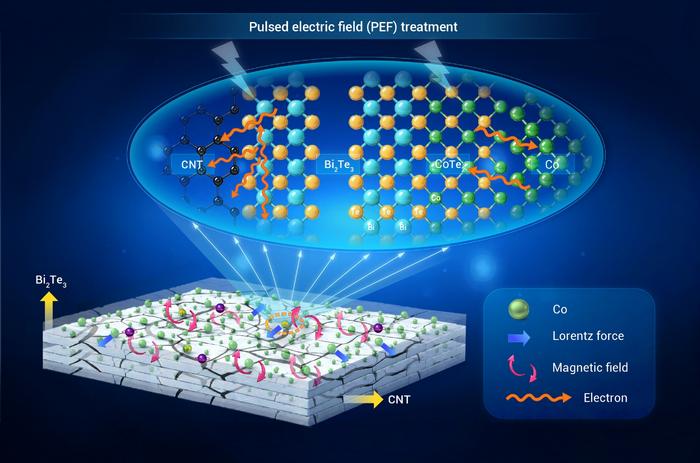
A team led by Ming Liu, Huijun Kang and Jiehe Sui at Harbin Institute of Technology and Dalian University of Technology tackled the coupling through interfaces rather than doping alone. On an insulating silica substrate they spun a carbon nanotube (CNT) network, then alternately sputtered five Bi2Te3 layers and four cobalt nanoparticle layers, keeping Bi2Te3 on top to protect the cobalt from oxidation. A short pulsed electric field (PEF) treatment — 0.3 A pulses at 0.1 s intervals for 600 s — was applied to the composite. It crystallized the previously amorphous CNT/Bi2Te3 boundary and drove the in-situ formation of a coherent Co/CoTe2/Bi2Te3 interface, replacing disordered, lattice-mismatched contacts with continuous crystalline pathways. Density functional theory and magnetic-field simulations supported the proposed magnetoelectric picture.
The two components did different jobs. Crystallized interfaces cut interfacial scattering and opened carrier pathways, raising mobility. Magnetic Co nanoparticles produced a magnetoelectric interaction that lifted the density-of-states effective mass, while carrier injection from both Co and the newly formed CoTe2 raised carrier concentration. At room temperature the film reached a power factor of 51.68 μW cm−1 K−2. A single-leg thermoelectric generator built from it delivered 10.26 W m−2 at a temperature difference of 39 K; a photo-thermoelectric detector reached 5.95×10^9 Jones under 365 nm ultraviolet illumination, with photoresponse also seen at visible and infrared wavelengths. These rank among the best values reported for Bi2Te3-based films.
The measurements come from 10 mm × 10 mm films and single-leg laboratory devices, not modules in service. The authors point to large-area fabrication, long-term stability, flexible integration and wavelength-dependent response as the next tests. The broader implication is that interface ordering plus a local magnetic field can decouple transport parameters that doping alone cannot, offering a materials-design route for compact generators and self-driven ultraviolet detectors.
Reference
Breaking the transport trade-off in Bi2Te3 films via interface reconstruction and magnetic coupling
Lan M., Jiang L., Liu M., et al.
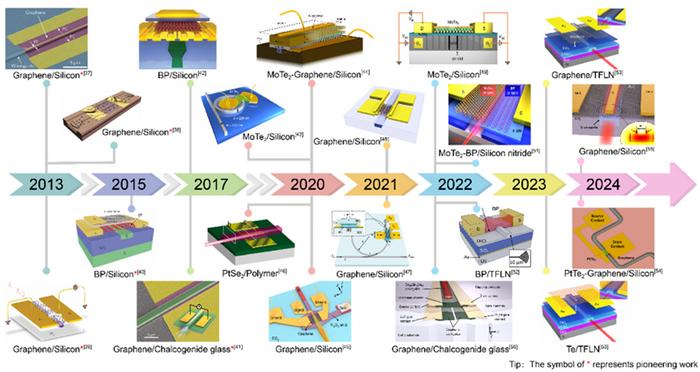
A review in Light: Science & Applications surveys waveguide-integrated 2D-material infrared photodetectors, tracing progress from early graphene-silicon devices to black phosphorus and transition metal dichalcogenides. By guiding light along the material, evanescent coupling extends light-matter interaction while keeping devices compact.
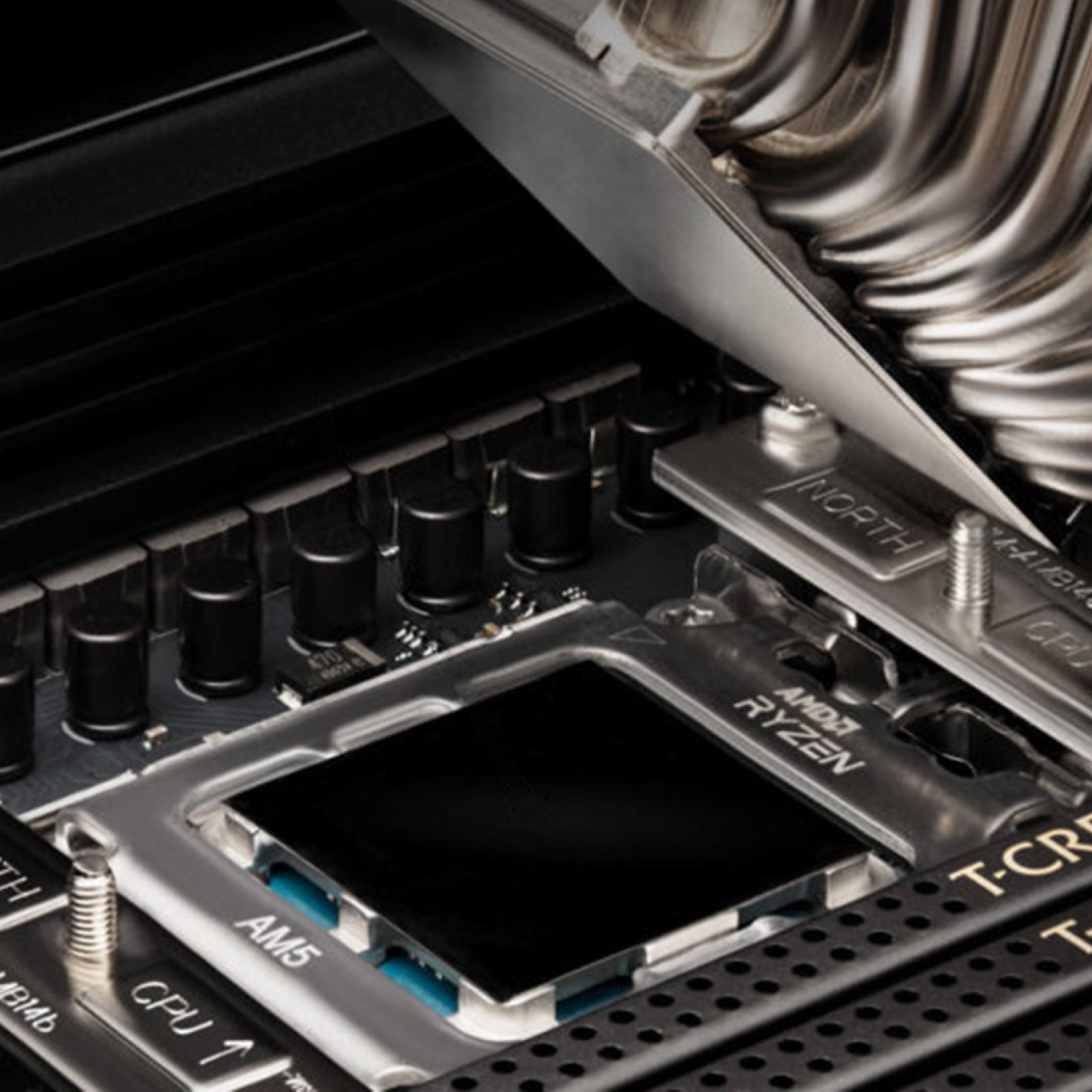
Noctua has released the NT-CP1 AM5/4 carbon nanotube thermal pad for AMD AM5 and AM4 processors, using Carbice technology. It costs EUR 24.95 / USD 24.95 and is available via Noctua's official Amazon stores.
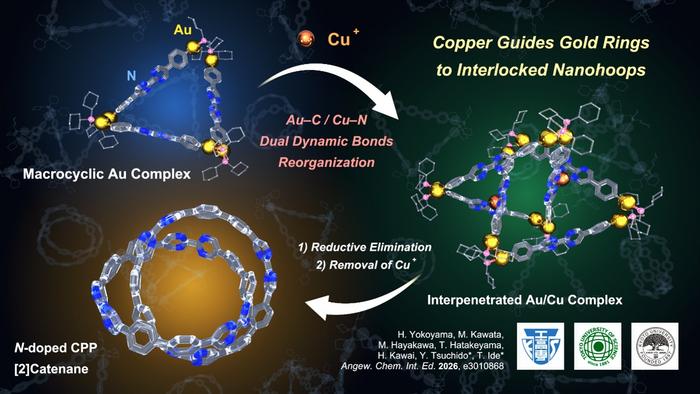
Researchers in Japan have combined gold(I) carbon bonds and copper(I) nitrogen coordination to assemble an interlocked catenane of nitrogen-doped carbon nanohoops in a single pot. Demetallation gave a metal-free [2]catenane of two fully conjugated [12]CPP rings in only eight steps, with a 2.9% overall yield that improves on conventional routes.
This week in nanotech
26 deals tracked
New products
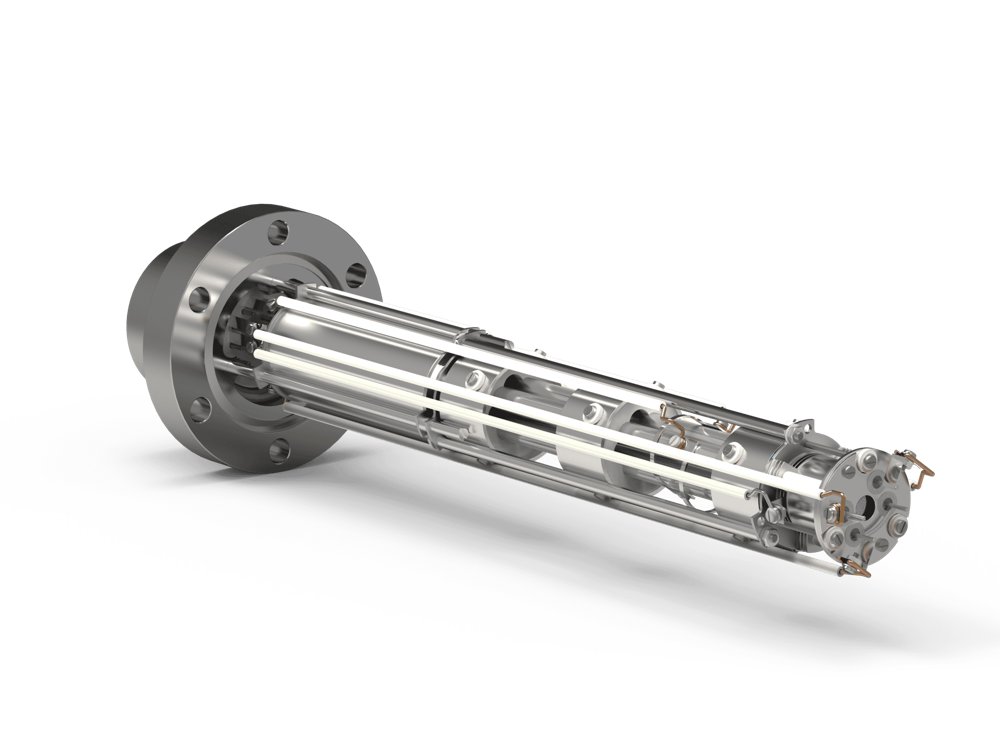 DLS-1 Mass Spectrometer for Fusion Gas AnalysisHiden Analytical Featured
 Nion-compatible In Situ STEM Holders for Electrical BiasingHummingbird Scientific Featured
 GHK-CuPeoples Peps
Market insights
Last 30 days: Semiconductors & Electronics was the busiest vertical: 55 of 176 events (31%).
Money raised per month