University of New South Wales (UNSW)
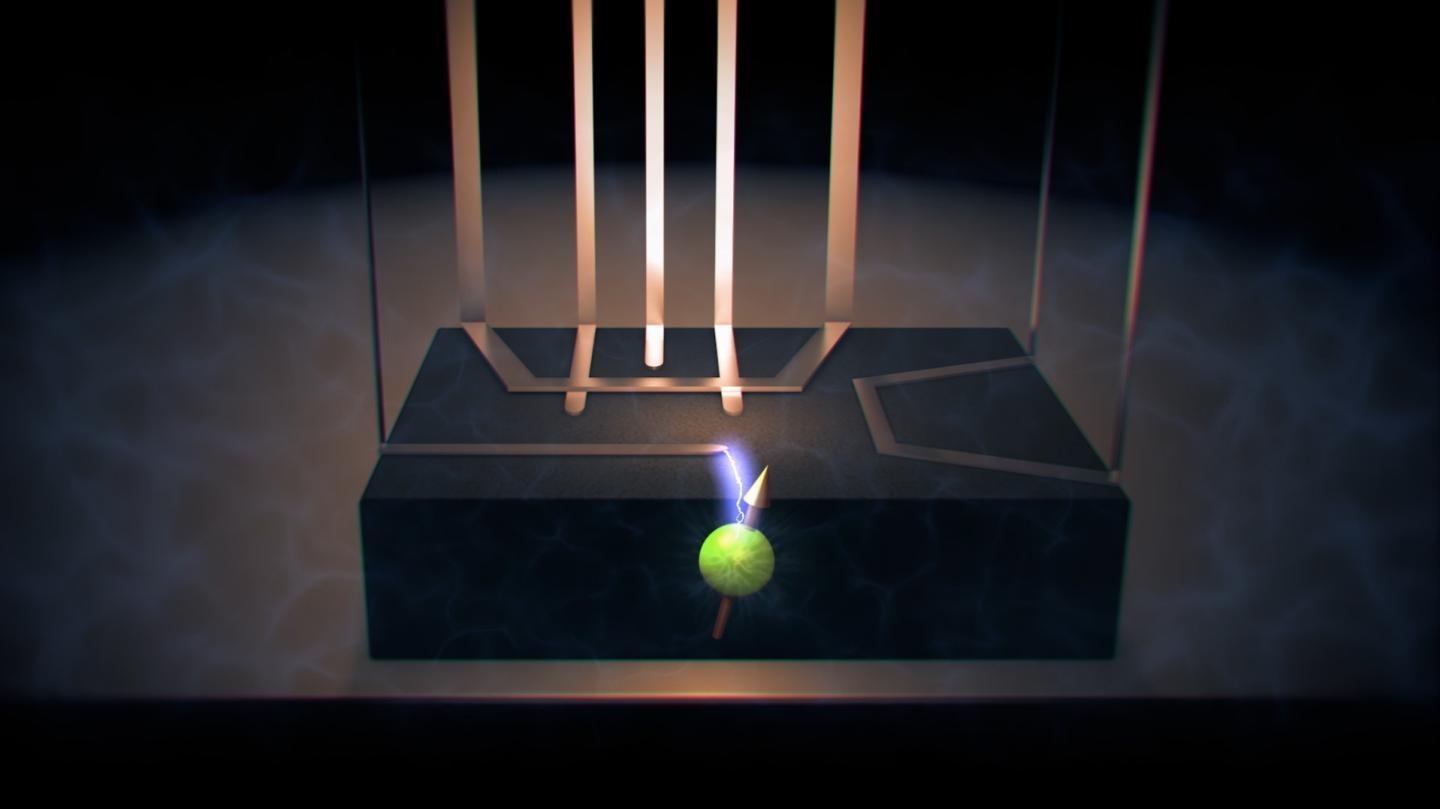
A happy accident in the laboratory has led to a breakthrough discovery that not only solved a problem that stood for more than half a century, but has major implications for the development of quantum computers and sensors. In a study published today in Nature, a team of engineers at UNSW Sydney has done what a celebrated scientist first suggested in 1961 was possible, but has eluded everyone since: controlling the nucleus of a single atom using only electric fields.
"This discovery means that we now have a pathway to build quantum computers using single-atom spins without the need for any oscillating magnetic field for their operation," says UNSW's Scientia Professor of Quantum Engineering Andrea Morello. "Moreover, we can use these nuclei as exquisitely precise sensors of electric and magnetic fields, or to answer fundamental questions in quantum science."
That a nuclear spin can be controlled with electric, instead of magnetic fields, has far-reaching consequences. Generating magnetic fields requires large coils and high currents, while the laws of physics dictate that it is difficult to confine magnetic fields to very small spaces - they tend to have a wide area of influence. Electric fields, on the other hand, can be produced at the tip of a tiny electrode, and they fall off very sharply away from the tip. This will make control of individual atoms placed in nanoelectronic devices much easier.
A new paradigm
Prof Morello says the discovery shakes up the paradigm of nuclear magnetic resonance, a widely used technique in fields as disparate as medicine, chemistry, or mining. "Nuclear Magnetic Resonance is one of the most widespread techniques in modern physics, chemistry, and even medicine or mining," he says. "Doctors use it to see inside a patient's body in great detail while mining companies use it to analyse rock samples. This all works extremely well, but for certain applications, the need to use magnetic fields to control and detect the nuclei can be a disadvantage."
Prof Morello uses the analogy of a billiard table to explain the difference between controlling nuclear spins with magnetic and electric fields.
"Performing magnetic resonance is like trying to move a particular ball on a billiard table by lifting and shaking the whole table," he says. "We'll move the intended ball, but we'll also move all the others."
"The breakthrough of electric resonance is like being handed an actual billiards stick to hit the ball exactly where you want it."
Amazingly, Prof Morello was completely unaware that his team had cracked a longstanding problem in finding a way to control nuclear spins with electric fields, first suggested in 1961 by a pioneer of magnetic resonance and Nobel Laureate, Nicolaas Bloembergen.
"I have worked on spin resonance for 20 years of my life, but honestly, I had never heard of this idea of nuclear electric resonance," Prof Morello says. "We 'rediscovered' this effect by complete accident - it would never have occurred to me to look for it. The whole field of nuclear electric resonance has been almost dormant for more than half a century, after the first attempts to demonstrate it proved too challenging."
Out of curiosity
The researchers had originally set out to perform nuclear magnetic resonance on a single atom of antimony - an element that possesses a large nuclear spin. One of the lead authors of the work, Dr Serwan Asaad, explains: "Our original goal was to explore the boundary between the quantum world and the classical world, set by the chaotic behaviour of the nuclear spin. This was purely a curiosity-driven project, with no application in mind."
"However, once we started the experiment, we realised that something was wrong. The nucleus behaved very strangely, refusing to respond at certain frequencies, but showing a strong response at others," recalls Dr Vincent Mourik, also a lead author on the paper.
"This puzzled us for a while, until we had a 'eureka moment' and realised that we were doing electric resonance instead of magnetic resonance."
Dr Asaad continued: "What happened is that we fabricated a device containing an antimony atom and a special antenna, optimized to create a high-frequency magnetic field to control the nucleus of the atom. Our experiment demands this magnetic field to be quite strong, so we applied a lot of power to the antenna, and we blew it up!"
Game on
"Normally, with smaller nuclei like phosphorus, when you blow up the antenna it's 'game over' and you have to throw away the device," says Dr Mourik. "But with the antimony nucleus, the experiment continued to work. It turns out that after the damage, the antenna was creating a strong electric field instead of a magnetic field. So we 'rediscovered' nuclear electric resonance."
After demonstrating the ability to control the nucleus with electric fields, the researchers used sophisticated computer modelling to understand how exactly the electric field influences the spin of the nucleus. This effort highlighted that nuclear electric resonance is a truly local, microscopic phenomenon: the electric field distorts the atomic bonds around the nucleus, causing it to reorient itself.
"This landmark result will open up a treasure trove of discoveries and applications," says Prof Morello. "The system we created has enough complexity to study how the classical world we experience every day emerges from the quantum realm. Moreover, we can use its quantum complexity to build sensors of electromagnetic fields with vastly improved sensitivity. And all this, in a simple electronic device made in silicon, controlled with small voltages applied to a metal electrode!"
Coherent electrical control of a single high-spin nucleus in silicon
Serwan Asaad, Vincent Mourik, Benjamin Joecker, Mark A. I. Johnson, Andrew D. Baczewski, Hannes R. Firgau, Mateusz T. Mądzik, Vivien Schmitt, Jarryd J. Pla, Fay E. Hudson, Kohei M. Itoh, Jeffrey C. McCallum, Andrew S. Dzurak, Arne Laucht, Andrea Morello.
Nature, 2020; 579 (7798): 205
DOI: 10.1038/s41586-020-2057-7
Contact information:
UNSW Professor of Quantum Engineering at School of Electrical Engineering & Telecommunications
a.morello@unsw.edu.au
Phone: +61 2 9385 4972
Quantinuum reported third quarter 2026 financial results and raised its 2026 revenue outlook after landing its largest cloud agreement. The company also unveiled a roadmap for its Nexus developer platform.
IonQ reported record third quarter revenue of $173.8 million, up 336 percent year over year, and raised full year 2026 guidance to $505 to $515 million on 110 percent quantum computing growth. Backlog more than doubled to $1.2 billion, with demand led by Superion 256 system deployments, including NVIDIA's first on-premise quantum computer. The company also advanced to Stage C of DARPA's Quantum Benchmarking Initiative and acquired Elisity to extend quantum security.
IonQ announced a partnership with QuantumCT, Connecticut's statewide quantum initiative, which will purchase access to IonQ's trapped-ion quantum computers for state organizations. The contract includes more than 150 hours of cloud runtime.
This week in nanotech
$10.2M raised
2 funding rounds · 18 deals tracked
New products
 Nion-compatible In Situ STEM Holders for Electrical BiasingHummingbird Scientific Featured
 DLS-1 Mass Spectrometer for Fusion Gas AnalysisHiden Analytical Featured
 Talphene™ Graphene AdditivesTalga Group
Market insights
Last 30 days: Quantum Technologies was the busiest vertical: 52 of 175 events (30%).
Money raised per month
Behind the deal
Who led Sandia National Laboratories’s $3.4M Grant?
See the investors with Insights Pro →