Iowa State University
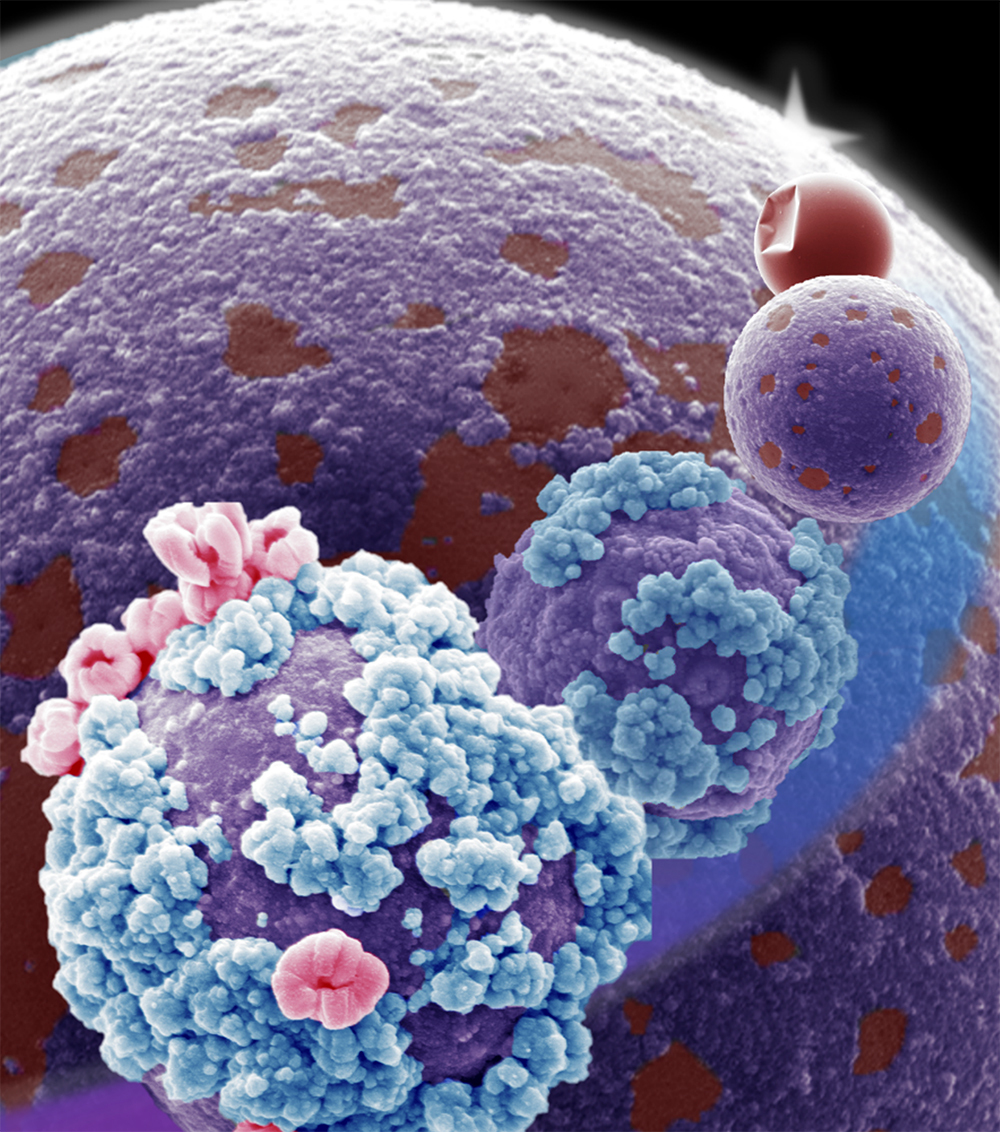
Just like a chameleon changes its skin color in response to its environment, engineers have found a way for liquid metal - and potentially solid metal - to change its surface structure in response to heat.
Treating particles of liquid metal alloys with heat causes them to roughen their surfaces with tiny spheres or nanowires, Iowa State University engineers reported in a paper featured on the cover of the Jan. 2 issue of the journal Angewandte Chemie.
Control the heat and you can control the surface patterns, said Martin Thuo, an Iowa State assistant professor of materials science and engineering, a co-founder of Ames startup SAFI-Tech Inc. and lead author of the paper.
And what could that tunable surface patterning lead to?
The technology could "inspire design of 'smart' alloy systems that evolve the surface patterns and their composition with temperature (or analogous stimuli) for applications ranging from sensing to catalysis," Thuo and his research team wrote in their paper.
The paper's co-authors are Andrew Martin and Winnie Kiarie, Iowa State doctoral students in materials science and engineering; and Boyce Chang, a postdoctoral fellow at the University of California, Berkeley, who earned his doctoral degree at Iowa State.
The research team started with a liquid metal alloy of gallium, indium and tin synthesized into particles covered with a smooth oxide shell that has been chemically stabilized. As the particles are heated, the surface thickens and stiffens and begins to behave more like a solid.
Eventually the surface breaks, allowing the liquid metal inside to come to the surface. The most reactive, gallium, breaks through first. More heat brings indium to the surface. And the highest heat - about 1,600 degrees Fahrenheit - brings out florets of tin.
This movement from the under-layer to the surface allows a liquid metal particle to "continuously invert its composition under thermal stimuli," the researchers wrote in the paper.
"The particles are responding to a certain level of heat and releasing a specific element based on temperature, just as a chameleon responds to the color of its environment," Thuo said. "That's why we say they're chameleon metals - but responding to heat, not to color as the reptile does."
Kiarie said the metal particles are responding to a very controlled environment - time, temperature and oxygen levels are carefully controlled by the researchers.
That allows the researchers to predict and program the exact surface texture of the particles.
Martin said the technology could be used to fine-tune a metal's performance as a catalyst or its ability to absorb compounds.
The researchers also say the technology will work with other metal alloys.
"This is not unique to these materials," Thuo said. "This is a behavior of metals in general. Other metals subject to the same treatment should do this. This is a universal property of metals."
That could make chameleon metals a very interesting and useful technology: "When you talk about smart materials, polymers come to mind," Thuo said. "But metals can do this, too. But it's a big beast - you just need to know how to tame it."
Chameleon Metals: Autonomous Nano‐Texturing and Composition Inversion on Liquid Metals Surfaces
Andrew Martin, Winnie Kiarie, Boyce Chang, Martin Thuo
Angewandte Chemie (2020) Volume 59, Issue 1
Contact information:
Martin Thuo
Iowa State assistant professor materials science and engineering
mthuo@iastate.edu
Phone: 515-294-8581
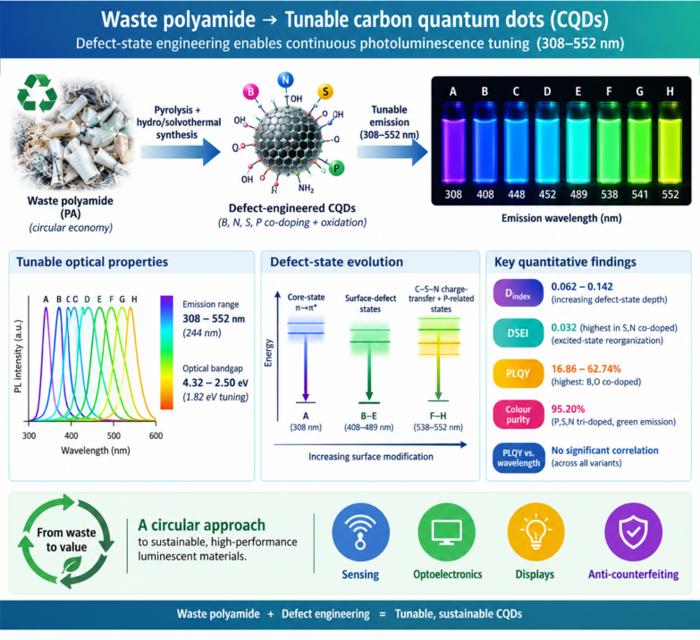
Waste polyamide-derived CQDs show continuous photoluminescence tuning from 308 to 552 nm through sequential defect-state engineering, with optical transition energies decreasing from 4.32 to 2.50 eV. @Christian Ebere Enyoh from Saitama University Carbon quantum dots (CQDs) are fluorescent carbon nanomaterials with potential applications in sensing, optoelectronics, displays, anti-counterfeiting, and environmental technologies. Their optical properties can be adjusted by modifying the carbon...
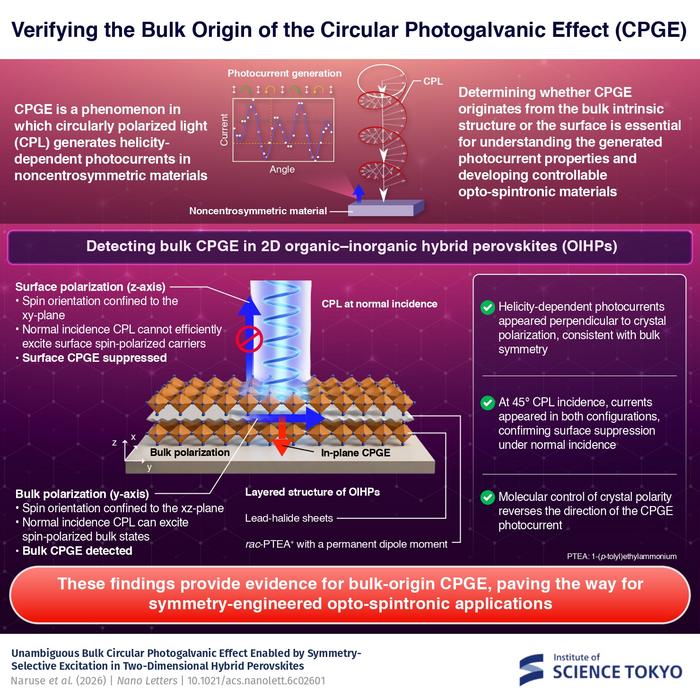
The researchers used circularly polarized light at normal incidence and found that helicity-dependent photocurrents appeared perpendicular to the crystal’s polarization but vanished when measured parallel to it, supporting a bulk origin of CPGE. @Institute of Science Tokyo The circular photogalvanic effect (CPGE), a phenomenon that generates helicity-dependent photocurrents in noncentrosymmetric materials, can originate purely from a crystal's internal structure without contribution from the...
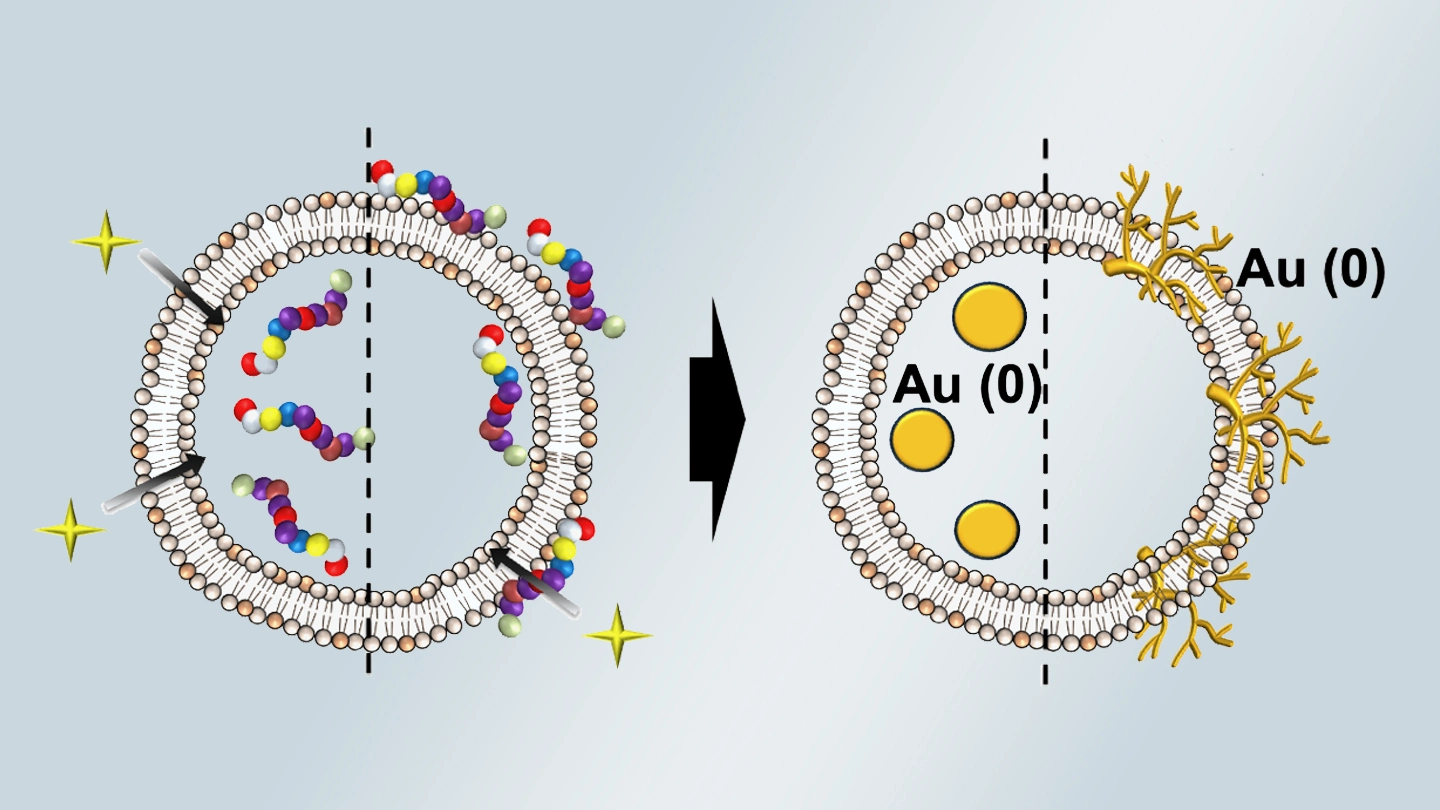
Summary of gold nanoparticle growth programming in liposome based on localization of biomineralization peptide The position of biomineralization peptides within liposomes can influence how gold nanoparticles grow, reports a research team from Institute of Science Tokyo. Peptides localized at the membrane interface promote branched structures, while those confined to the liposome interior favor spherical nanoparticles. The findings offer a new strategy for controlling nanoscale reaction...
