University of Massachusetts Amherst (UMass Amherst)
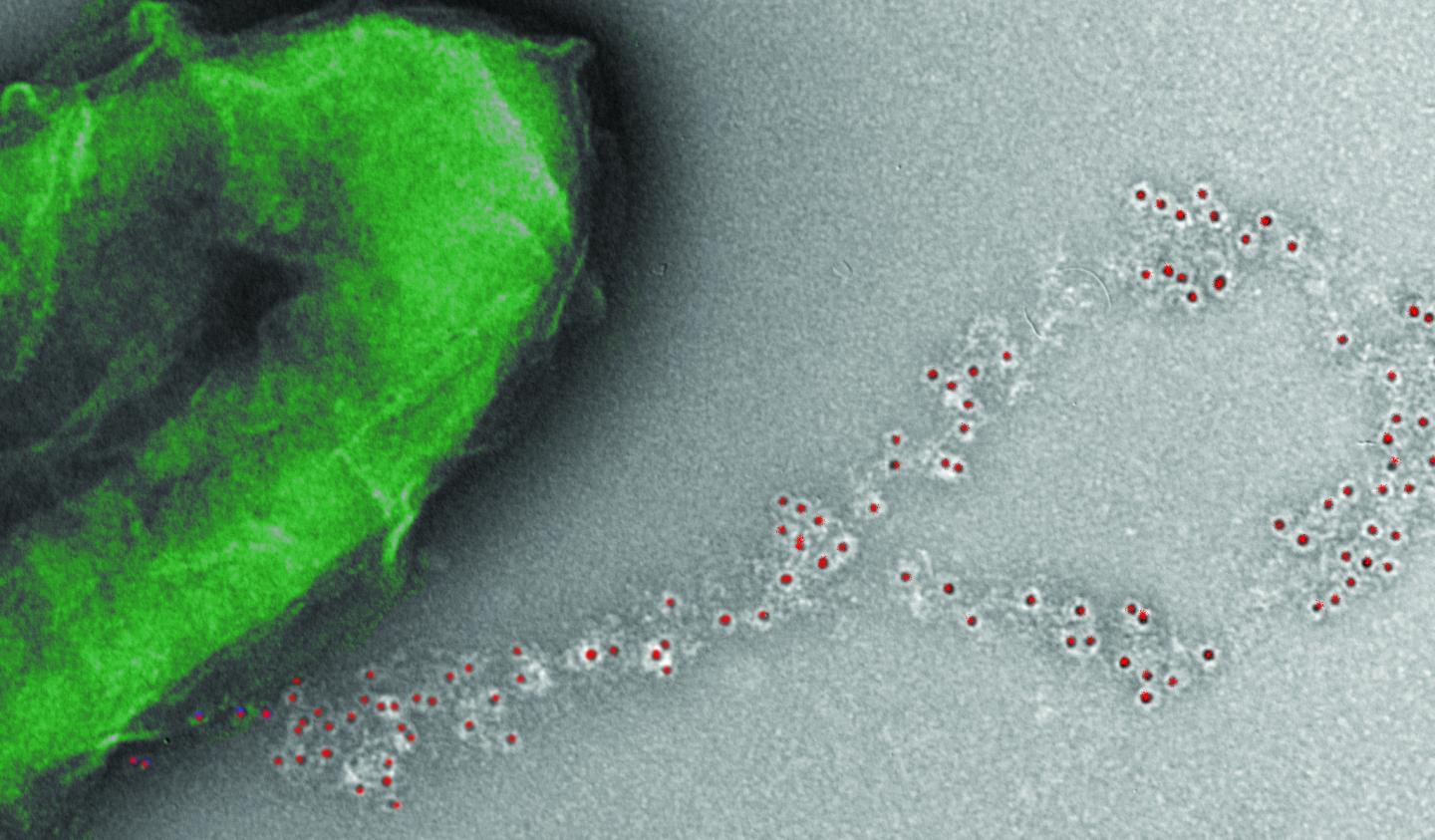
In the latest paper from the Geobacter Lab led by microbiologist Derek Lovley at the University of Massachusetts Amherst, he and colleagues report "a major advance" in the quest to develop electrically conductive protein nanowires in the bacterium Geobacter sulfurreducens for use as chemical and biological sensors. Details appear in the current issue of the American Chemical Society journal, ACS Synthetic Biology.
Electrically conductive protein nanowires found in Geobacter have been a subject of intense study in his lab for several years, Lovley notes, because they offer so many advantages over expensive silicon nanowires and carbon nanotubes that require toxic chemicals and high energy processes to produce.
By contrast, Geobacter's nanowires can be sustainably mass-produced and grown with renewable feedstocks. They require low energy input - one estimate says it costs 100 times less energy to produce them than silicon nanowires - and they can be recycled, the microbiologist notes. Protein nanowires are more sensitive, thinner and more flexible than silicone wires so more can be packed into a smaller space, with better sensing capabilities. They are also stable in water or bodily fluids, an important feature for biomedical applications.
Lovley, who discovered the electricity-conducting microbes in Potomac River mud more than 30 years ago, says, "In our previous research we focused on tuning the conductivity of the wires by modifying the gene for the protein that Geobacter assembles into the wire. We now have a toolbox of wires to choose from with a million-fold range in conductivity. That provides broad flexibility for electronic device design."
"One of the most promising applications for protein nanowires is biomedical and environmental sensors," he explains. "We want to design the wire that specifically binds a biologic or chemical of interest. When that molecule binds to the wire it will be obvious as a change in electric signal."
"The next goal was to see if we could modify the nanowires' surface properties without destroying their conductivity, which is what we've shown in this latest proof-of-concept paper," Lovley points out. His lab's recent studies demonstrate that peptides up to 9 amino acids long can be added to the nanowires' amino acid backbone, and "decorating" it with even more peptides is possible.
The researchers tested two different peptide "decoration" scenarios - so named because the peptides exposed along the outside of the wires are like tiny bulbs on a string of Christmas lights, Lovley says.
They first constructed a strain of G. sulfurreducens that made synthetic nanowires decorated with a six-histidine "His-tag" that specifically bound nickel to the wire surface. Next they demonstrated the possibility of producing wires with two decorations, the His-tag and a "linker" nine-peptide "HA-tag" exposed on the outer surface. They also demonstrated that the number of decorations on the wire could be controlled by introducing a genetic circuit to control expression of the HA-tag. Neither tag diminished the wires' conductivity, the authors report.
These broad possibilities for modifying the nanowires with peptides, plus their "green," sustainable attributes hold promise for further advances, the researchers say. The nanowires' properties "can now be readily modified to have new functionalities. For example, as we show in the paper, peptides can be designed to specifically bind chemicals or biologics of interest, which will be useful for designing nanowire sensors."
Decorating the Outer Surface of Microbially Produced Protein Nanowires with Peptides
Toshiyuki Ueki, David J.F. Walker, Pier-Luc Tremblay, Kelly P. Nevin, Joy E. Ward, Trevor L. Woodard, Stephen S. Nonnenmann, Derek R. Lovley
ACS Synth. Biol. July 12, 2019
DOI: 10.1021/acssynbio.9b00131
Contact information:
Derek Lovley
Professor of Microbiology at UMass Amherst
dlovley@microbio.umass.edu
Tel: 413-695-1690
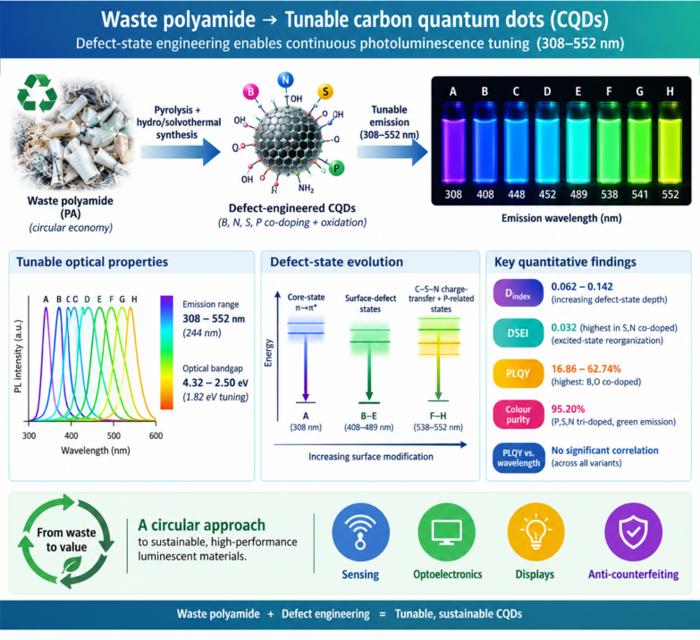
Waste polyamide-derived CQDs show continuous photoluminescence tuning from 308 to 552 nm through sequential defect-state engineering, with optical transition energies decreasing from 4.32 to 2.50 eV. @Christian Ebere Enyoh from Saitama University Carbon quantum dots (CQDs) are fluorescent carbon nanomaterials with potential applications in sensing, optoelectronics, displays, anti-counterfeiting, and environmental technologies. Their optical properties can be adjusted by modifying the carbon...
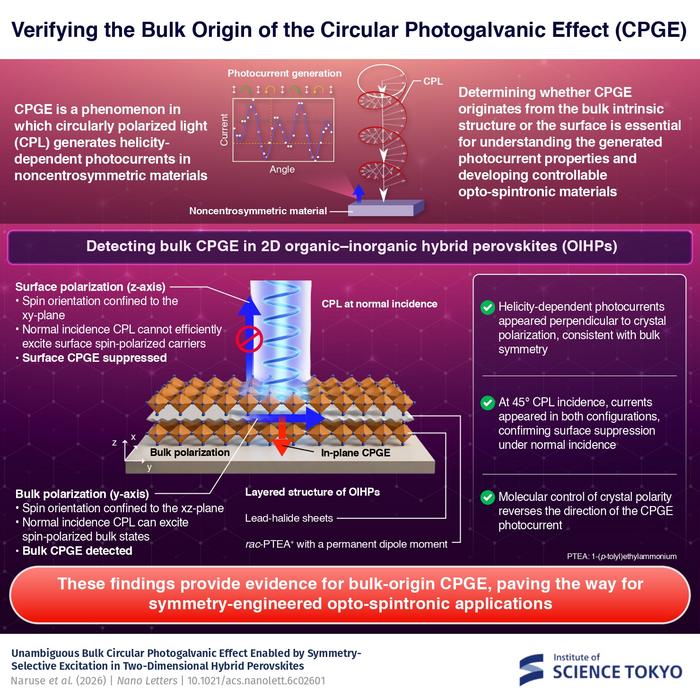
The researchers used circularly polarized light at normal incidence and found that helicity-dependent photocurrents appeared perpendicular to the crystal’s polarization but vanished when measured parallel to it, supporting a bulk origin of CPGE. @Institute of Science Tokyo The circular photogalvanic effect (CPGE), a phenomenon that generates helicity-dependent photocurrents in noncentrosymmetric materials, can originate purely from a crystal's internal structure without contribution from the...
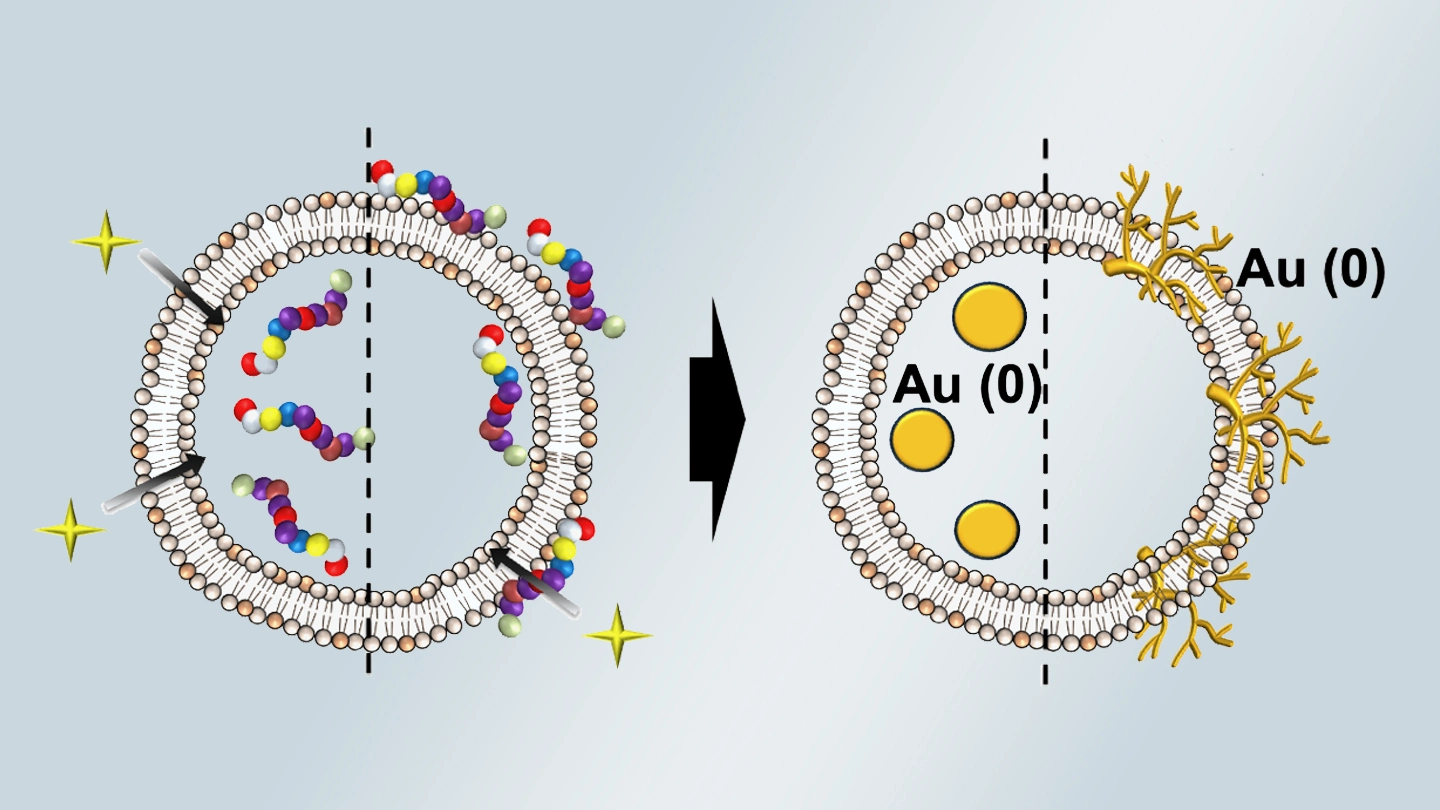
Summary of gold nanoparticle growth programming in liposome based on localization of biomineralization peptide The position of biomineralization peptides within liposomes can influence how gold nanoparticles grow, reports a research team from Institute of Science Tokyo. Peptides localized at the membrane interface promote branched structures, while those confined to the liposome interior favor spherical nanoparticles. The findings offer a new strategy for controlling nanoscale reaction...
