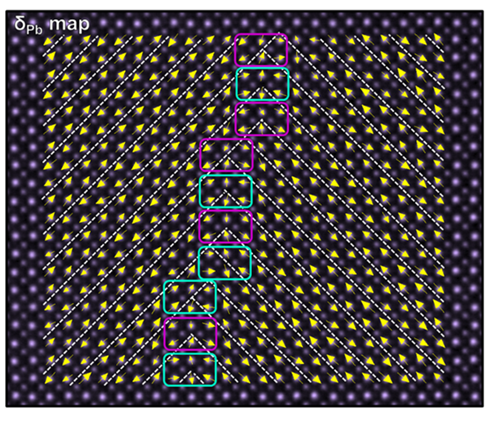
In physics, topological singularities are highly stable structures that occur on a very small scale. Thanks to their winding geometry, they are extremely resistant to change. This remarkable stability makes them of particular interest for various applications, most notably information storage. One example is the electric vortex, a microscopic 'whirlpool' formed by electric dipoles — regions where positive and negative charges are separated and depicted as tiny arrows — rotating in a circular pattern. A related but less obvious structure is the antivortex, which is formed by dipoles converging in one direction and diverging in another.
Such phenomena have been widely studied in ferroelectric materials, which are materials with spontaneous polarization. However, the existence of vortices in materials with no net polarity had never been observed. Until now. In a recent breakthrough, scientists at ICN2 contributed to a study that reported the presence of electric vortices and antivortices in PbZrO₃, an antiferroelectric material characterised by having antiparallel dipoles and no net polarity. This surprising discovery challenges assumptions about which materials can host such topological structures.
An unprecedented discovery
These surprising findings, recently published in Nature Materials, are the result of an international collaboration between researchers from ICN2, the University of Sydney, Wuhan University, the University of Silesia, the Institute of Applied Physics in Warsaw and the University of Liège. Dr Ying Liu, from the ICN2 Oxide Nanophysics Group, was one of the lead researchers in the study, supervised by ICREA Prof. Gustau Catalán. ICREA Prof. Jordi Arbiol, head of the ICN2 Advanced Electron Nanoscopy Group, was also involved.
The researchers used advanced electron microscopy techniques and theoretical calculations to demonstrate that electric vortices and antivortices can emerge in materials with no net polarisation. As Prof. Gustau Catalán states, 'We still don’t know whether these findings will lead to real-world applications. But what’s clear is that they open up exploration of topological phenomena in materials that had previously been excluded from this type of research”.
Although it's still early days, this discovery could have important implications for the future development of smaller, more powerful electronic devices.
Reference
Vortices and antivortices in antiferroelectric PbZrO3
Ying Liu, Huazhang Zhang, Konstantin Shapovalov, Ranming Niu, Julie M. Cairney, Xiaozhou Liao, Krystian Roleder, Andrzej Majchrowski, Jordi Arbiol, Philippe Ghosez & Gustau Catalan
https://www.nature.com/articles/s41563-025-02245-3
Catalan Institute of Nanotechnology (ICN2)
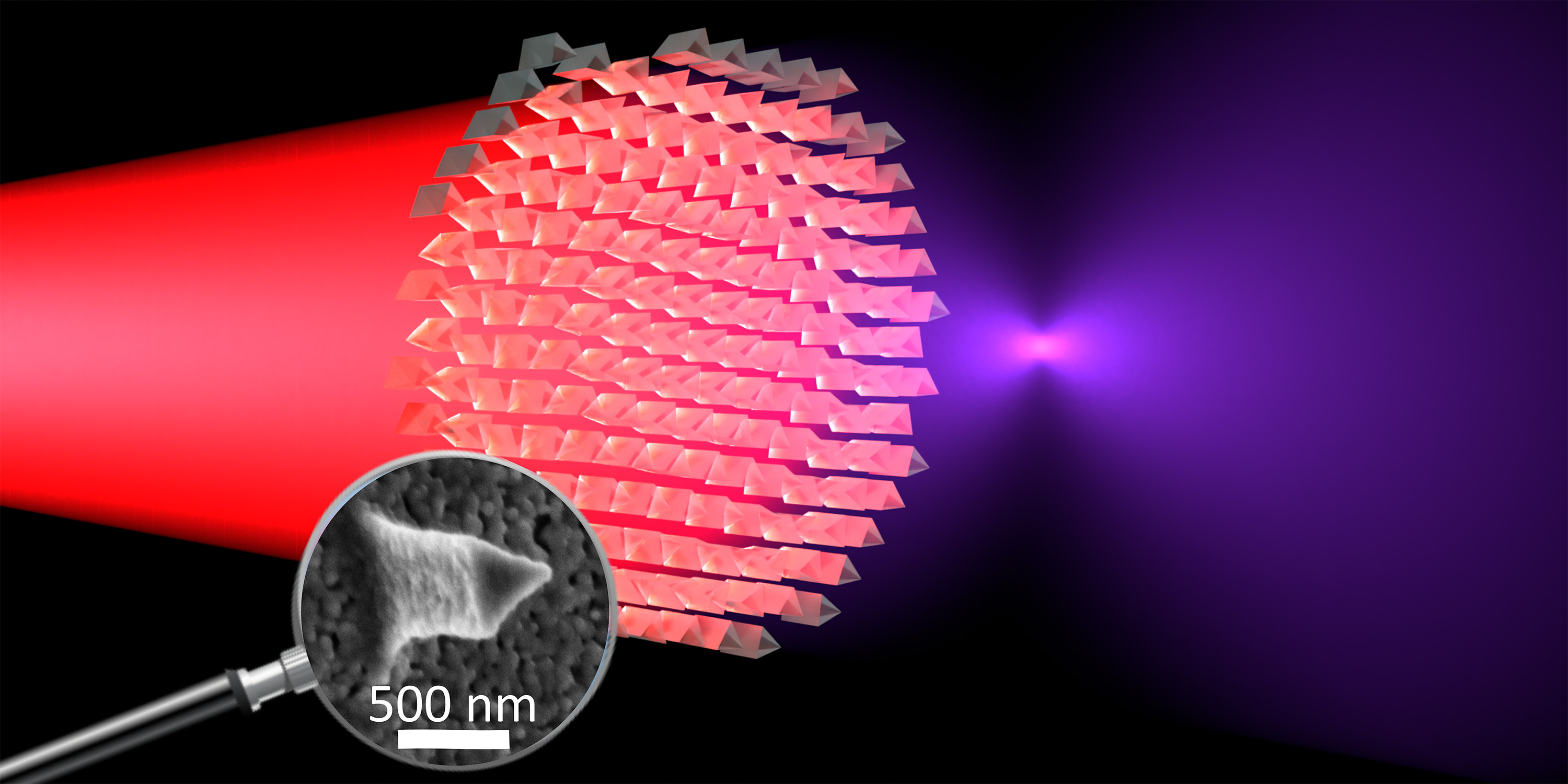
Using a new technique, the ETH researchers succeeded in creating the first lithium niobate metalenses with precisely engineered nanostructures. While functioning as normal light focusing lenses, these devices can simultaneously change the wavelength of laser light. When infrared light with a wavelength of 800 nanometres is sent through the metalens, visible radiation with a wavelength of 400 nanometres emerges on the other side and is directed at a designated point.

A team of researchers from Brown University has developed a new nanotechnology-based approach that could improve treatment of fungal infections, particularly those caused by the increasingly drug-resistant Candida species.
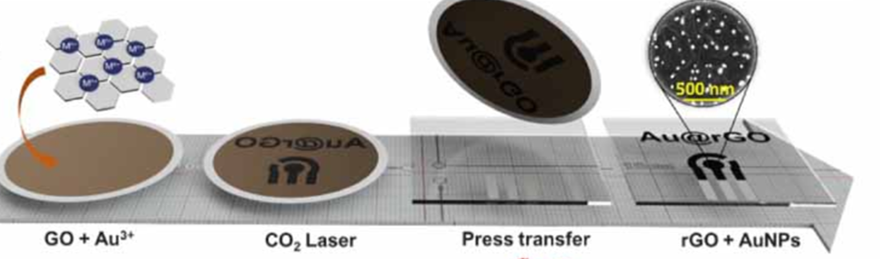
Recently, two scientists from the ICN2 Nanobioelectronics and Biosensors Group participated in a perspective article analysing advances and challenges of the use of 2D materials in sensing technologies. This work represents an international collaboration as part of the European Graphene Flagship initiative, aimed at advancing graphene research and its application in society.
This week in nanotech
$109M raised
3 funding rounds · 18 deals tracked
New products
 DLS-1 Mass Spectrometer for Fusion Gas AnalysisHiden Analytical Featured
 Nion-compatible In Situ STEM Holders for Electrical BiasingHummingbird Scientific Featured
 Talphene™ Graphene AdditivesTalga Group
Market insights
Last 30 days: Semiconductors & Electronics drew the most money: $545M.
Money raised per month