University of Michigan (U-M)
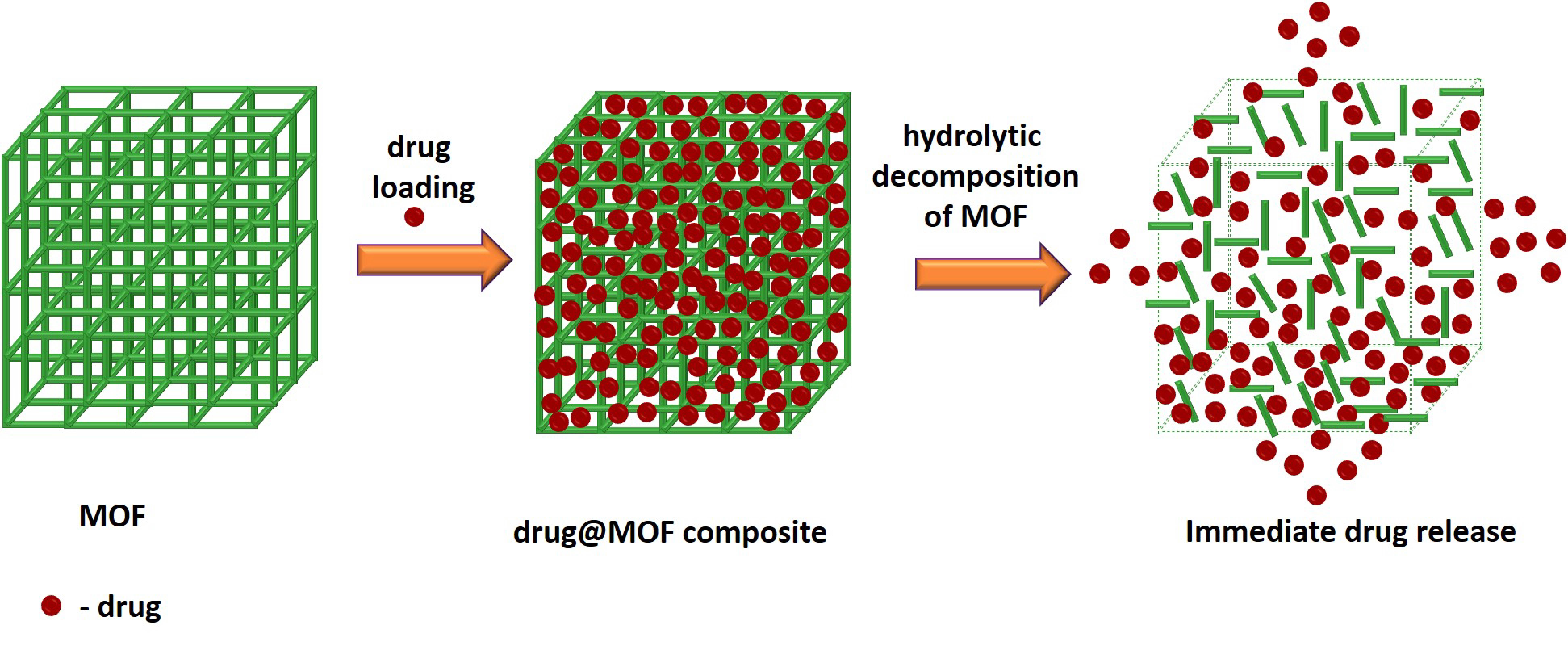
Stable metal organic frameworks are prized for their ability to capture carbon dioxide or harvest atmospheric water, but U-M researchers have developed a use for unstable metal organic frameworks: as a system for drug delivery.
Ninety percent of drugs in development don't dissolve well or at all in the body, according to a 2012 study. Metal organic frameworks, or MOFs, are rigid, porous structures composed of metal linked by organic ligands. While researching unstable MOFs, U-M chemist Adam Matzger realized they may work as a delivery system for these kinds of drugs.
"It struck us that while everyone was shooting for stable MOFs, we could use what we had learned about instability of MOFs to get a degradable substance that would rapidly release drugs. It was a really unexpected finding," said Matzger, the Charles G. Overberger Collegiate Professor of Chemistry and a professor of macromolecular science and engineering.
The MOF delivery system takes advantage of one strategy of delivering insoluble drugs, Matzger says. The strategy is to deliver them in an amorphous form, meaning that the drugs are kept from crystallizing. Once the drug compounds crystallize, they become less soluble--and therefore less bioavailable, which means less of the drug crosses into the bloodstream.
MOFs are able to keep these drugs in an amorphous state because of their porous structure. MOF-5 in particular looks like a set of cubes stacked on top of each other: picture an endlessly repeating 3D grid. When the researchers load a drug into this grid, the pores in the MOF compartmentalize the drug molecules, holding the compound in the desired amorphous state.
Researchers have previously used polymers to hold drug compounds in an amorphous state, but drug molecules could still migrate and crystallize in the polymer, which affects solubility and therefore how much of a drug is bioavailable. Because MOF rigidly holds drug molecules apart but quickly decomposes, drug dosage is easily controlled, Matzger says. The compound itself crosses into the bloodstream, while the MOF decomposes in the body.
The researchers, who include postdoctoral fellow Kuthuru Suresh, decided to use MOF-5 for a few reasons. First, its metal component is zinc, a metal with low toxicity used in many supplements, and the organic component is an acid called terephthalic acid. Second, MOF-5 is relatively unstable, which the researchers demonstrated in separate work that examined the stability of different MOFs.
"What we do here is we increase the solubility while guaranteeing dosage stability," Matzger said. "This approach is relatively universal. We show it for three drugs, but the fact that the pores are too small to allow a crystal to form is going to be true for all drugs."
Enhanced Drug Delivery by Dissolution of Amorphous Drug Encapsulated in a Water Unstable MOF
Adam J. Matzger, Kuthuru Suresh
Angewandte Chemie, 2019
Contact information:
Professor of chemistry and professor of macromolecular science and engineering at U-M
matzger@umich.edu
Phone: 734-615-6627

Researchers led by Professor Jaeyune Ryu at Seoul National University identified local pH near electrodes as a decisive variable in organic electrosynthesis. By designing a reactor that narrows electrode spacing and flows electrolyte to counterbalance acidic and alkaline zones, they raised selectivity for lactones and epoxides, feedstocks for biodegradable plastics, polyurethanes, adhesives, and epoxy resins, from about 16% to 97% using only oxygen and electricity, eliminating added peroxide…

Silver nanoparticles with diameters of ~10 nm deliver the best performance as electrocatalysts. The silver particles are sprayed onto the electrode together with a conductive carbon powder. The ideal mixture consists of 20 per cent by mass silver and 80 per cent by mass carbon powder. This image was taken using a transmission electron microscope (TEM). © HZB Via electrolysis, CO₂ can be reduced to CO, a raw material for further chemical products such as fuels. Within the GreenQuest Project,...

A flexible metal–organic framework developed by researchers from Institute of Science Tokyo enables the structural determination of large "beyond rule of 5" molecules from microgram-scale samples. Using APF-40 as a crystalline sponge, the researchers determined the structures of 12 pharmaceutical-related molecules, including the 899 Da drug molecule doramectin and trace ivermectin derivatives. The method could aid drug discovery, natural products research, and the characterization of rare...






