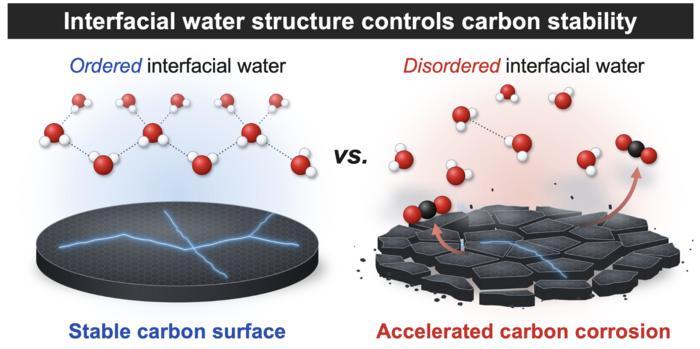
Osaka, Japan – Carbon is inexpensive, conductive, and widely used in technologies such as fuel cells and water electrolyzers. But under strongly oxidizing conditions, carbon electrodes gradually corrode. Researchers at the University of Osaka and their international collaborators have now found that the arrangement of water molecules directly next to the electrode plays a key role in this degradation, suggesting a new way to improve durability.
By monitoring both carbon corrosion and interfacial water during operation, the researchers found that corrosion accelerated as the network connecting nearby water molecules became more disrupted. Weakly connected water appeared to be preferentially involved in the oxidation of carbon to carbon dioxide, and deliberately disturbing the network further increased corrosion.
Rather than modifying the carbon itself, the team then changed its immediate environment. They used different ion-conducting polymers, known as ionomers, to reorganize water at the electrode surface. Sustainion created a more strongly connected water network than the commonly used Nafion and reduced carbon corrosion by about 51%.
The researchers next tested the concept in a chlorine-producing system using a carbon-supported platinum catalyst. Although Sustainion improved durability, it initially reduced catalytic activity. By combining Sustainion with Nafion, the team retained high initial activity while limiting performance loss to 19% after 500 cycles.
“Electrodes are often considered the main players in electrochemical reactions, but the water immediately surrounding them is also important,” says Dr. Yu Katayama, one of the corresponding authors at the University of Osaka. “Our results show that designing the environment around an electrode, not only the electrode material itself, could help improve its durability.”
The findings highlight control of interfacial water as a promising design principle for carbon electrodes and could contribute to longer-lasting electrochemical technologies, including green hydrogen production, chlorine manufacturing, and fuel cells.
Reference
Interfacial Water-Networks Regulate the Anodic Stability of Carbon Electrodes
Junsic Cho, David Hernández‐Castillo, Jinjong Kim, Tomohiko Utsunomiya, Haesol Kim, Taejung Lim, Young Yong Kim, Hyo Sang Jeon, Hyung‐Suk Oh, Yu Katayama, Sang Hoon Joo, Kai S. Exner, and Chang Hyuck Choi
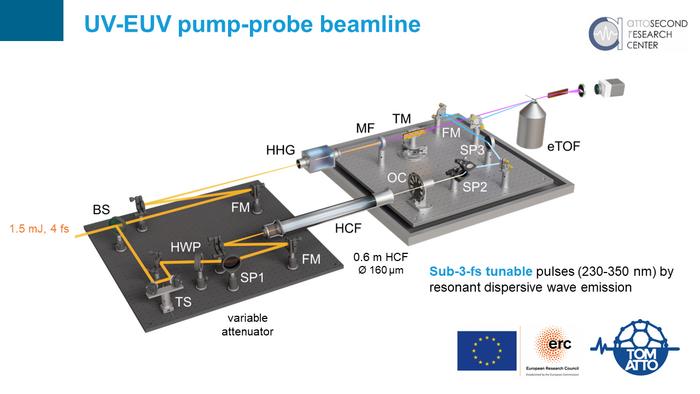
A new apparatus led by the Politecnico di Milano resolves molecular dynamics with roughly 3 femtosecond precision, placing it among the leaders in time-resolved photoelectron spectroscopy. Using synchronised ultraviolet and attosecond extreme ultraviolet pulses, researchers tracked acetylacetone after light absorption and separated two successive passages through a conical intersection, a distinction earlier instruments could not make.
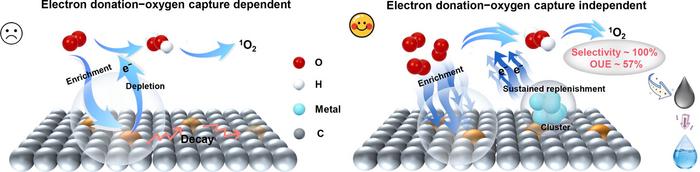
A nitrogen-doped carbon cathode with cobalt clusters and oxygen vacancies decouples oxygen capture from electron donation, enabling a self-aeration system that generates oxygen in situ and converts it into singlet oxygen. The approach removed 98% of sulfamethazine and over 90% of total organic carbon, cutting treatment costs to $0.25 per cubic meter, a 95-98% reduction versus conventional advanced oxidation, with 82% lower indirect emissions.
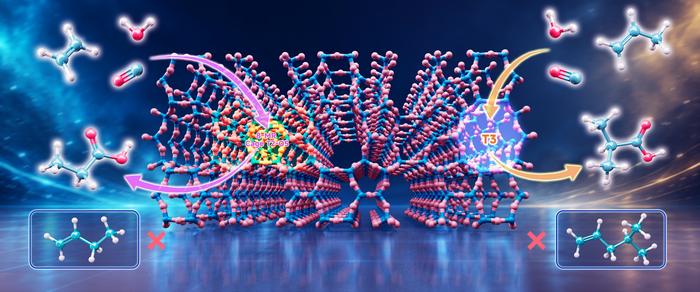
Zeolite pore architecture can drive olefin carbonylation without precious metals or organic ligands, researchers report in Nature. Propene converts to isobutyric acid and ethene to propionic acid in the presence of water, with pore size and active-site location determining which olefin reacts selectively. Confined pores also suppress competing polymerization, and the solid catalyst is easily separated from products.
This week in nanotech
$281.1M raised
7 funding rounds · 35 deals tracked
New products
 Nion-compatible In Situ STEM Holders for Electrical BiasingHummingbird Scientific Featured
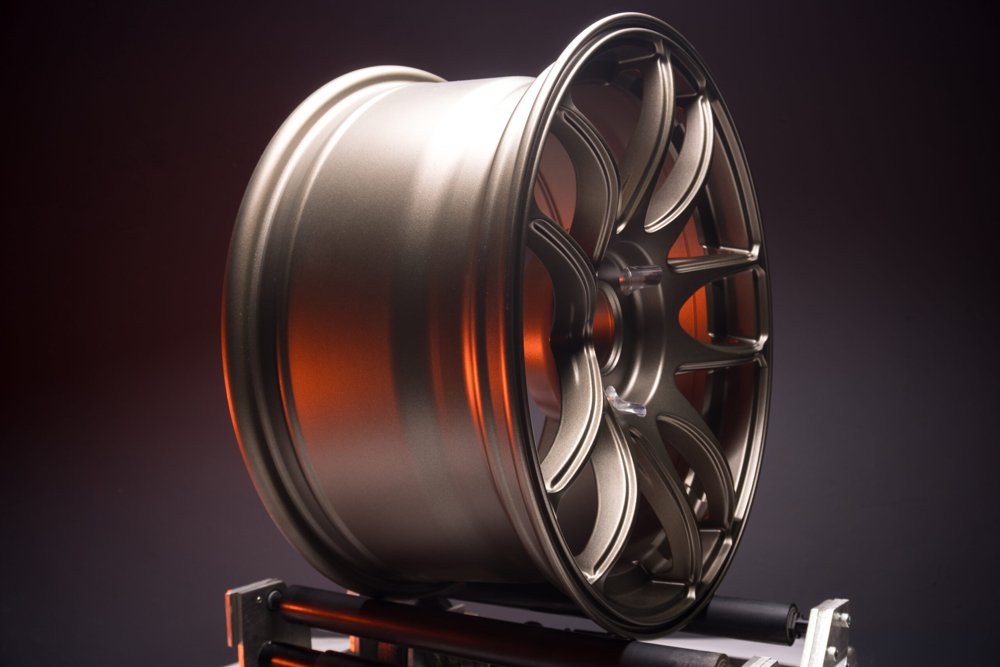 Ti-WCMBN Nanomaterialia Featured
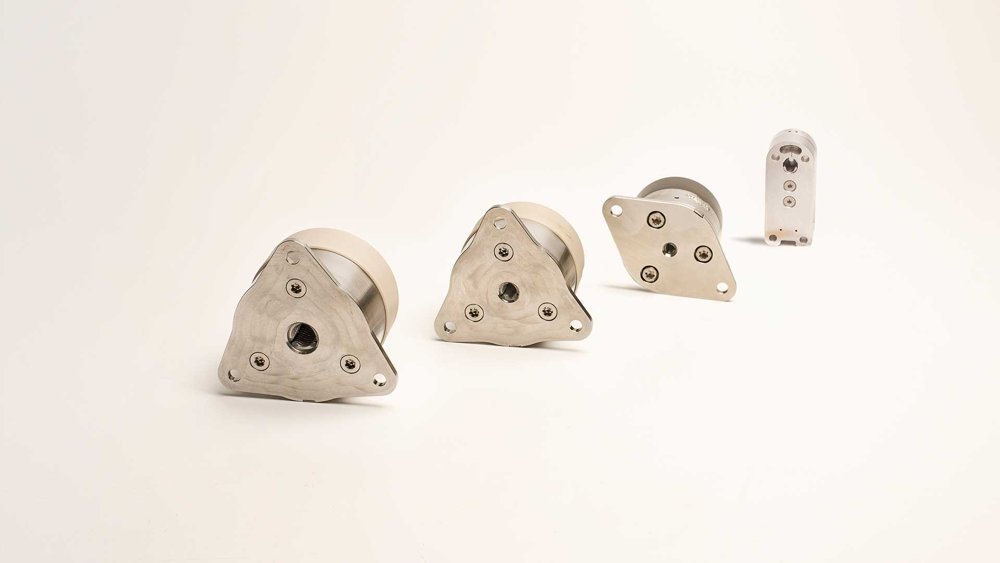 Hold Down & Release Mechanisms (HDRM) REACT – 5KN, 15KN and 35KN space qualified resettable mechanismsARQUIMEA
Market insights
Last 30 days: Quantum Technologies drew the most money: $3.17B.
Money raised per month
Behind the deal
Who invested in Vertical Semiconductor’s $73M Grant?
See the investors with Insights Pro →