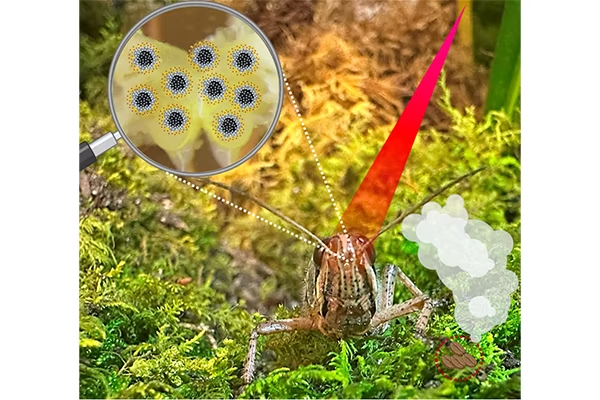
Our sensory systems are highly adaptable. A person who cannot see after turning off a light in the night slowly achieves superior power to see even small objects. Women often attain a heightened sense of smell during pregnancy. How can the same sensory system that was underperforming can also exceed the expectation based on its prior performance?
Since nature has perfected its sensory systems over evolutionary time scales, an interdisciplinary team of researchers in the McKelvey School of Engineering at Washington University in St. Louis tapped into these capabilities to adapt the system on demand to perform at its peak performance. Their tools to achieve this goal: locusts and nanomaterials too small to see.
Srikanth Singamaneni and Barani Raman, both professors in the McKelvey School of Engineering, led a team that harnessed the power of specially made nanostructures that can absorb light and create heat, known as the photothermal effect, and act as containers to store and release chemicals on demand. They used these nanostructured materials to boost neural response in the locust's brain to specific odors and to improve their identification. Results of the research were published in Nature Nanotechnology Jan. 25, 2024.
Singamaneni, the Lilyan & E. Lisle Hughes Professor in the Department of Mechanical Engineering & Materials Science, and Raman, professor of biomedical engineering, have collaborated for years with Shantanu Chakrabartty, the Clifford W. Murphy Professor in the Preston M. Green Department of Electrical & Systems Engineering, to harness the superior sensing capabilities of the locust olfactory system. Recently they demonstrated the feasibility of using a bio-hybrid electronic nose for sensing explosive vapors.
“We let the biology do the harder job of converting information about vaporous chemicals into an electrical neural signal,” Raman said. “These signals are detected in the insect antennae and are transmitted to the brain. We can place electrodes in the brain, measure the locusts’ neural response to odors, and use them as fingerprints to distinguish between chemicals.”
The idea, though sound, has a potential roadblock.
“We are limited by the number of electrodes and where we can place them,” Singamaneni said. “Since we will get only a partial signal, we want to amplify this signal. This is where we turned to heat and neuromodulation to enhance the signal we get.”
In the new research, the team used two strategies to boost the locusts’ ability to detect odors. First, the team created a biocompatible and biodegradable polydopamine nanoparticle that converts light to heat through a process called photothermal effect.
"Heat affects diffusion,” Raman said. “Imagine adding cold milk to hot coffee. The idea is to use the heat generated by nanostructures to locally heat, for example, a nanoheater, and enhance the neural activity.”
Second, these nanostructured materials can be made to load chemicals for storage. However, they need to be encapsulated by a covering material. The team used a phase-change material called tetradecanol which is solid at room temperature and transitions to liquid upon heating. When heated, the same nanoheaters will ooze the chemicals stored within them in addition to generating heat.
Singamaneni and the team stored octopamine, a neuromodulator involved in various functions, and released it on demand. Usually, these neuromodulators are released based on the needs of the organism. However, using the nanostructured heaters, they were released on demand to enhance the neural signals.
“Our study presents a generic strategy to reversibly enhance neural signals at the brain site where we place the electrodes,” Raman said.
“The nano-enabled neuromodulation strategy we developed opens new opportunities to realize tailored cyborg chemical sensing approaches,” said Prashant Gupta, a graduate student in Singamaneni’s lab and first author of the paper. “This approach would change an existing passive approach where information is simply read into an active one where the capabilities of the neural circuits as a basis for information processing are fully used.”
Reference
Augmenting insect olfaction performance through nano-neuromodulation
Prashant Gupta, Rishabh Chandak, Avishek Debnath, Michael Traner, Brendan M. Watson, Hengbo Huang, Hamed Gholami Derami, Harsh Baldi, Shantanu Chakrabartty, Baranidharan Raman & Srikanth Singamaneni
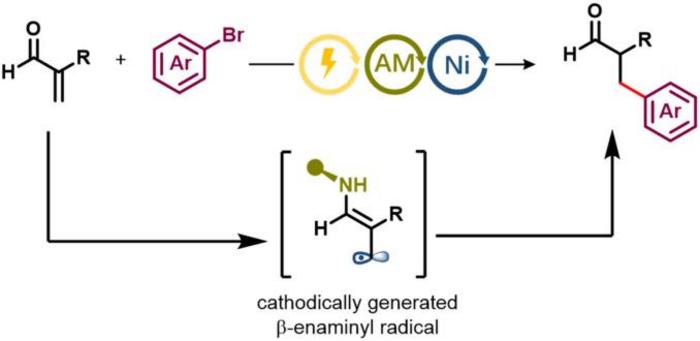
A primary amine and nickel dual catalytic system uses electrochemistry to reverse the usual reactivity of aminocatalytic intermediates, reducing an iminium ion at the cathode to a β-enaminyl radical instead of oxidizing an enamine. Run at 1.10 V with an inexpensive achiral amine, the method couples α-branched acroleins with aryl and alkenyl halides, giving β-functionalised aldehydes in up to 91% yield and 80% on gram scale.
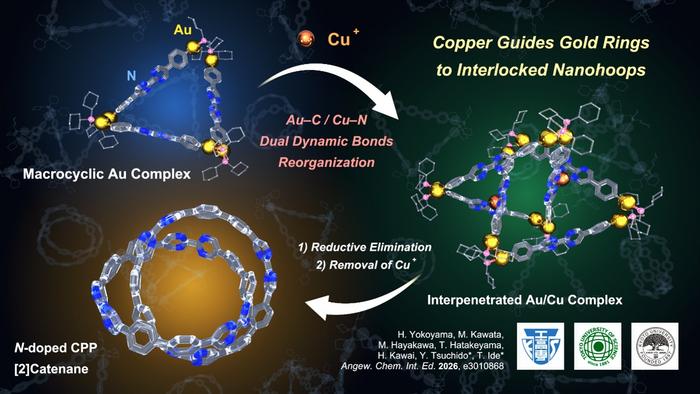
Researchers in Japan have combined gold(I) carbon bonds and copper(I) nitrogen coordination to assemble an interlocked catenane of nitrogen-doped carbon nanohoops in a single pot. Demetallation gave a metal-free [2]catenane of two fully conjugated [12]CPP rings in only eight steps, with a 2.9% overall yield that improves on conventional routes.
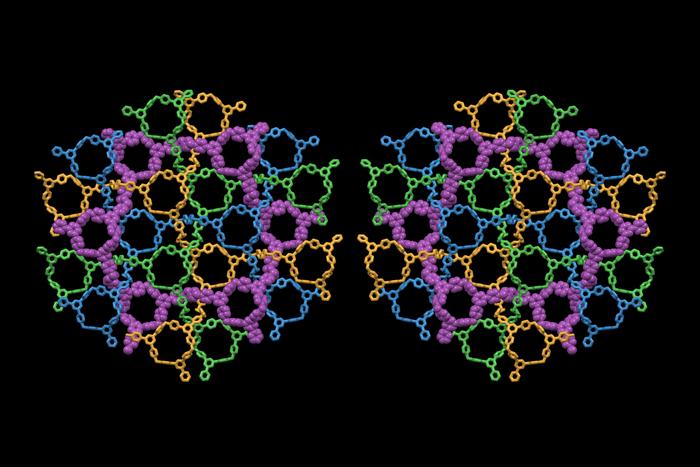
Chemists at UT Austin and Zhejiang University have developed a self-assembling molecularly woven fabric that separates benzene from cyclohexane far more efficiently than distillation, whose near-identical boiling points make conventional processing costly. Stacked layers of clockwise and counterclockwise chiral networks form a springy, reusable filter that absorbed 97.9% of benzene from a 50/50 mixture.
This week in nanotech
25 deals tracked
New products
 Orion Sputtering Deposition SystemsAJA International Featured
 Ti-WCMBN Nanomaterialia Featured
 PDK (Process Design Kit)DB HiTek
Market insights
Last 30 days: Semiconductors & Electronics was the busiest vertical: 55 of 176 events (31%).
Money raised per month