EPFL

Optical microresonators convert laser light into ultrashort pulses travelling around the resonator’s circumference. These pulses, called “dissipative Kerr solitons”, can propagate in the microresonator maintaining their shape.
When solitons exit the microresonator, the output light takes the form of a pulse train – a series of repeating pulses with fixed intervals. In this case, the repetition rate of the pulses is determined by the microresonator size. Smaller sizes enable pulse trains with high repetition rates, reaching hundreds of gigahertz in frequency. These can be used to boost the performance of optical communication links or become a core technology for ultrafast LiDAR with sub-micron precision.
Exciting though it is, this technology suffers from what scientists call “light-bending losses” – loss of light caused by structural bends in its path. A well-known problem in fiber optics, light-bending loss also means that the size of microresonators cannot drop below a few tens of microns. This therefore limits the maximum repetition rates we can achieve for pulses.
Publishing in Nature Physics, researchers from the lab of Tobias J. Kippenberg at EPFL have now found a way to bypass this limitation and uncouple the pulse repetition rate from the microresonator size by generating multiple solitons in a single microresonator.
The scientists discovered a way of seeding the microresonator with the maximum possible number of dissipative Kerr solitons with precisely equal spacing between them. This new formation of light can be thought of as an optical analogue to atomic chains in crystalline solids, and so the researchers called them “perfect soliton crystals” (PSCs).
Due to interferometric enhancement and the high number of optical pulses, PSCs coherently multiply the performance of the resulting pulse train – not just its repetition rate, but also its power.
The researchers also investigated the dynamics of PSC formations. Despite their highly organized structure, they seem to be closely linked to optical chaos, a phenomenon caused by light instabilities in optical microresonators, which is also common for semiconductor-based and fiber laser systems.
“Our findings allow the generation of optical pulse trains with ultra-high repetition rates with several terahertz, using regular microresonators,” says researcher Maxim Karpov. “These can be used for multiple applications in spectroscopy, distance measurements, and as a source of low-noise terahertz radiation with a chip-size footprint.” Meanwhile, the new understanding of soliton dynamics in optical microresonators and the behavior of PSCs opens up new avenues into the fundamental physics of soliton ensembles in nonlinear systems.
References
Maxim Karpov, Martin H. P. Pfeiffer, Hairun Guo, Wenle Weng, Junqiu Liu, Tobias J. Kippenberg. Dynamics of soliton crystals in optical microresonators. Nature Physics 09 September 2019. DOI: 10.1038/s41567-019-0635-0
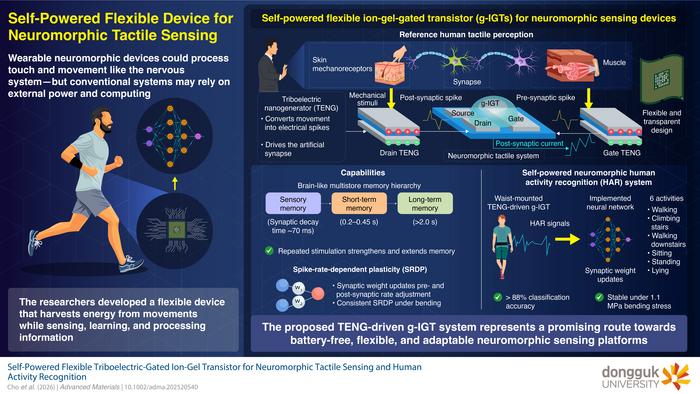
The proposed TENG-driven g-IGT is a flexible, self-powered neuromorphic device capable of reproducing multiple memory states and spike-rate-dependent learning Neuromorphic devices, which are designed to emulate aspects of biological neural networks, are promising candidates for developing low-power and intelligent sensing technologies, including wearable applications. Among the device architectures explored for neuromorphic computing, graphene-channel ion-gel-gated transistors (g-IGTs) are...

Rice University researchers have shown that sub-nanometer wrinkles in graphene generate flexoelectric charge separation, reshaping local electrical behavior through curvature alone. Extreme bending produces polarization far stronger than in larger systems and may enable geometry-controlled electronics without chemical doping. Published in Advanced Materials.

Researchers at NC State have extended twistronics beyond van der Waals materials into strongly bonded crystalline oxides. By stacking sodium niobate membranes with twist angles controlled down to 0.1 degrees, and confirming results via synchrotron X-ray diffraction, the team found interlayer bonds distort the atomic lattice, shifting phase structure and domain configuration. The technique works at near-millimeter scale, far larger than typical twistronic devices, marking a real step toward pract
