Max Planck Institute for Polymer Research
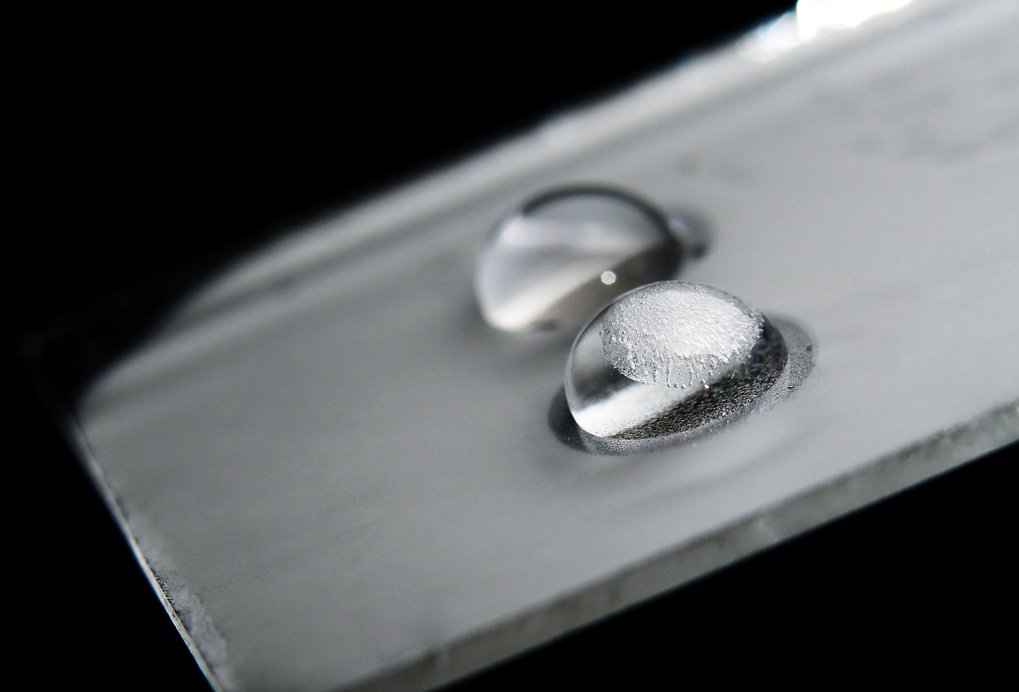
Whether on a windowpane at home or during the industrial cleaning of computer chips: Droplets sliding over solid surfaces become electrically charged. Yet the physical mechanism behind this charging remains a subject of debate to this day. This charging is usually attributed to the exchange of charged particles (ions) at the interface between the droplet and the surface. Researchers at the Max Planck Institute for Polymer Research have now investigated two different types of liquids—so-called polar and nonpolar liquids—in both their liquid and frozen states. The researchers discovered that there is apparently at least one additional effect behind droplet charging
When droplets glide across surfaces, they usually become positively charged and leave a negatively charged trail on the surface. This process is known as slide electrification. The resulting electric charges influence the movement of droplets on various surfaces. On a windowpane, for example, this contributes to droplets occasionally getting stuck. During the cleaning of computer chips in industrial manufacturing processes, this can even damage the sensitive components. Therefore, understanding which fundamental processes contribute to droplet charging is of great interest.
Currently, charge transfer is typically explained using the concept of the electrochemical double layer: When a droplet contacts a surface, negatively charged ions usually spontaneously attach themselves to the wetted surface. These, in turn, attract mobile positive countercharges from the liquid, which are located just a few nanometers from the surface within the liquid. As the droplet slides across the surface, negative charges remain on the surface and the droplet becomes positively charged.
To investigate the underlying mechanisms, the researchers compared the behavior of two different types of liquids—polar and nonpolar liquids—in both liquid and frozen states. A common example of a polar liquid is water, which conducts electricity, whereas oil, as a nonpolar liquid, does not conduct electrical current. Ions in the two types behave differently depending on the liquid and its phase. In nonpolar liquids, freely moving ions play virtually no role in charge transport. Ion mobility is also severely restricted in frozen polar liquids. By allowing droplets of various liquids and in different states of matter to slide across surfaces and then measuring the charge state of the droplets, the researchers were able to investigate the actual role that mobile ions play in charge transfer.
The surprising result: Even nonpolar liquids become charged in both the solid and liquid phases as they slide across a surface, albeit much less so than polar liquids. Given the established assumption that nonpolar liquids contain virtually no freely moving ions, there must therefore be another form of charge transport that leads to the droplets becoming charged. For some time now, there has therefore been discussion as to whether a direct exchange of electrons could take place.
“This suggests that our previous understanding—according to which charge transfer occurs exclusively via ions—may not be entirely accurate. Slide electrification could occur via at least two mechanisms, with the dominant charge transfer process alternating between ion and electron transfer depending on electronegativity, state of matter, and temperature,” explains Dr. Rutvik Lathia, a researcher at the Max Planck Institute for Polymer Research.
The assumption of direct electron transfer stems mainly from studies of triboelectric charging between two solids, which occurs, for example, when ice slides. When two solids rub against each other, their electron clouds can overlap, allowing them to exchange an electron directly. Charge transfer can also result from extremely high local voltages that arise when two solids rub against each other. However, this effect does not occur when a liquid glides over a solid, which is why it had previously been assumed that charging occurred via ion exchange.
The researchers now hope that the new findings, published in the journal Nature Physics, will support the development of improved materials for applications such as triboelectric energy harvesting, ice-repellent surfaces, or droplet-based technologies.
Reference
Electrification mechanisms in sliding liquid and frozen drops
Lathia, R., Leibauer, B., Ratschow, A.D., Steffen, W., Butt, H.-J.
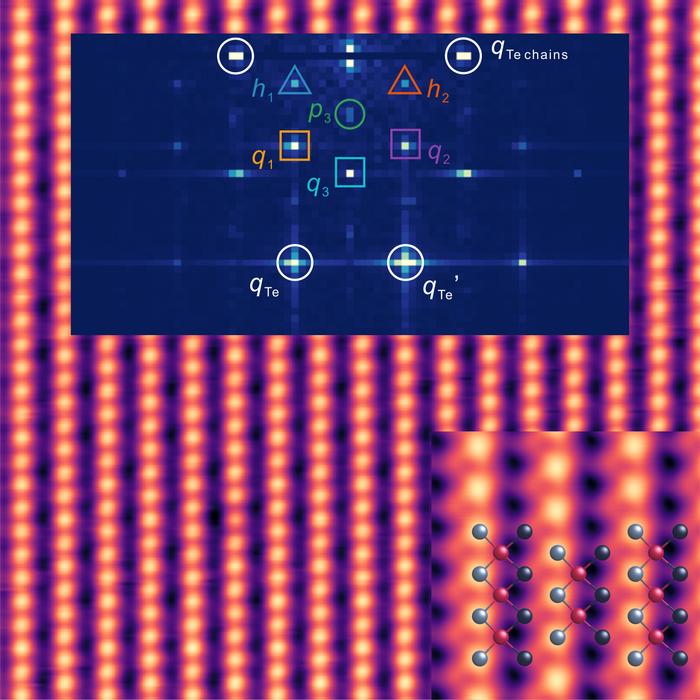
A Fourier transform revealing spatial patterns on the surface at 300 millikelvins. A charge density wave signals the presence of the pair density wave. The background is tellurium atoms on the surface of uranium ditelluride. @University of Illinois Urbana-Champaign’s Grainger College of Engineering Physicists with the University of Illinois Urbana-Champaign’s Grainger College of Engineering have identified a new form of superconducting behavior. Experiments on the metal uranium ditelluride...
Stack two atomically thin layers, rotate one slightly against the other, and a new material emerges. The resulting moiré pattern can slow electrons down so much that their interactions take over. This produces superconductivity, magnetism and exotic fractional quantum states that neither layer shows on its own. This field, known as twistronics, has become one of the most active frontiers in condensed matter physics. So far, however, it has been built on only a handful of materials, mainly...
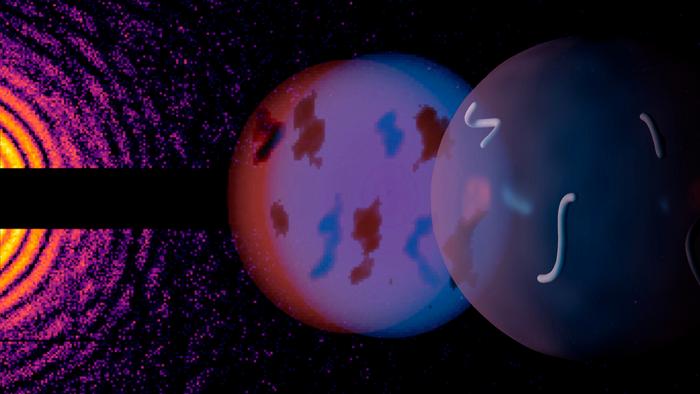
From a two-colour diffraction pattern (left), two snapshots of a helium droplet doped with xenon nanoparticles can be reconstructed (centre). These images can inform a potential 3D rendering of a xenon-doped helium nanodroplet (right). An overarching goal of ultrafast science is to enable researchers to watch structural changes in matter on their natural timescale. Experimentally, this translates into taking two snapshots of the same nanoscale object that are only femtoseconds apart to...
