Karlsruhe Institute of Technology (KIT)
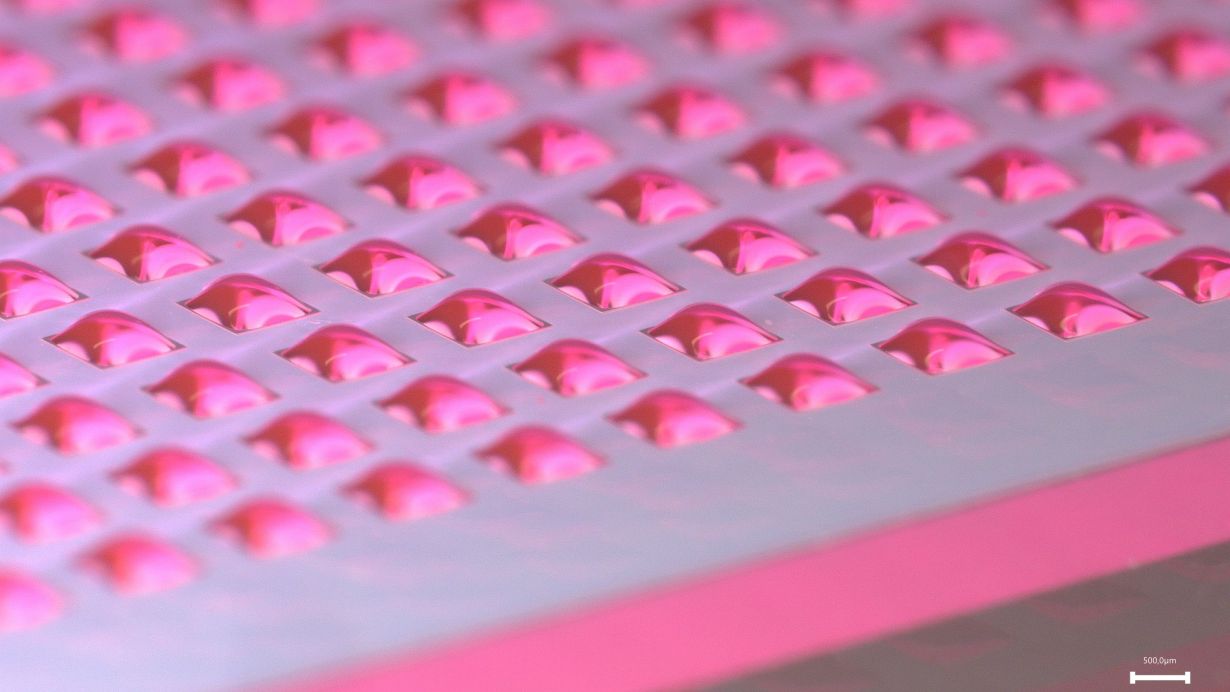
Until now, the early phase of drug discovery for the development of new therapeutics has been both cost- and time-intensive. Researchers at KIT (Karlsruhe Institute of Technology) have now developed a platform on which extremely miniaturized nanodroplets with a volume of only 200 nanoliters per droplet – comparable to a grain of sand – and containing only 300 cells per test can be arranged. This platform enables the researchers to synthesize, characterize, and test thousands of therapeutic agents on the same chip, saving time and resources. The researchers report on their findings in the journal “Angewandte Chemie.”
Drug discovery for new therapeutic agents currently relies on high-throughput screenings that comprise separate, resource-intensive steps for the synthesis, biological testing, and characterization of new active substances. This method is generally practicable only at major pharmaceutical companies, takes several years of development, incurs costs of hundreds of millions of euros, and requires a large amount of raw materials.
“In particular, academic and smaller industrial research institutions are not able to mobilize these resources,” says Professor Pavel Levkin from KIT’s Institute of Biological and Chemical Systems (IBCS). “Our technology removes this barrier and could open the door for many more players to contribute to drug discovery.”
1,000 Times Smaller Droplets in Experimental Settings
To accelerate drug discovery for cancer therapy, researchers from the Department of Biofunctional Materials headed by Levkin have now developed an integrated nanodroplet array platform. “It combines the previously separate processes for the development of new anti-cancer drugs on a single chip – using a single, miniaturized workflow,” says Levkin.
The scientists managed to scale down the experiments by a factor of 1000, i.e., from the microliter to the nanoliter range. “Thanks to our direct-to-biology approach, where direct biological tests of the synthesized molecules are conducted without prior preparation, we are able to reduce the time and resources invested in synthesis and screening drastically by using only 200 nanoliters per droplet and 300 cells for each test – comparable in volume to a grain of sand,” says Levkin.
The researchers synthesized and tested various potential MEK inhibitors (mitogen-activated protein kinase inhibitors) – agents that block the MEK enzyme, which is involved in the development of different types of cancer, such as skin and colon cancer. One well-known MEK inhibitor, mirdametinib, is already used for treating rare, inoperable tumors. Based on its molecular structure, the research group produced a library of potential novel MEK inhibitors. “Using the new nanodroplet method, we produced 325 potential MEK inhibitors in just seven days — and found that 46 of them worked as well as mirdametinib in lab tests,” says Levkin.
Cell-based Tests in Miniature Format
The researchers examined the activity of the newly produced molecules using live cells. “In this process, we investigated the viability of the colon cancer cell line HT-29, which is vulnerable to MEK inhibitors,” says Liana Bauer, doctoral researcher at the IBCS-FMS and lead author of the published study.
For characterization of the molecules, the team used the MALDI-MSI method (matrix-assisted laser desorption/ionization– mass spectrometry imaging). This technology allows the researchers to analyze the chemical composition of samples and visualize their spatial distribution. The analysis was conducted in cooperation with a research group led by Professor Carsten Hopf from the Center for Mass Spectrometry and Optical Spectroscopy (CeMOS) at TH Mannheim (Technical University of Applied Sciences).
With the new array, it was possible to analyze all 325 products in triplicate, a total of 975 single samples, directly on the chip. “We were able to show that this method also works at an extremely small scale with nanodroplets,” explains Bauer.
By combining molecule synthesis, testing, and analysis on a single platform, the new approach could make high-throughput drug discovery more accessible to academic labs and smaller biotech companies. “This is a big step toward faster, cheaper, and more efficient discovery of urgently needed new drugs,” says Levkin.
Reference
Nanodroplet Array Platform for Integrated Synthesis and Screening of MEK Inhibitors: a Miniaturized Approach to Early Drug Discovery
Maximilian Seifermann, Julius Höpfner, Liana Bauer, Divya Varadharajan, Stefan Schmidt, Björn Fröhlich, Benjamin Wellenhofer, Charlotte Luchena, Carsten Hopf, Anna A. Popova, Pavel A. Levkin

Addressing a major roadblock in next-generation photonic computing and signal processing systems, researchers in the Harvard John A. Paulson School of Engineering and Applied Sciences (SEAS) have created a device that can bridge digital electronic signals and analog light signals in one fluid step. Built on chips made out of lithium niobate, the workhorse material of optoelectronics, the new device offers a potential replacement for the ubiquitous but energy-intensive digital-to-analog conver...
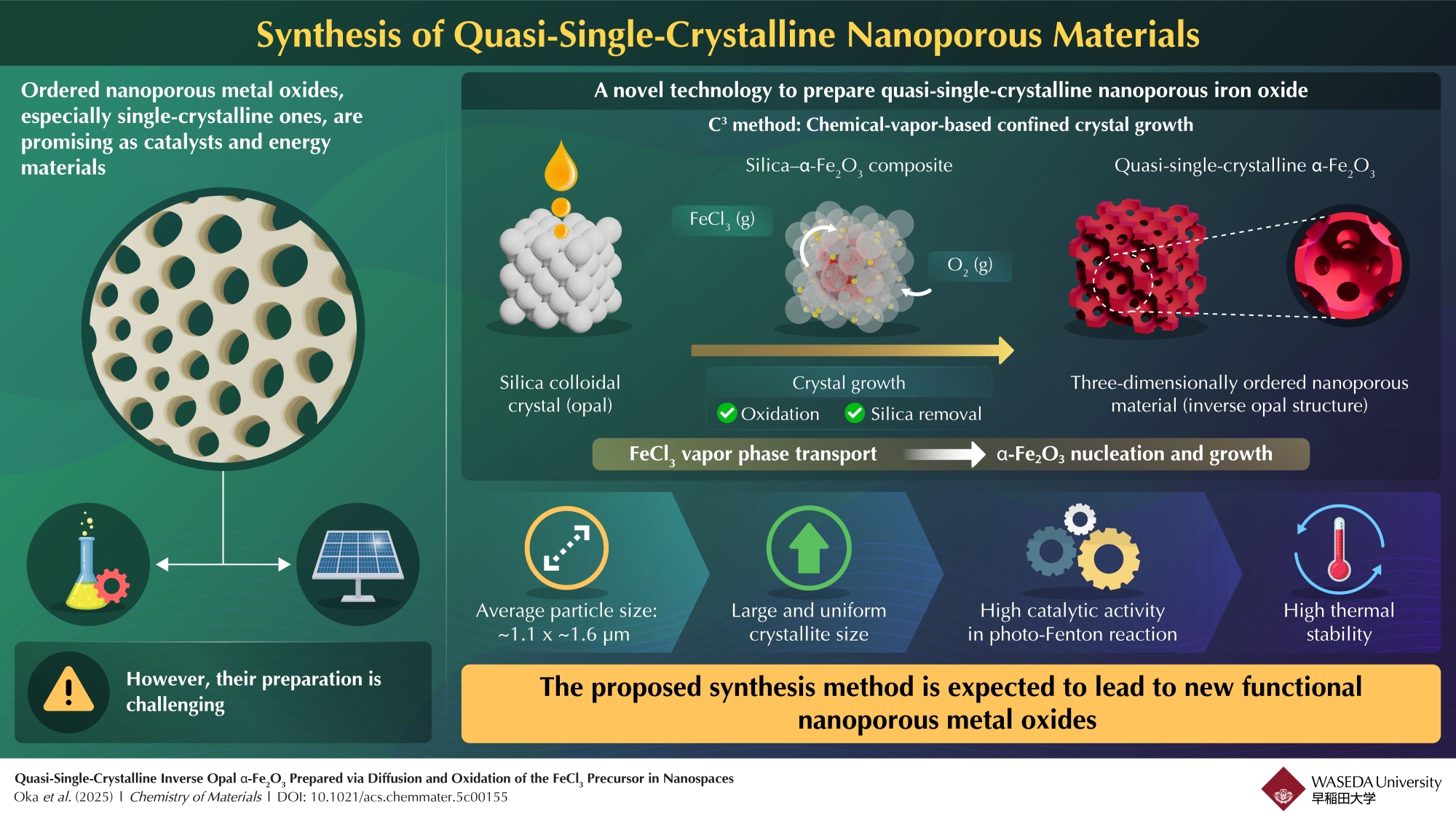
Nanoporous metal oxides have a wide variety of applications, such as catalysts, electrodes, energy materials, sensors, and biomaterials. Recently, a team of researchers has demonstrated a novel synthesis method for their efficient and desirable preparation. Specifically, they prepared difficult-to-prepare quasi-single-crystalline inverse opal α-Fe2O3, demonstrating that crystal growth occurs in nanospace due to volatilization and oxidation of metal chlorides. This technology is expected to fu...
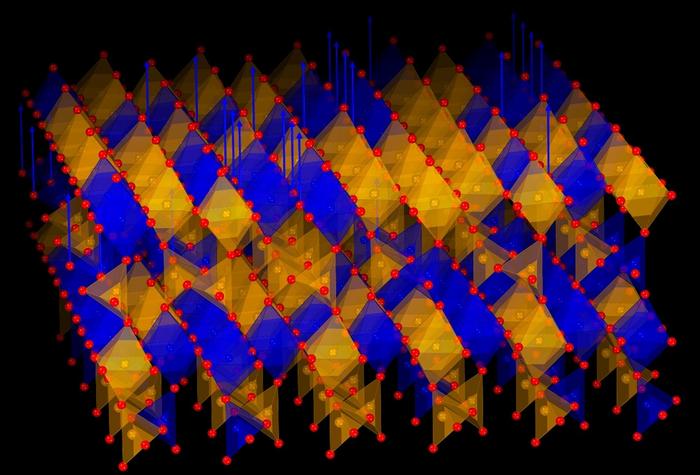
A team of scientists from Korea and Japan has discovered a new type of crystal that can "breathe"—releasing and absorbing oxygen repeatedly at relatively low temperatures. This unique ability could transform the way we develop clean energy technologies, including fuel cells, energy-saving windows, and smart thermal devices. The newly developed material is a special kind of metal oxide made of strontium, iron, and cobalt. What makes it extraordinary is that it can release oxygen when heated in...