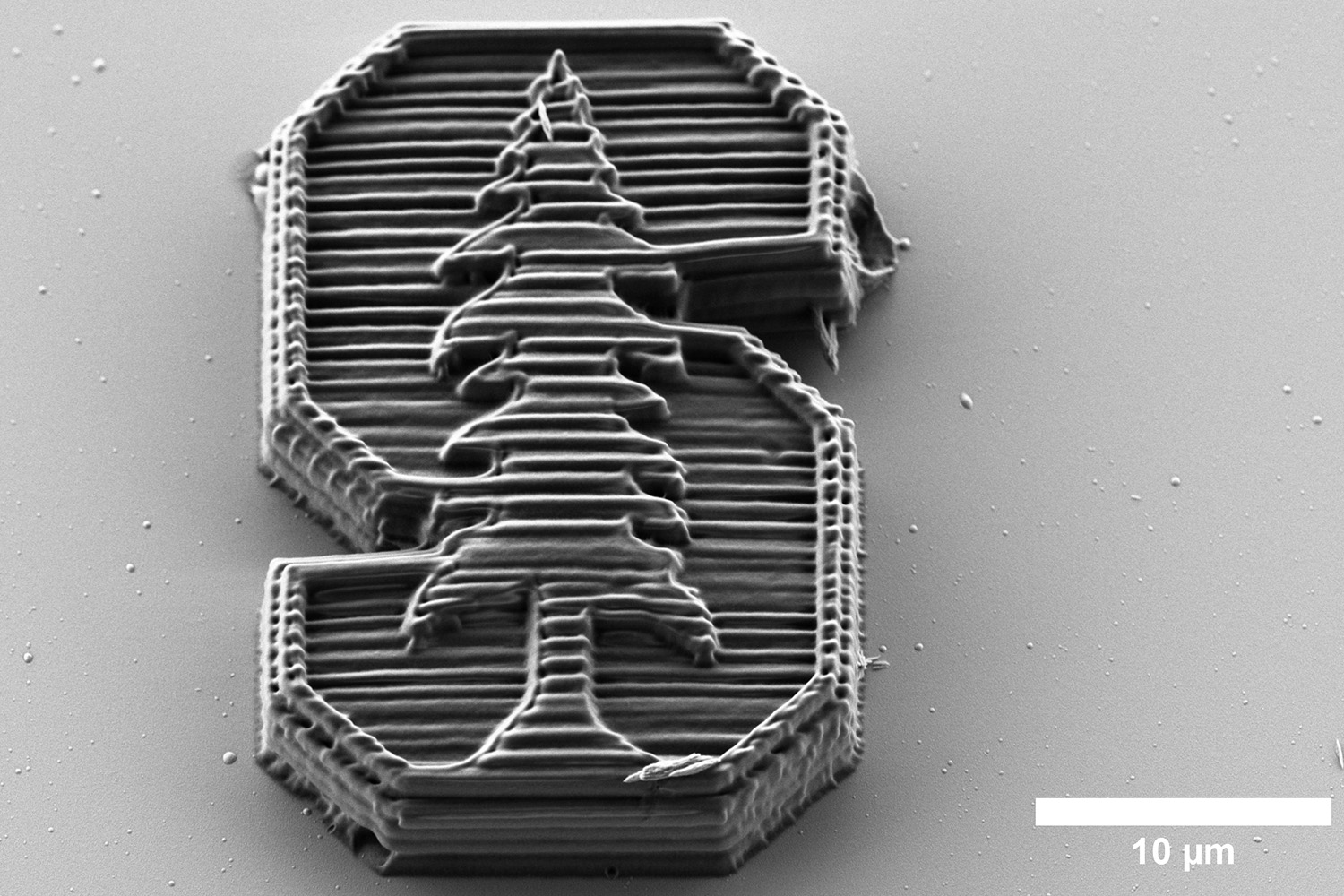
Science fiction envisions rapid 3D printing processes that can quickly create new objects out of any number of materials. But in reality, 3D printing is still limited in the properties and types of materials that are available for use, especially when printing at very small scales.
Researchers at Stanford have developed a new material for printing at the nanoscale – creating structures that are a fraction of the width of a human hair – and used it to print minuscule lattices that are both strong and light. In a paper published in Science, the researchers demonstrated that the new material is able to absorb twice as much energy than other 3D-printed materials of a comparable density. In the future, their invention could be used to create better lightweight protection for fragile pieces of satellites, drones, and microelectronics.
“There’s a lot of interest right now in designing different types of 3D structures for mechanical performance,” says Wendy Gu, an assistant professor of mechanical engineering and a corresponding author on the paper. “What we’ve done on top of that is develop a material that is really good at resisting forces, so it’s not just the 3D structure, but also the material that provides very good protection.”
Introducing metal nanoclusters
To design a better material for 3D printing, Gu and her colleagues incorporated metal nanoclusters – tiny clumps of atoms – into their printing medium. The researchers are printing with a method known as two-photon lithography, where the printing material is hardened through a chemical reaction initiated by laser light. They found that their nanoclusters were very good at jump-starting this reaction and resulted in a material that was a composite of the polymer printing medium and metal.
“The nanoclusters have very good properties for taking in the laser light, and then converting that to a chemical reaction,” Gu says. “And they’re able to do this with several classes of polymers, so they’re even more versatile than I expected.”
The researchers were able to combine metal nanoclusters with acrylates, epoxies, and proteins – several common classes of polymers that are used in 3D printing. Moreover, the nanoclusters helped to speed up the printing process. By combining the nanoclusters with proteins, for example, Gu and her colleagues were able to print at a rate of 100 millimeters per second, which is about 100 times faster than had previously been achieved in nanoscale protein printing.
The researchers tested their new material with several different lattice structures, prioritizing the ability to carry a heavy load in some and the ability to absorb an impact in others. With the nanocluster-polymer composite, all the structures demonstrated an impressive combination of energy absorption, strength, and recoverability – essentially the ability to squish and spring back.
“The lattice structure certainly matters, but what we’re showing here is that if the material it’s made out of is optimized, that’s more important for performance,” Gu says. “You don’t have to worry about exactly what the 3D structure is if you have the right materials to print with.”
Copying the natural world
In some ways, Gu and her colleagues are trying to mimic what nature has already perfected. Bone, for example, gets its resilience from the combination of a hard exterior, nanoscale porosity, and small amounts of soft material. This combination of a 3D structure and multiple, well-designed materials allows our bones to transfer energy without breaking (most of the time) and still remain relatively lightweight. Ideally, 3D-printed protective structures would also have multiple types of material within them, some harder and some softer, to better disperse an impact and resist crushing.
“Since the nanoclusters are able to polymerize these different classes of chemicals, we may be able to use them to print multiple materials in one structure,” Gu says. “That’s one thing we’d like to aim for.”
Reference
Mechanical nanolattices printed using nanocluster-based photoresists
Qi Li, John Kulikowski, David Doan, Ottman A. Tertuliano, Charles J. Zeman IV, Melody M. Wang, George C. Schatz, X. Wendy Gu
https://www.science.org/doi/10.1126/science.abo6997
Stanford University
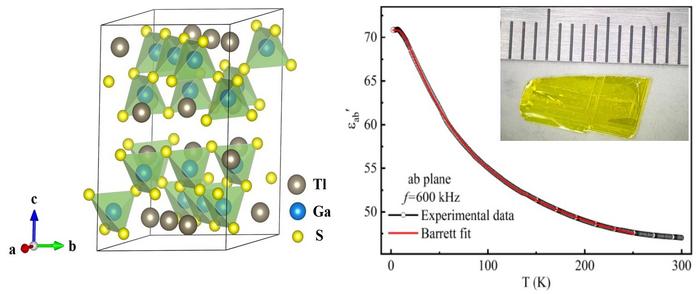
TlGaS2 single crystals show both in-plane and out-of-plane polarization, a rare combination in two-dimensional ferroelectrics that could widen options for ferroelectric transistors and non-volatile memory. Infrared spectroscopy revealed a soft phonon mode below 75 K, a signature tied to quantum ferroelectricity, along with weak structural changes across temperatures that lack clear heat-capacity signals, hinting at local rearrangements rather than conventional phase transitions.
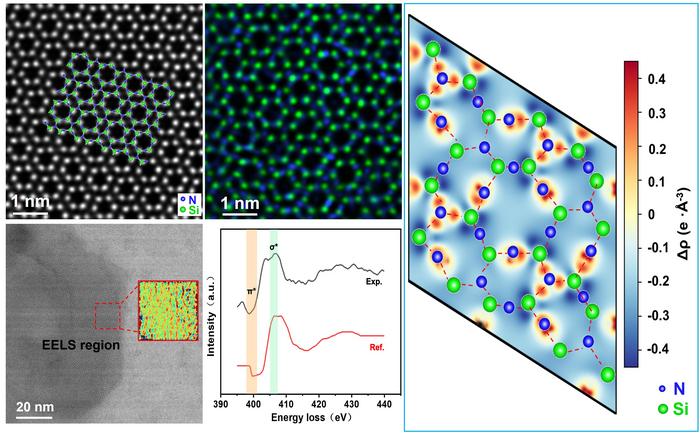
A β-Si3N4 nanolayer about 20 nm thick and continuous over several micrometers has been formed between carbon and silicon carbide without conventional oxide sintering additives, using a porous carbon framework infiltrated with molten silicon. Complementary atomic-resolution imaging resolved both silicon and nitrogen sublattices, confirming the ABAB stacking and corner-sharing tetrahedral network, while electron energy-loss spectroscopy and first-principles calculations linked the spectra to…
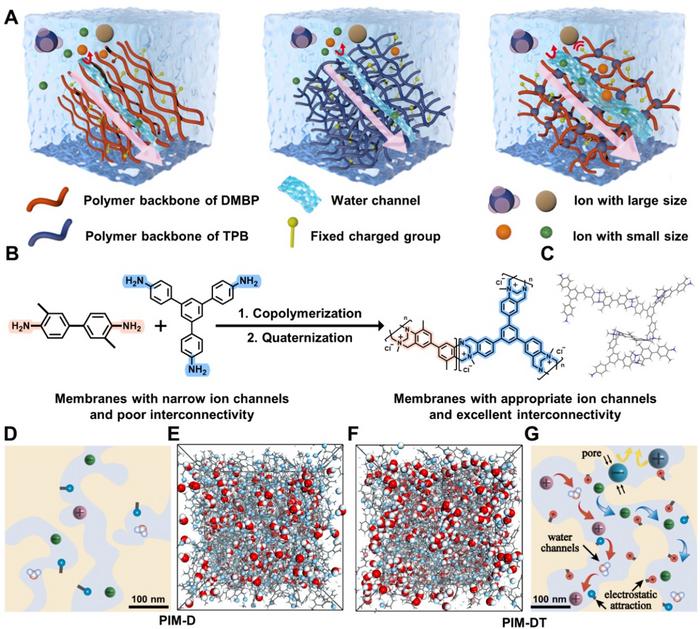
A polymer membrane with interconnected water-filled channels just 0.5 to 0.7 nanometers wide separates singly charged ions from multiply charged ones in both cationic and anionic systems. Built from Tröger's base-derived porous organic polymers, it cut the magnesium-to-lithium ratio in salt-lake brine roughly 500-fold across three electrodialysis stages, yielding 99.5 percent pure lithium carbonate, and enriched sodium chloride to 99.4 percent of ion mass from simulated seawater.
This week in nanotech
$751.8M raised
6 funding rounds · 37 deals tracked
New products
 Nion-compatible In Situ STEM Holders for Electrical BiasingHummingbird Scientific Featured
 Ti-WCMBN Nanomaterialia Featured
 Ionic® Purification SystemBionano Genomics, Inc.
Market insights
Last 30 days: Quantum Technologies drew the most money: $3.18B.
Money raised per month
Behind the deal
Who invested in Vertical Semiconductor’s $73M Grant?
See the investors with Insights Pro →