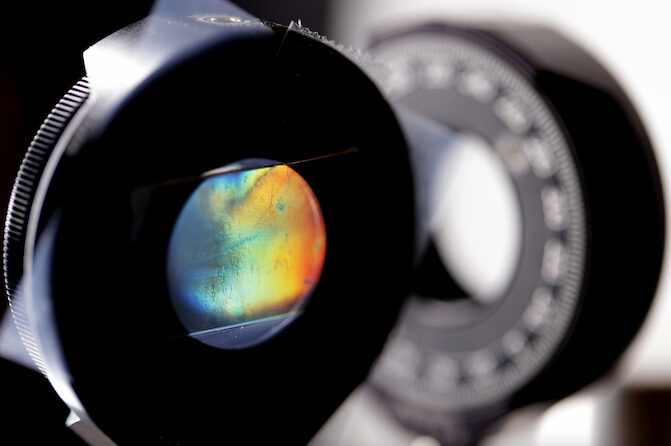
Imaging the hot turbulence of aircraft propulsion systems may now be possible with sturdy sheets of composite materials that twist light beams, according to research led by the University of Michigan and Air Force Research Laboratory.
The sheets were produced with a new manufacturing method that opens possibilities beyond aircraft design, as it enables new classes of materials to be used in polarization optics. While the team demonstrated high temperature tolerance, new mechanical, electrical and physical properties are expected to emerge as well—with potential applications in energy, sensors for vehicles and robots, and space exploration.
“Combining multiple functionalities into 2D materials opens up a world of possibilities,” said Dhriti Nepal, senior research materials engineer at the Air Force Research Laboratory and a co-corresponding author of the study published recently in Nature.
“Think of a butterfly’s wings, which allow it to fly, regulate temperature, and reflect light to produce specific colors for attracting mates and avoiding predators. This technique provides new design opportunities for creating multifunctional devices capable of anything one can imagine.”
The key is arranging nanomaterials that don’t twist light on their own onto layers that turn light waves into either left- or right-handed spirals, known as circular polarizations. In the aircraft example, turbulence created by the engine spins the light, which is then filtered through the material for imaging. Today, devices like LCD screens and thermochromic paints already control the twist and orientation of light waves using liquid crystals, but they melt not far above ambient temperatures.
“There could be situations in which you want to twist light outside the normal operating temperatures of liquid crystals. Now, we can make light-polarizing devices for those kinds of settings,” said Nicholas Kotov, the Irving Langmuir Distinguished University Professor of Chemical Sciences and Engineering at U-M and lead author of the study.
The new material can twist light at 250 degrees Celsius, and through the imaging of turbulence in aircraft engines and other applications, it could enable aerospace engineers to improve designs for better aircraft flight performance.
“Future aerospace systems continue to push the edge of technical feasibility. These low-cost optical materials afford modularity, which is crucial for optimizing solutions for a broad range of future technologies,” said Richard Vaia, materials and manufacturing chief scientist at the Air Force Research Laboratory and a corresponding author of the study.
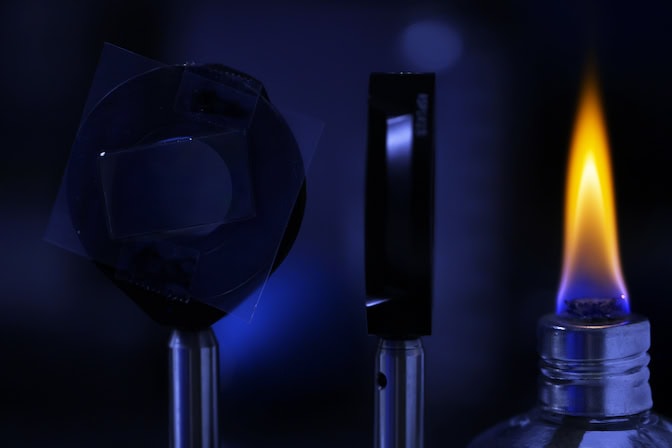
To make the materials, the researchers put microscopic grooves into a plastic sheet and covered it with several layers of tiny, flat particles with a diameter 10,000 times smaller than a millimeter. These particles were held in place with alternating layers of a molecular adhesive, and they could be made from any material that can be made into flat nanoparticles. For their heat-tolerant materials, the researchers used ceramic-like materials called MXenes.
As light moves through the material, it divides into two beams, one with horizontally oscillating waves and another with vertically oscillating waves. The vertical waves pass through faster than the horizontal waves. As a result, the waves exit out of phase and appear as a spiral of light. The angle of the grooves determines the direction in which the light spirals, and layers of silver nanowires can help ensure the light spirals solely to the left or right.
“Our calculations suggest that the optical properties didn’t come from the nanoplates themselves, but from their orientation on the grooves caused by our fabrication process,” said André Farias de Moura, associate professor of chemistry at the Federal University of São Carlos and a co-corresponding author of the study.
Reference
Nano-achiral complex composites for extreme polarization optics
Jun Lu, Wenbing Wu, Felippe Mariano Colombari, Ali Jawaid, Bryan Seymour, Kody Whisnant, Xiaoyang Zhong, Wonjin Choi, Joerg Lahann, Richard A. Vaia, André Farias de Moura, Dhriti Nepal & Nicholas A. Kotov
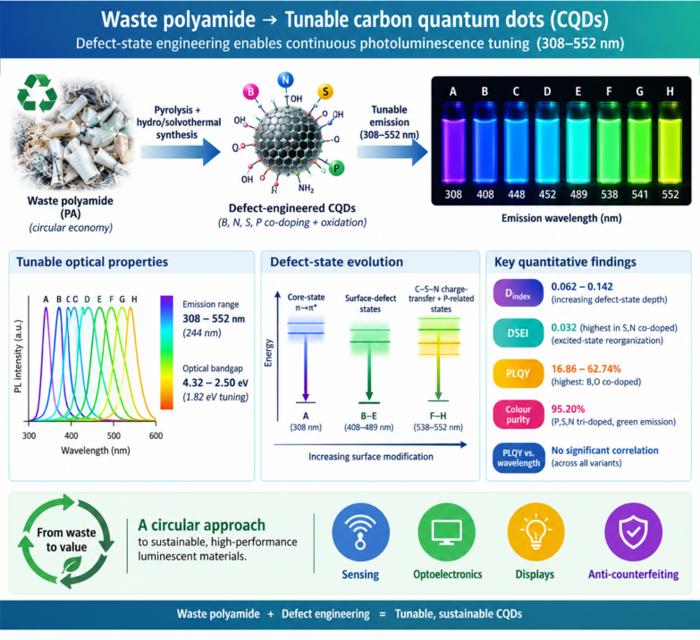
Waste polyamide-derived CQDs show continuous photoluminescence tuning from 308 to 552 nm through sequential defect-state engineering, with optical transition energies decreasing from 4.32 to 2.50 eV. @Christian Ebere Enyoh from Saitama University Carbon quantum dots (CQDs) are fluorescent carbon nanomaterials with potential applications in sensing, optoelectronics, displays, anti-counterfeiting, and environmental technologies. Their optical properties can be adjusted by modifying the carbon...
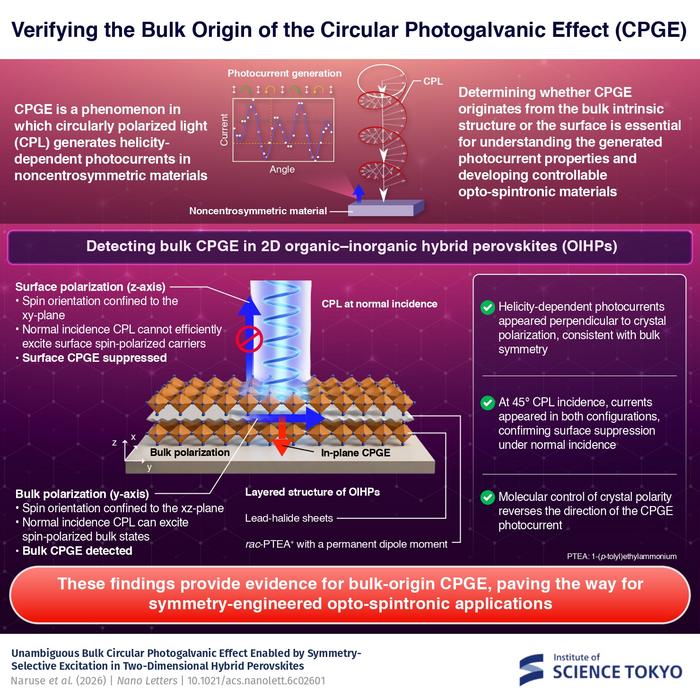
The researchers used circularly polarized light at normal incidence and found that helicity-dependent photocurrents appeared perpendicular to the crystal’s polarization but vanished when measured parallel to it, supporting a bulk origin of CPGE. @Institute of Science Tokyo The circular photogalvanic effect (CPGE), a phenomenon that generates helicity-dependent photocurrents in noncentrosymmetric materials, can originate purely from a crystal's internal structure without contribution from the...
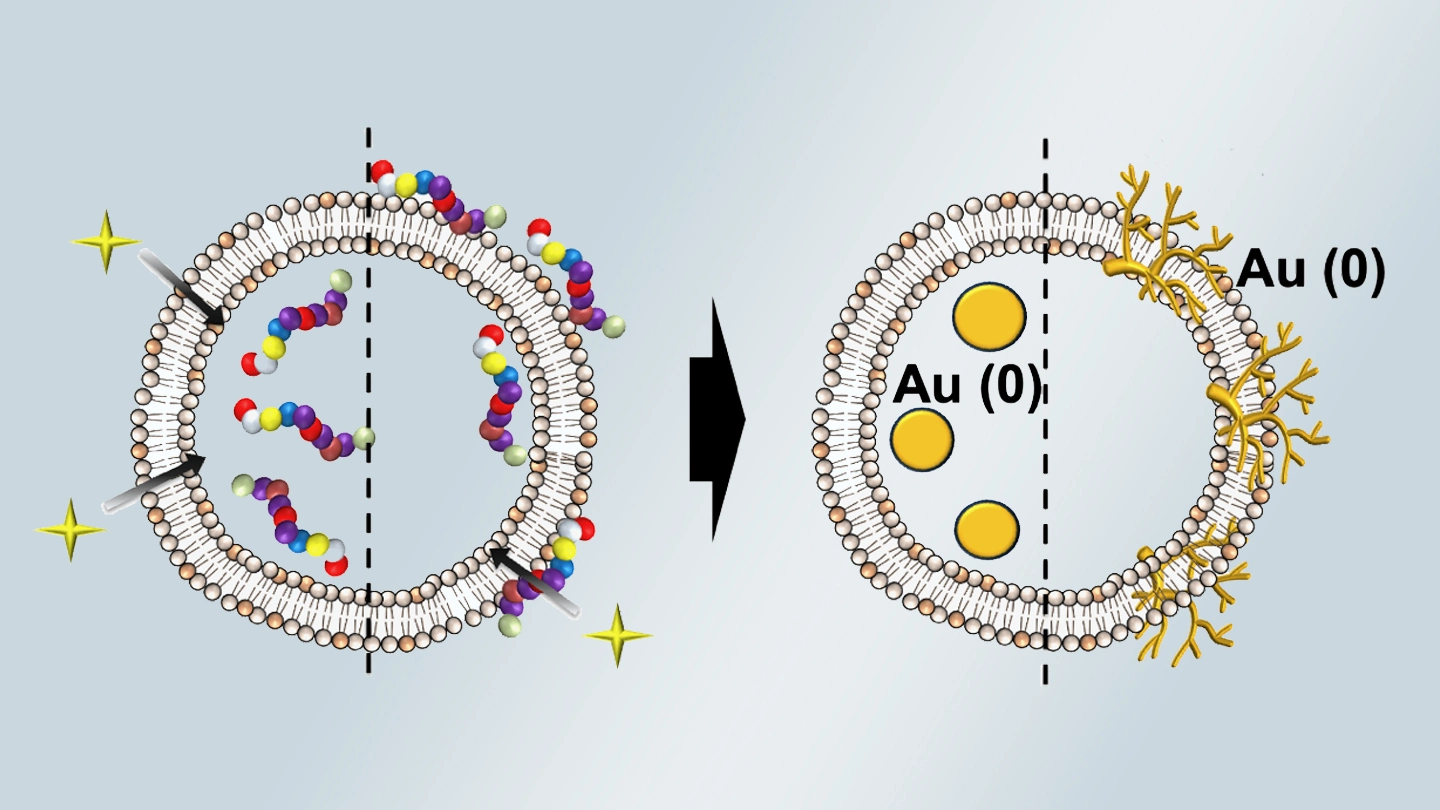
Summary of gold nanoparticle growth programming in liposome based on localization of biomineralization peptide The position of biomineralization peptides within liposomes can influence how gold nanoparticles grow, reports a research team from Institute of Science Tokyo. Peptides localized at the membrane interface promote branched structures, while those confined to the liposome interior favor spherical nanoparticles. The findings offer a new strategy for controlling nanoscale reaction...
