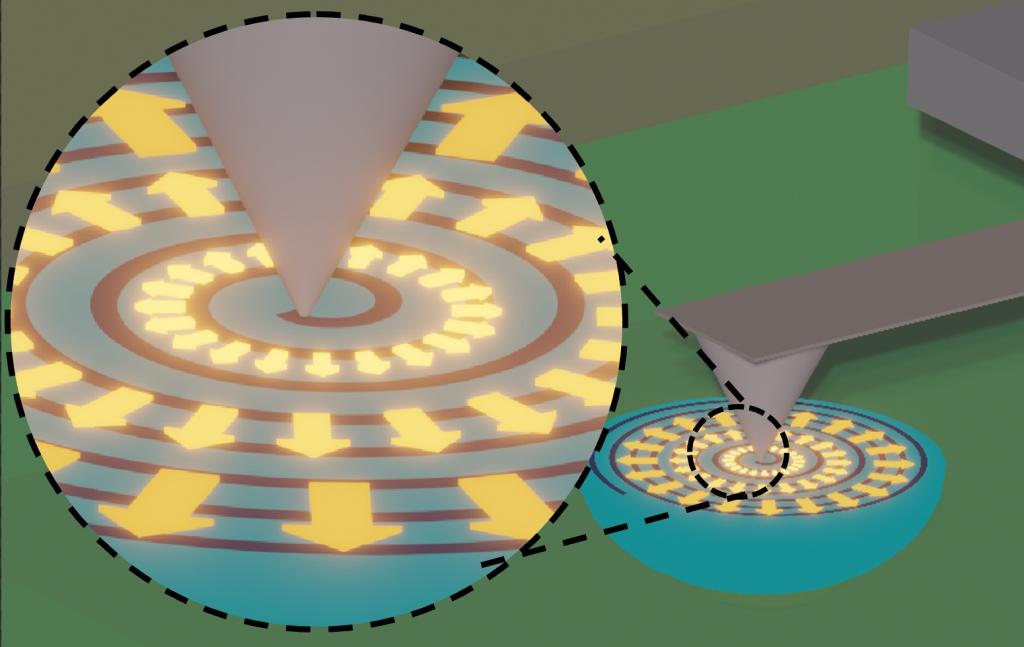
Next-generation technologies, such as leading-edge memory storage solutions and brain-inspired neuromorphic computing systems, could touch nearly every aspect of our lives — from the gadgets we use daily to the solutions for major global challenges. These advances rely on specialized materials, including ferroelectrics — materials with switchable electric properties that enhance performance and energy efficiency. A research team led by scientists at the Department of Energy’s Oak Ridge National Laboratory has developed a novel technique for creating precise atomic arrangements in ferroelectrics, establishing a robust framework for advancing powerful new technologies.
“Local modification of the atoms and electric dipoles that form these materials is crucial for new information storage, alternative computation methodologies or devices that convert signals at high frequencies,” said ORNL’s Marti Checa, the project’s lead researcher. “Our approach fosters innovations by facilitating the on-demand rearrangement of atomic orientations into specific configurations known as topological polarization structures that may not naturally occur.” In this context, polarization refers to the orientation of small, internal permanent electric fields in the material that are known as ferroelectric dipoles.
To create complex structures that can be activated as needed, the team’s technique uses an electric stylus that functions like a superfine pencil. The stylus can effortlessly alter electric dipoles in ferroelectrics by orienting them in selected directions, much like how children create images on magnetic drawing boards.
Just as a city’s layout shapes the way people navigate it, designed topological structures impart distinctive properties to materials. The stylus presents exciting opportunities for creating materials with tailored characteristics ideal for low-power nanoelectronics and the high-speed broadband communications essential for the 6G era.
Transitioning from the 5G standard to the sixth generation of mobile communication technology will involve significant advances and transformations in the design and usage of communication networks. Broadband and computing technologies are intricately linked, each enhancing the performance of the other. Therefore, innovative materials will play a crucial role in broadening the possibilities for computing.
Upcoming nanoelectronic advances
Today’s classical computers communicate in a straightforward language of “yes” and “no,” represented by ones and zeros. This binary system relies on the flow of electricity through tiny circuits. However, this dual-choice framework is limiting and energy intensive because of the demands of writing and reading data.
By contrast, topological polarization structures can rapidly and effectively alter their polarization states, providing high stability with low energy consumption for switching. This swift change in polarization enhances the value of ferroelectrics, improving speed, efficiency and versatility across various devices. Furthermore, they allow for data retention without power, paving the way for the development of high-density, energy-efficient computing systems.
Scientists are exploring materials that can process information faster, as required by 6G-era broadband communications. These structures can also be exploited in devices that operate at high frequencies, thanks to intrinsic sub-terahertz resonances, which are natural oscillations or vibrations within a material or system that occur at frequencies below one terahertz — one trillion hertz.
Such progress could significantly enhance the processing power and efficiency of future computing systems, enabling them to solve more complex problems and perform tasks with greater adaptability and speed — capabilities that classical computers struggle to achieve.
Finally, these structures allow for the precise control of electronic and optical properties and thus could be used for tunable optoelectronic devices. A combination of unique electrical, mechanical and thermal properties makes ferroelectrics highly suitable for neuromorphic computing and other new technologies.
Swift polarization shifts, superdomain dynamics
The ORNL-led research unveiled how an advanced ferroelectric ceramic material commonly known as PSTO switches its polarization in a multistep process, guided by the electrical stylus. PSTO, or lead strontium titanate, is elementally composed of lead, strontium, titanium and oxygen.
A concept called the trailing field is commonly used to explain why ferroelectrics reorient their tiny electric dipoles — small positive and negative charges — in the plane of the material in response to an electric field moving along the surface.
However, the research team proposed as an alternative the existence of an intermediate out-of-plane state to describe the phase that occurs while the material is transitioning from one polarization state to another. This phase is a brief shift in polarization direction that occurs when the vertical part of an electric field momentarily orients the electric dipoles out of the plane of the surface when polarization changes in a thin layer of ferroelectric material.
The scientists’ insight about the intermediate out-of-plane state has enabled the precise, on-demand manipulation of superdomain structures. Superdomain structures are large-scale patterns of tiny regions within ferroelectric materials such as PSTO, each with a different alignment of electric dipoles. Superdomain structures are important because they affect how well the materials perform in various applications by influencing their overall behavior and properties.
This study also demonstrated the ability to examine the delicate balance between elastic and electrostatic energy. Ferroelectrics have both mechanical (elastic) and electrical (electrostatic) energy interactions, which influence each other. For example, changing the shape of a ferroelectric can affect its electrical properties, and vice versa. Studying this balance helps researchers understand how to control the material’s behavior more precisely.
Additionally, the researchers explored the accommodation of frustrated superboundaries — areas where different regions with dissimilar electric properties meet in the material. These boundaries cannot easily align or adjust to minimize energy expenditure because of conflicting forces or constraints and thus rarely occur in nature. However, the on-demand creation of new topological polarization structures enables researchers to stabilize these frustrated superboundaries and study their singular properties.
Prediction, control with nanoscale accuracy
By integrating structural and functional data about the ferroelectric material gathered from correlative microscopy techniques, the researchers created detailed phase-field models that predict how the material will behave under various conditions. This capability facilitates understanding and optimizing the stability and polarization of the material.
“Our project has developed advanced methods to precisely pattern materials at the nanoscale,” Checa said. “By combining specially designed electric stylus tip movements with automated experimental setups, we’ve demonstrated the ability to explore new and complex states of ferroelectric materials that weren’t accessible before. A key aspect of this accomplishment is that it allows for a better understanding and control of these materials’ unique properties.”
Reference
On-demand nanoengineering of in-plane ferroelectric topologies
Marti Checa, Bharat Pant, Alexander Puretzky, Bogdan Dryzhakov, Rama K. Vasudevan, Yongtao Liu, Pravin Kavle, Arvind Dasgupta, Lane W. Martin, Ye Cao, Liam Collins, Stephen Jesse, Neus Domingo & Kyle P. Kelley
https://www.nature.com/articles/s41565-024-01792-1
Oak Ridge National Laboratory
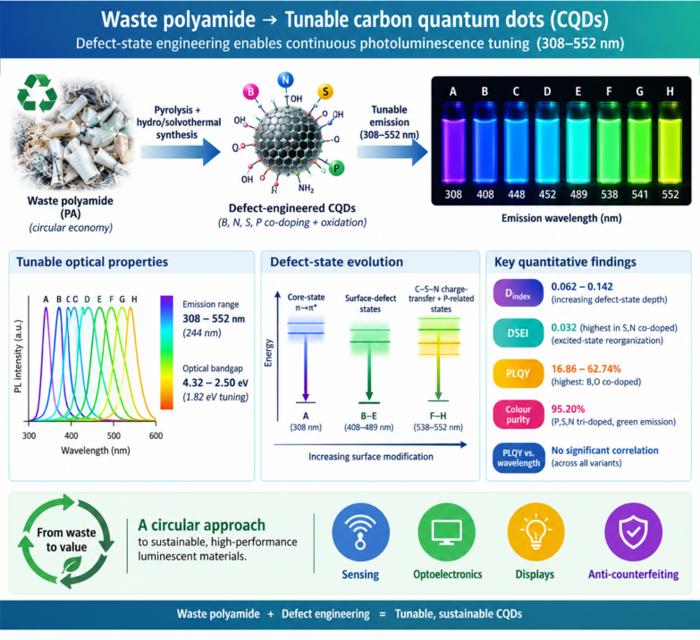
Waste polyamide-derived CQDs show continuous photoluminescence tuning from 308 to 552 nm through sequential defect-state engineering, with optical transition energies decreasing from 4.32 to 2.50 eV. @Christian Ebere Enyoh from Saitama University Carbon quantum dots (CQDs) are fluorescent carbon nanomaterials with potential applications in sensing, optoelectronics, displays, anti-counterfeiting, and environmental technologies. Their optical properties can be adjusted by modifying the carbon...
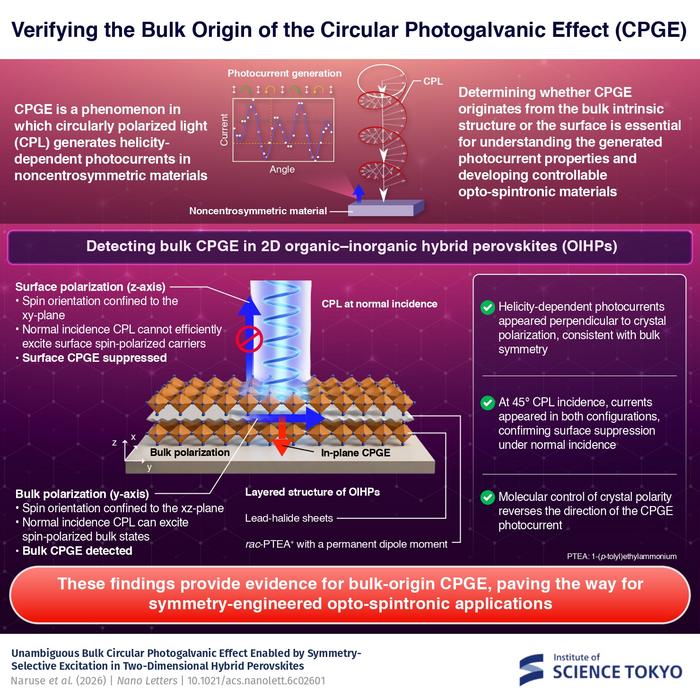
The researchers used circularly polarized light at normal incidence and found that helicity-dependent photocurrents appeared perpendicular to the crystal’s polarization but vanished when measured parallel to it, supporting a bulk origin of CPGE. @Institute of Science Tokyo The circular photogalvanic effect (CPGE), a phenomenon that generates helicity-dependent photocurrents in noncentrosymmetric materials, can originate purely from a crystal's internal structure without contribution from the...
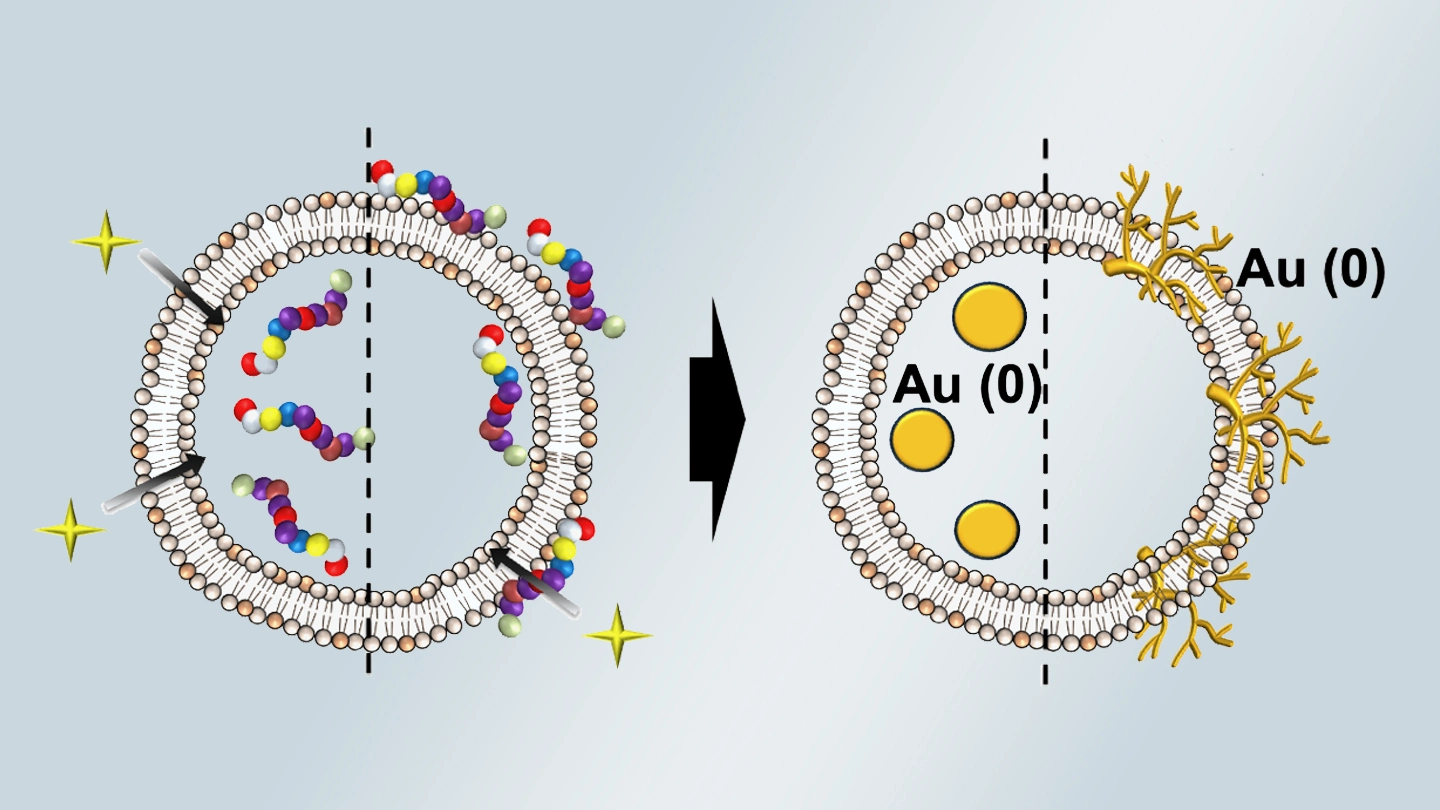
Summary of gold nanoparticle growth programming in liposome based on localization of biomineralization peptide The position of biomineralization peptides within liposomes can influence how gold nanoparticles grow, reports a research team from Institute of Science Tokyo. Peptides localized at the membrane interface promote branched structures, while those confined to the liposome interior favor spherical nanoparticles. The findings offer a new strategy for controlling nanoscale reaction...
