University of Massachusetts Amherst (UMass Amherst)
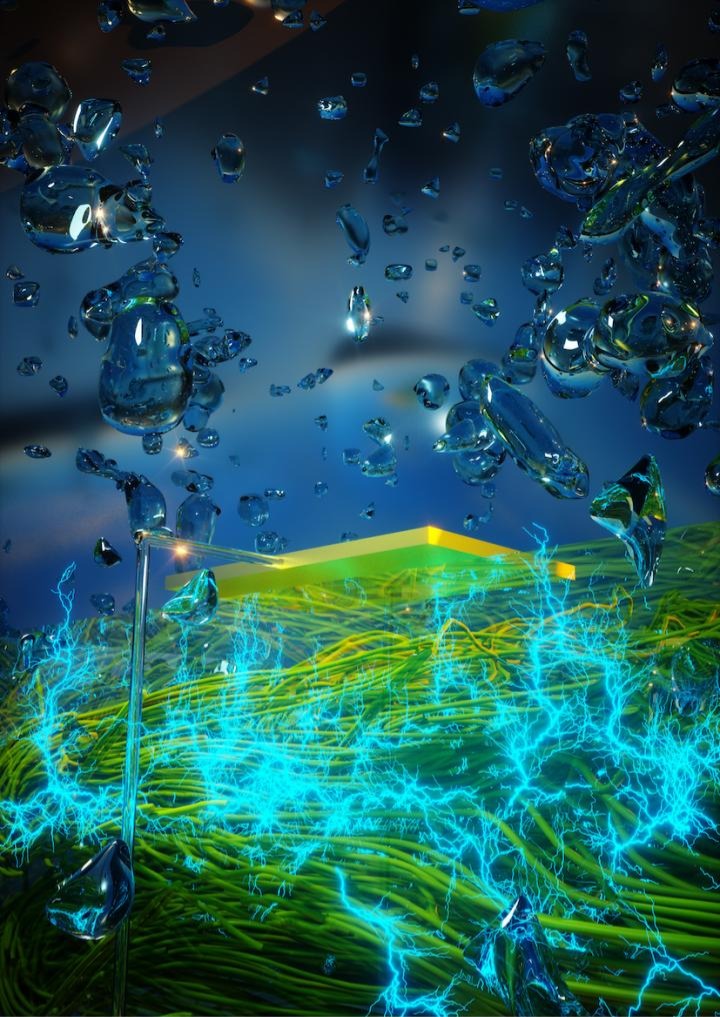
Scientists at the University of Massachusetts Amherst have developed a device that uses a natural protein to create electricity from moisture in the air, a new technology they say could have significant implications for the future of renewable energy, climate change and in the future of medicine.
As reported today in Nature, the laboratories of electrical engineer Jun Yao and microbiologist Derek Lovley at UMass Amherst have created a device they call an “Air-gen.” or air-powered generator, with electrically conductive protein nanowires produced by the microbe Geobacter. The Air-gen connects electrodes to the protein nanowires in such a way that electrical current is generated from the water vapor naturally present in the atmosphere.
“We are literally making electricity out of thin air,” says Yao. “The Air-gen generates clean energy 24/7.” Lovely, who has advanced sustainable biology-based electronic materials over three decades, adds, “It’s the most amazing and exciting application of protein nanowires yet.”
The new technology developed in Yao’s lab is non-polluting, renewable and low-cost. It can generate power even in areas with extremely low humidity such as the Sahara Desert. It has significant advantages over other forms of renewable energy including solar and wind, Lovley says, because unlike these other renewable energy sources, the Air-gen does not require sunlight or wind, and “it even works indoors.”
The Air-gen device requires only a thin film of protein nanowires less than 10 microns thick, the researchers explain. The bottom of the film rests on an electrode, while a smaller electrode that covers only part of the nanowire film sits on top. The film adsorbs water vapor from the atmosphere. A combination of the electrical conductivity and surface chemistry of the protein nanowires, coupled with the fine pores between the nanowires within the film, establishes the conditions that generate an electrical current between the two electrodes.
The researchers say that the current generation of Air-gen devices are able to power small electronics, and they expect to bring the invention to commercial scale soon. Next steps they plan include developing a small Air-gen “patch” that can power electronic wearables such as health and fitness monitors and smart watches, which would eliminate the requirement for traditional batteries. They also hope to develop Air-gens to apply to cell phones to eliminate periodic charging.
Yao says, “The ultimate goal is to make large-scale systems. For example, the technology might be incorporated into wall paint that could help power your home. Or, we may develop stand-alone air-powered generators that supply electricity off the grid. Once we get to an industrial scale for wire production, I fully expect that we can make large systems that will make a major contribution to sustainable energy production.”
Continuing to advance the practical biological capabilities of Geobacter, Lovley’s lab recently developed a new microbial strain to more rapidly and inexpensively mass produce protein nanowires. “We turned E. coli into a protein nanowire factory,” he says. “With this new scalable process, protein nanowire supply will no longer be a bottleneck to developing these applications.”
The Air-gen discovery reflects an unusual interdisciplinary collaboration, they say. Lovley discovered the Geobacter microbe in the mud of the Potomac River more than 30 years ago. His lab later discovered its ability to produce electrically conductive protein nanowires. Before coming to UMass Amherst, Yao had worked for years at Harvard University, where he engineered electronic devices with silicon nanowires. They joined forces to see if useful electronic devices could be made with the protein nanowires harvested from Geobacter.
Xiaomeng Liu, a Ph.D. student in Yao’s lab, was developing sensor devices when he noticed something unexpected. He recalls, “I saw that when the nanowires were contacted with electrodes in a specific way the devices generated a current. I found that that exposure to atmospheric humidity was essential and that protein nanowires adsorbed water, producing a voltage gradient across the device.”
In addition to the Air-gen, Yao’s laboratory has developed several other applications with the protein nanowires. “This is just the beginning of new era of protein-based electronic devices” said Yao.
The research was supported in part from a seed fund through the Office of Technology Commercialization and Ventures at UMass Amherst and research development funds from the campus’s College of Natural Sciences.
Power generation from ambient humidity using protein nanowires
Xiaomeng Liu, Hongyan Gao, Joy E. Ward, Xiaorong Liu, Bing Yin, Tianda Fu, Jianhan Chen, Derek R. Lovley & Jun Yao
Nature volume 578, pages 550–554 (2020)
DOI: 10.1038/s41586-020-2010-9
Contact information:
Jun Yao
UMass Amherst Assistant Professor of BME
juny@umass.edu
Phone: (413) 545-3324
Derek Lovley
UMass Amherst Professor of Microbiology
dlovley@microbio.umass.edu
Phone: (413) 348-4936
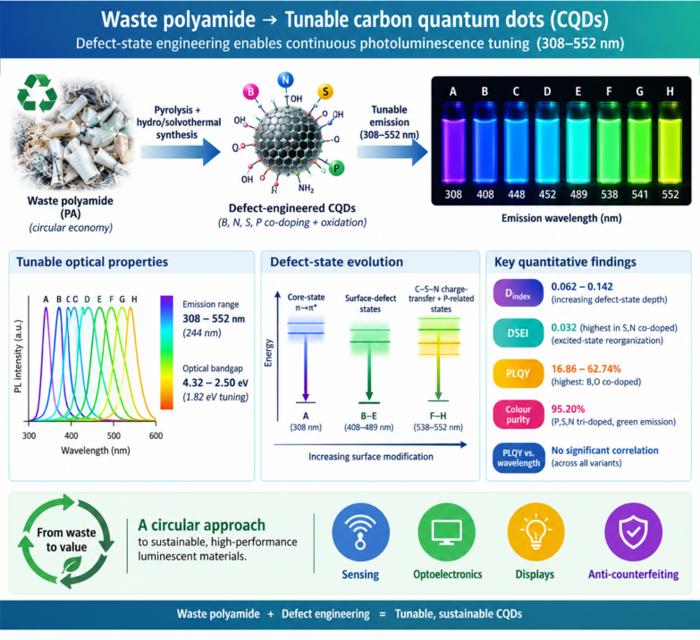
Waste polyamide-derived CQDs show continuous photoluminescence tuning from 308 to 552 nm through sequential defect-state engineering, with optical transition energies decreasing from 4.32 to 2.50 eV. @Christian Ebere Enyoh from Saitama University Carbon quantum dots (CQDs) are fluorescent carbon nanomaterials with potential applications in sensing, optoelectronics, displays, anti-counterfeiting, and environmental technologies. Their optical properties can be adjusted by modifying the carbon...
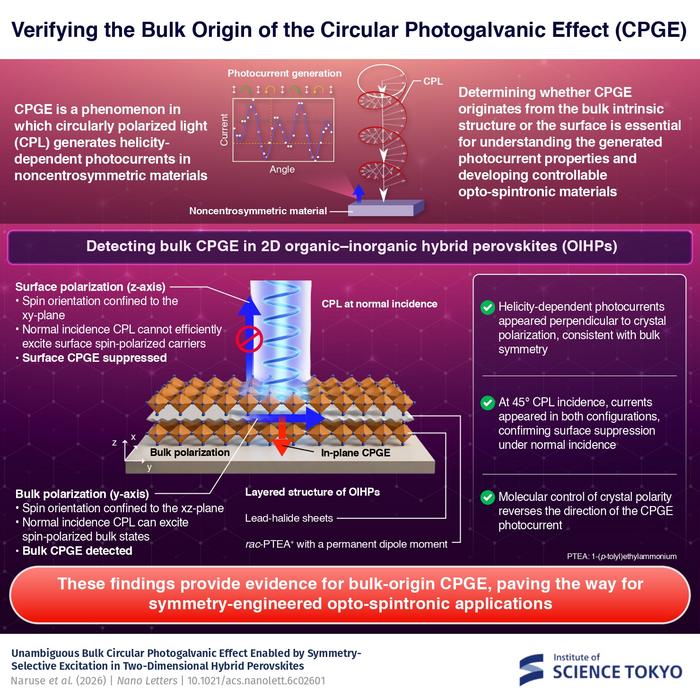
The researchers used circularly polarized light at normal incidence and found that helicity-dependent photocurrents appeared perpendicular to the crystal’s polarization but vanished when measured parallel to it, supporting a bulk origin of CPGE. @Institute of Science Tokyo The circular photogalvanic effect (CPGE), a phenomenon that generates helicity-dependent photocurrents in noncentrosymmetric materials, can originate purely from a crystal's internal structure without contribution from the...
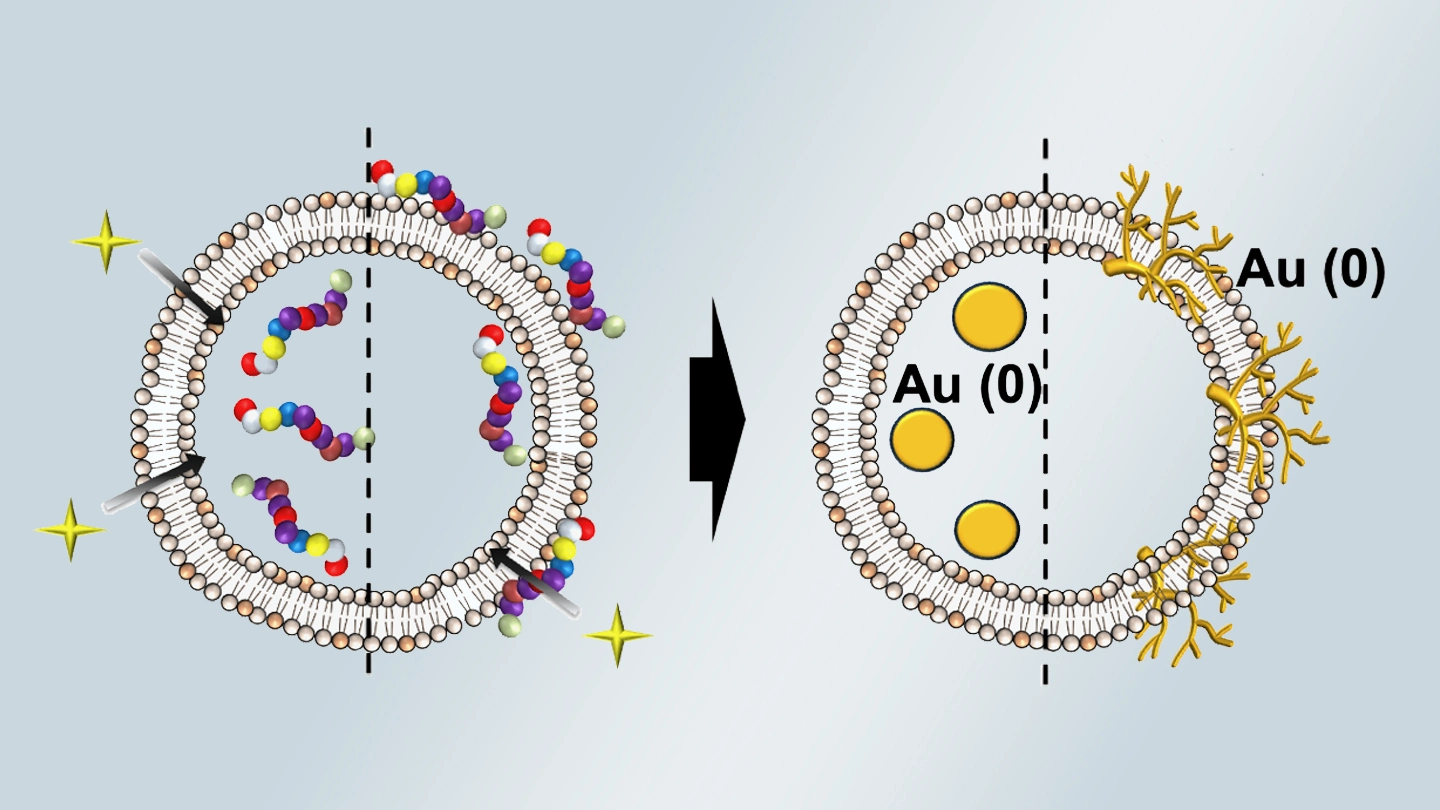
Summary of gold nanoparticle growth programming in liposome based on localization of biomineralization peptide The position of biomineralization peptides within liposomes can influence how gold nanoparticles grow, reports a research team from Institute of Science Tokyo. Peptides localized at the membrane interface promote branched structures, while those confined to the liposome interior favor spherical nanoparticles. The findings offer a new strategy for controlling nanoscale reaction...
