Quantum computing harnesses enigmatic properties of small particles to process complex information. But quantum systems are fragile and error-prone, and useful quantum computers have yet to come to fruition.
Researchers in the Quantum Dynamics Unit at the Okinawa Institute of Science and Technology Graduate University (OIST) devised a new method — called image charge detection — to detect electrons’ transitions to quantum states. Electrons can serve as quantum bits, the smallest unit of quantum information; these bits are foundational to larger computational systems. Quantum computers may be used to understand the mechanism of superconductivity, cryptography, artificial intelligence, among other applications.
“There is a huge gap between controlling few quantum bits and building a quantum computer,” said Dr. Erika Kawakami, the lead author of a new study, published in Physical Review Letters with editor’s suggestion. “With the current state-of-art quantum bits, a quantum computer would need to be the size of a football field. Our new approach could potentially create a ten-centimeter chip.”
A New Potential for Electrons on Helium
Electrons need to be immobilized to serve as quantum bits; otherwise they move freely. To create an electron-capturing system, the researchers used liquid helium, which liquefies at cold temperatures, as a substrate. Since helium is free of impurities, these electrons are expected to retain quantum states longer than in any other materials, which is important for realizing a quantum computer.
Prof. Denis Konstantinov and his collaborators, Kawakami and Dr. Asem Elarabi, placed a parallel-plate capacitor inside of a copper cell cooled to 0.2 degrees Kelvin (-272.8 degrees Celsius) and filled with condensed liquid helium. Electrons generated by a tungsten filament sat atop the liquid helium’s surface, between the two capacitor plates. Then, microwave radiation introduced into the copper cell excited electrons’ quantum states, causing the electrons to move away from the bottom capacitor plate and come closer to the top capacitor plate.
The researchers confirmed the excitation of quantum states by observing an electrostatic phenomenon called image charge. Like a reflection in a mirror, image charge precisely reflects the movement of electrons. If an electron moves further from the capacitor plate, then the image charge moves alongside it.
Moving forward, the researchers hope to use this image charge detection to measure an individual electron’s spin state, or quantum orbital state, without disrupting the integrity of the quantum systems.
“Currently, we can detect the quantum states of an ensemble of many electrons,” Konstantinov said. “The strong point of this new method is that we can scale down this technique to a single electron and to use it as a quantum bit.”
Image-Charge Detection of the Rydberg States of Surface Electrons on Liquid Helium
Erika Kawakami, Asem Elarabi, and Denis Konstantinov
Phys. Rev. Lett. 123, 086801 – Published 19 August 2019

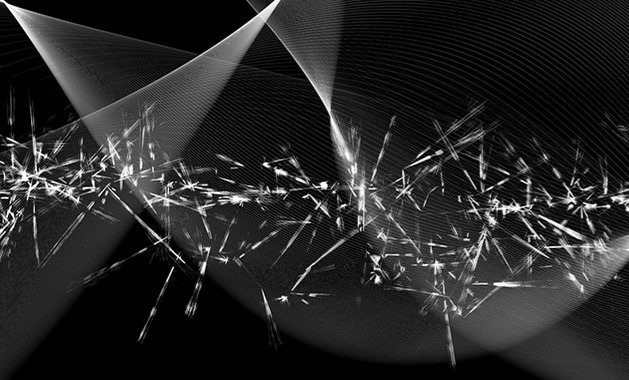
A quantum "wave packet" (in the middle) launched from the same kind of starting point behaves differently. Even after bouncing around for a very long time, faint filament-like patterns (bright glow) are still visible, a tattoo tracing back to its early history. This lingering imprint is the "quantum birthmark" described in the study. Credit: Joonas Keski-Rahkonen, Tampere University Even the most chaotic quantum systems keep a permanent mark of their own past – a "quantum birthmark" – that...
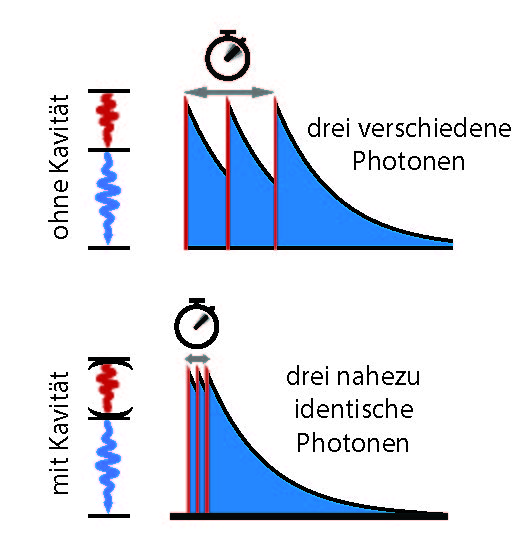
Illustration (University of Basel, Timon Baltisberger): Biexziton decay can generate photons of very high quality if the system is specifically controlled using an optical cavity. Under these conditions, 90 per cent of the photons are indistinguishable. Working in close collaboration, researchers from Paderborn University, the University of Basel and Ruhr University Bochum have made a significant breakthrough in the field of quantum communication. In their recently published paper in the...
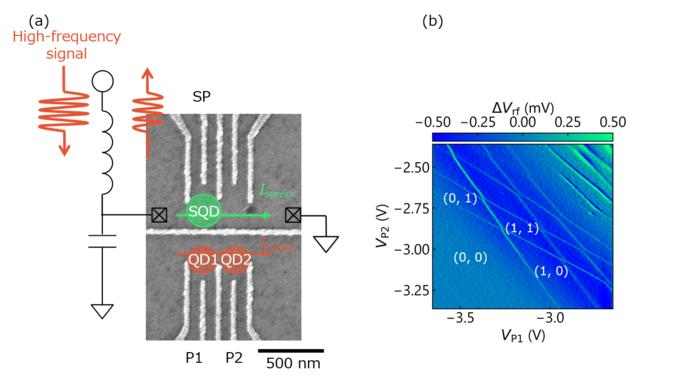
(a) The structure of the gate electrodes on the ZnO device used in the experiment in this paper. (b) The charge stability diagram indicating the formation of ZnO double quantum dot in few-electron regime. Researchers at Tohoku University, in collaboration with the National Institute for Materials Science (NIMS) and the University of Tokyo, have taken an important step toward semiconductor quantum computing using zinc oxide (ZnO). The team successfully demonstrated charge sensing,...
