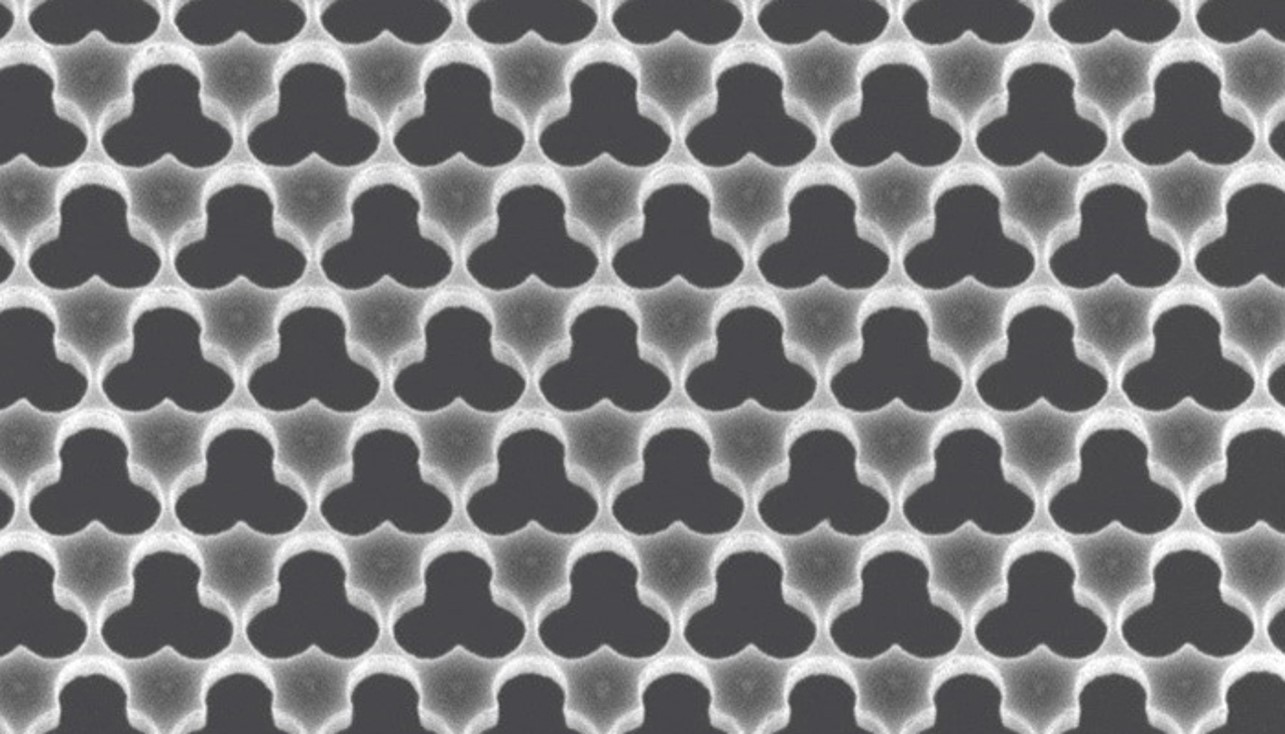
A study led by researchers from the Catalan Institute of Nanoscience and Nanotechnology (ICN2, Barcelona) proposes an innovative way to engineer the structure of nanomaterials, which dampens the mechanical vibrations that negatively affect nanometre-scale structures. This finding, published in the journal ‘Nature Nanotechnology’, represents a simple and energy-efficient solution to the problem of vibrations in solids and could have numerous applications in the field of nanotechnology, quantum computing, opto-mechanics, signal processing, and biosensors.
"Very small solid objects, at the nanoscale, are highly sensitive to vibrations generated by thermal energy, and that is a problem for nanotechnology,” explains CSIC researcher Dr David García, formerly a member of the ICN2 Phononic and Photonic Nanostructures Group and currently a researcher at the Materials Science Institute of Madrid (ICMM-CSIC). “At present,” continues García, “a lot of energy and money is spent to solve it because very low-temperature cooling techniques are used to control vibrations. We have managed to achieve it in a much simpler way: by making the materials with a clover-shaped geometric structure we can eliminate these vibrations in a specific frequency range.”
By fabricating a silicon membrane with a simple geometric pattern similar to a clover, the authors of this study were able to create destructive interferences that cancel out the mechanical vibrations in a wide range of energies without the need to cool the material. This kind of structure could be an excellent platform to realise phononic waveguides because the vibration control allows the guiding of phononic waves in a specific fashion. Moreover, since the patterned membranes were fabricated in a silicon-on-insulator surface, as modern chips, integration with current electronic and photonic technologies could be seamless.
The geometric pattern can be adapted to cope with vibrations at different energies: by reducing or enlarging the connection between the clover structures composing the geometry, the range of vibration frequencies cancelled out can be modified. This allows tuning the design to different applications, depending on the critical frequencies. While previous works had approached vibration suppression at lower frequencies, this research is the first reported experimental evidence of complete elimination of mechanical vibration at “hypersonic” frequencies, i.e., above 1 GHz. The effects of this geometry were studied by means of the non-invasive and non-destructive technique called Brillouin scattering.
Reference
Engineering nanoscale hypersonic phonon transport
O. Florez, G. Arregui, M. Albrechtsen, R. C. Ng, J. Gomis-Bresco, S. Stobbe, C. M. Sotomayor-Torres & P. D. García
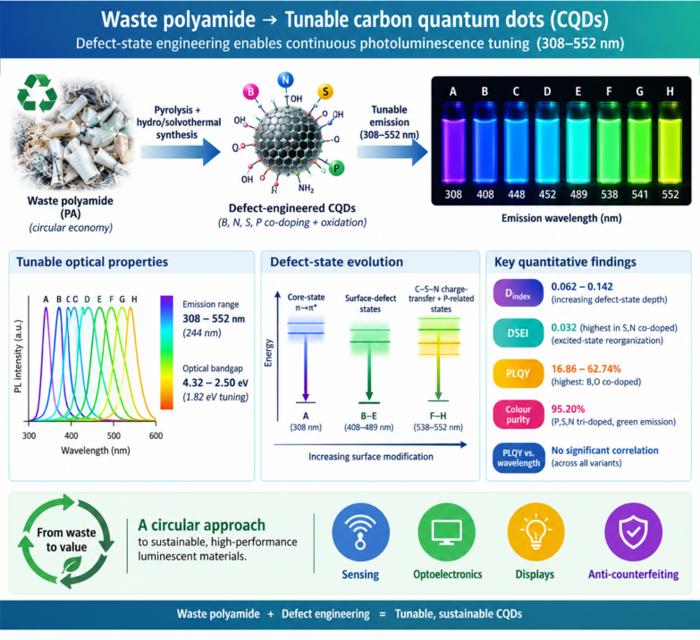
Waste polyamide-derived CQDs show continuous photoluminescence tuning from 308 to 552 nm through sequential defect-state engineering, with optical transition energies decreasing from 4.32 to 2.50 eV. @Christian Ebere Enyoh from Saitama University Carbon quantum dots (CQDs) are fluorescent carbon nanomaterials with potential applications in sensing, optoelectronics, displays, anti-counterfeiting, and environmental technologies. Their optical properties can be adjusted by modifying the carbon...
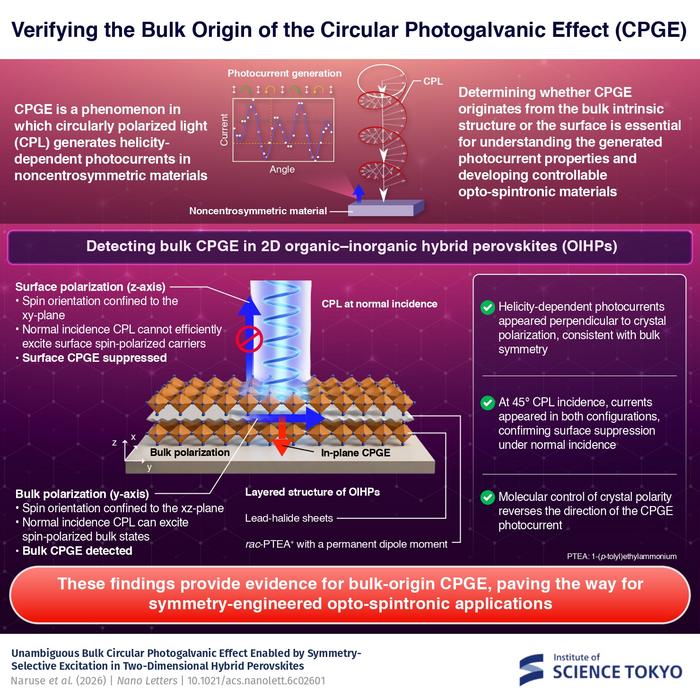
The researchers used circularly polarized light at normal incidence and found that helicity-dependent photocurrents appeared perpendicular to the crystal’s polarization but vanished when measured parallel to it, supporting a bulk origin of CPGE. @Institute of Science Tokyo The circular photogalvanic effect (CPGE), a phenomenon that generates helicity-dependent photocurrents in noncentrosymmetric materials, can originate purely from a crystal's internal structure without contribution from the...
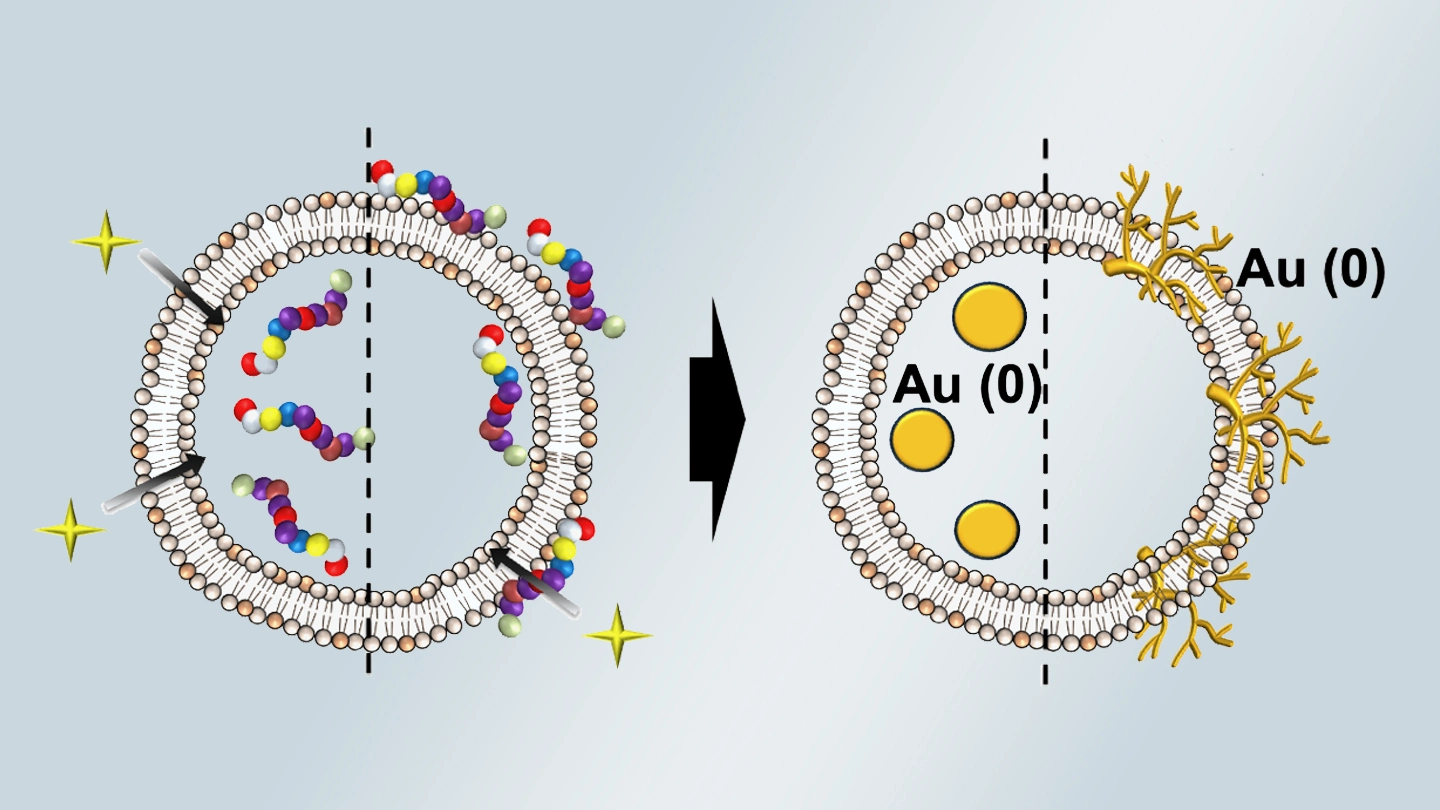
Summary of gold nanoparticle growth programming in liposome based on localization of biomineralization peptide The position of biomineralization peptides within liposomes can influence how gold nanoparticles grow, reports a research team from Institute of Science Tokyo. Peptides localized at the membrane interface promote branched structures, while those confined to the liposome interior favor spherical nanoparticles. The findings offer a new strategy for controlling nanoscale reaction...
