Northwestern University

Homeland Security might soon have a new tool to add to its arsenal.
Researchers at Northwestern University and Argonne National Laboratory have developed a new material that opens doors for a new class of neutron detectors.
With the ability to sense smuggled nuclear materials, highly efficient neutron detectors are critical for national security. Currently, there are two classes of detectors which either use helium gas or flashes of light. These detectors are very large -- sometimes the size of a wall.
Northwestern and Argonne's material introduces a third class: a semiconductor that can absorb neutrons and generate electrical signals that can be easily measured. The semiconductor-based detector is also highly efficient and stable. It can be used both in small, portable devices for field inspections and very large detectors that use arrays of crystals.
"People have imagined semiconductor neutron detectors for a long time," said Northwestern's Mercouri Kanatzidis, who led the research. "The idea was there, but no one had the right material to do it."
Kanatzidis is the Charles E. and Emma H. Morrison Professor of Chemistry in Northwestern's Weinberg College of Arts and Sciences. He has a joint appointment with Argonne.
When heavy elements, such as uranium and plutonium, decay, their atoms eject neutrons from their nuclei. Most neutron detectors are so-called scintillators that work by sensing ejected neutrons and then emitting light to alert the user. This new material is a semiconductor and does not emit light, but instead directly detects electrical signals induced by the neutrons. In addition to security applications, neutron detectors are used in radiation safety, astronomy, plasma physics, materials science and crystallography.
Whereas classic types of thermal neutron detectors have been in use since the 1950s, a practical semiconductor material has remained elusive. Excellent at absorbing neutrons, lithium quickly emerged as the most promising material for neutron detecting devices. But integrating lithium into a semiconductor and making it stable (lithium crumbles when it meets water) was another story.
"You can find good semiconductors, but they don't have lithium," Kanatzidis said. "Or you can find stable lithium compounds that are not good semiconductors. We found the best of both worlds. The specific lithium-6 isotope, which is reasonably abundant and low cost, is a strong neutron absorber."
In their study, Kanatzidis and his team discovered the right combination of materials to make a working device that also keeps lithium stable. Their new material -- lithium-indium-phosphorous-selenium -- is layered in structure and enriched with the lithium-6 isotope.
"The crystal structure is special," Kanatzidis said. "The lithium is inside the layers, so water cannot reach it. That's a big, important feature of this material."
The resulting semiconductor neutron detector can detect thermal neutrons from even a very weak source -- and can do so within nanoseconds. It also can discriminate between neutrons and other types of nuclear signals, such as gamma rays. This prevents false alarms.
One final added bonus: the material contains a very high amount of lithium. So a smaller fraction of the material can absorb the same amount of neutrons as a giant device. This leads to devices small enough to fit in your hand.
"It's important to have all sizes of neutron detectors and as many kinds as possible, such as our new semiconductor," Kanatzidis said. "You want ones that are as big as a wall, where you can pass a truck right by it. But you also want small ones that can be portable for inspections out in the field."
Direct thermal neutron detection by the 2D semiconductor 6LiInP2Se6
Daniel G. Chica, Yihui He, Kyle M. McCall, Duck Young Chung, Rahmi O. Pak, Giancarlo Trimarchi, Zhifu Liu, Patrick M. De Lurgio, Bruce W. Wessels, Mercouri G. Kanatzidis.
Nature, 2020; 577 (7790): 346
DOI: 10.1038/s41586-019-1886-8
Contact information:
Mercouri Kanatzidis
Northwestern Professor of Chemistry
m-kanatzidis@northwestern.edu
Phone: 847-467-1541
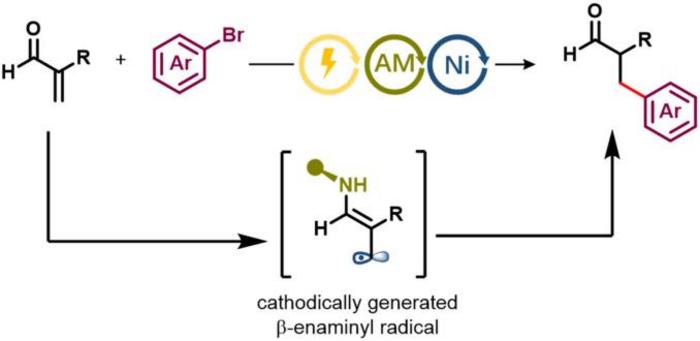
A primary amine and nickel dual catalytic system uses electrochemistry to reverse the usual reactivity of aminocatalytic intermediates, reducing an iminium ion at the cathode to a β-enaminyl radical instead of oxidizing an enamine. Run at 1.10 V with an inexpensive achiral amine, the method couples α-branched acroleins with aryl and alkenyl halides, giving β-functionalised aldehydes in up to 91% yield and 80% on gram scale.

Researchers in Japan have combined gold(I) carbon bonds and copper(I) nitrogen coordination to assemble an interlocked catenane of nitrogen-doped carbon nanohoops in a single pot. Demetallation gave a metal-free [2]catenane of two fully conjugated [12]CPP rings in only eight steps, with a 2.9% overall yield that improves on conventional routes.

Chemists at UT Austin and Zhejiang University have developed a self-assembling molecularly woven fabric that separates benzene from cyclohexane far more efficiently than distillation, whose near-identical boiling points make conventional processing costly. Stacked layers of clockwise and counterclockwise chiral networks form a springy, reusable filter that absorbed 97.9% of benzene from a 50/50 mixture.
This week in nanotech
25 deals tracked
New products
 Ti-WCMBN Nanomaterialia Featured
 Nion-compatible In Situ STEM Holders for Electrical BiasingHummingbird Scientific Featured
 CruciblesBasis Materials
Market insights
Last 30 days: Semiconductors & Electronics was the busiest vertical: 54 of 175 events (31%).
Money raised per month