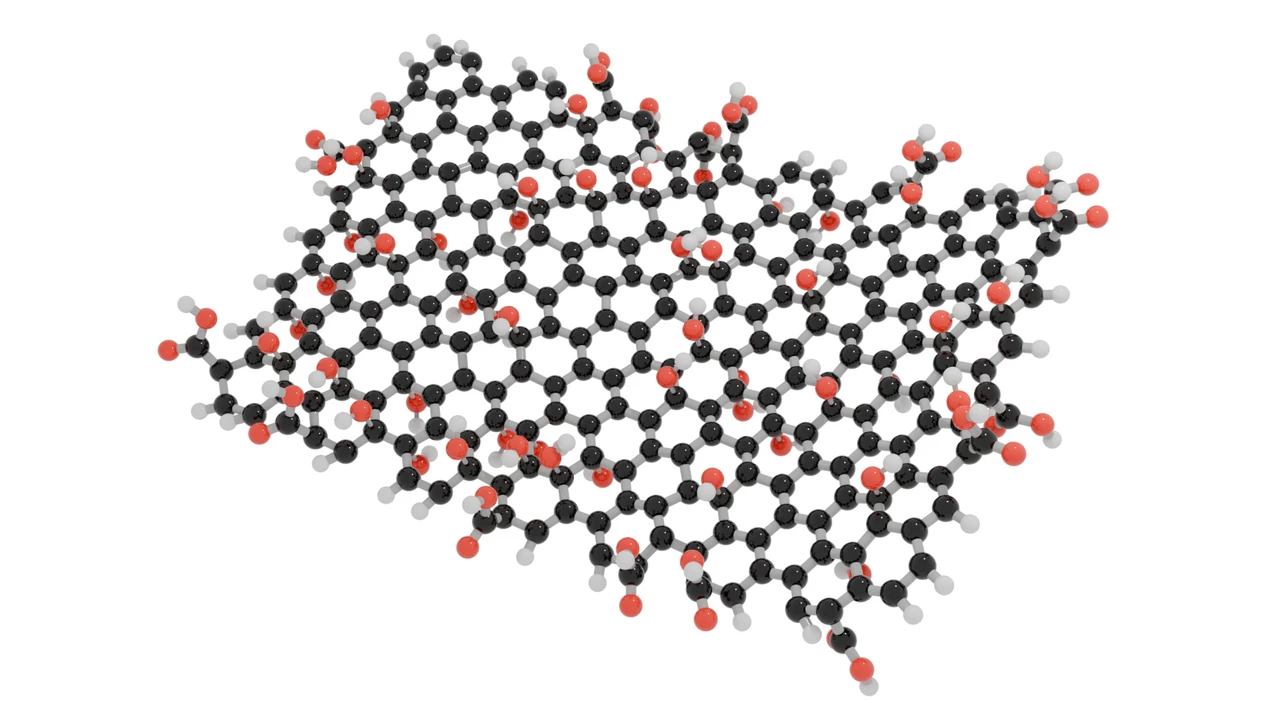
Graphene oxide is often used to produce graphene by removing oxygen. However, if you have holes in graphene oxide, you have holes also after converting it into graphene. Therefore, the quality of the graphene oxide is very important. Alexandr Talyzin and his research group at Umeå university have now cracked the puzzle of how to safely make good graphene oxide. Their results were recently published in the scientific journal Carbon.
Graphene is often described as a “wonder material thanks to its flexibility, high mechanical strength and conductivity. But all properties of graphene are affected by defects. Graphene produced from graphene oxide has much worse than expected mechanical properties and conductivity.
Too dangerous for industrial manufacturing
Many studies have demonstrated that synthesis by the most commonly used method, Hummers method, always results in a significant number of defects. The much older Brodie method provides nearly completely hole-free graphene oxide but this type of graphene oxide is still not produced by any companies and not available commercially.
“It is simply too dangerous and not suitable for industrial manufacturing,” says Alexandr Talyzin.
Now, researchers from Umeå have found a new method that combines the acid from the Hummers method (H2SO4) and the oxidant from the Brodie method (potassium chlorate), allowing them to produce graphene oxide with a number of defects as small as those in Brodie, but using a synthesis procedure as simple as Hummers oxidation.
“This method should be named after Bartosz Gurzeda, a researcher working in my group with the help of the Kempe Stipendium, as the Gurzeda method,” says Alexandr Talyzin.
Can be used for water treatment
According to Alexandr Talyzin, there are all reasons to believe that the Gurzeda method will become as popular as Hummers oxidation whenever defect-free graphene oxide is needed. This is for making graphene by removing oxygen groups or for the preparation of gas protection coatings, semi-permeable membranes, sensors, and many other possible applications.
In the recent decade, a lot of interest has also arisen for applications of graphene oxide itself. Layered graphene oxide materials are intensively studied for membrane applications with the dream of producing drinkable water by simple filtration of salts from sea water or creating semi-permeable protective coatings that allow water to pass while keeping dangerous organic pollutants, such as toluene, away.
“We want the research society to try and test this new graphene oxide in their applications and see the difference. Graphene oxide is not one material; it is a family of materials with rather different properties, providing us with infinite opportunities for new applications,” says Alexandr Talyzin.
Reference
Graphite oxide by “chlorate route” oxidation without HNO3: Does acid matter?
Bartosz Gurzęda, Nicolas Boulanger, Mads R.V. Jørgensen, Innokenty Kantor, Alexandr V. Talyzin
https://www.sciencedirect.com/science/article/pii/S0008622324001180?via%3Dihub
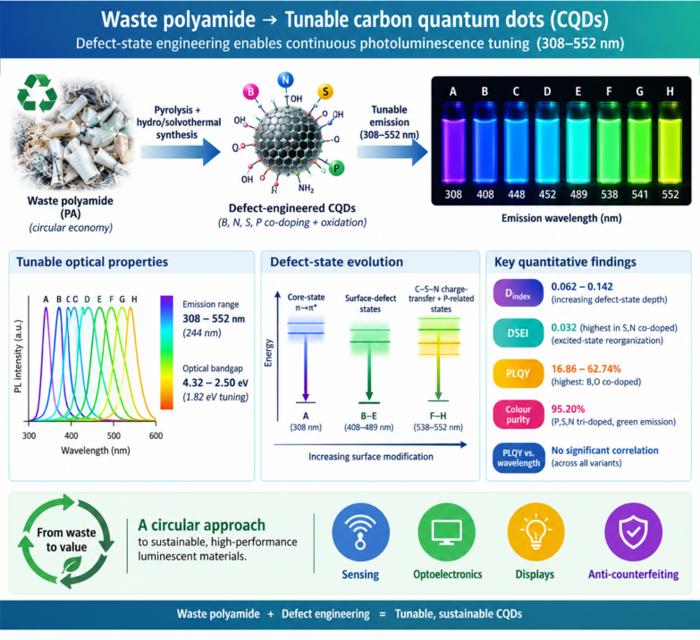
Waste polyamide-derived CQDs show continuous photoluminescence tuning from 308 to 552 nm through sequential defect-state engineering, with optical transition energies decreasing from 4.32 to 2.50 eV. @Christian Ebere Enyoh from Saitama University Carbon quantum dots (CQDs) are fluorescent carbon nanomaterials with potential applications in sensing, optoelectronics, displays, anti-counterfeiting, and environmental technologies. Their optical properties can be adjusted by modifying the carbon...
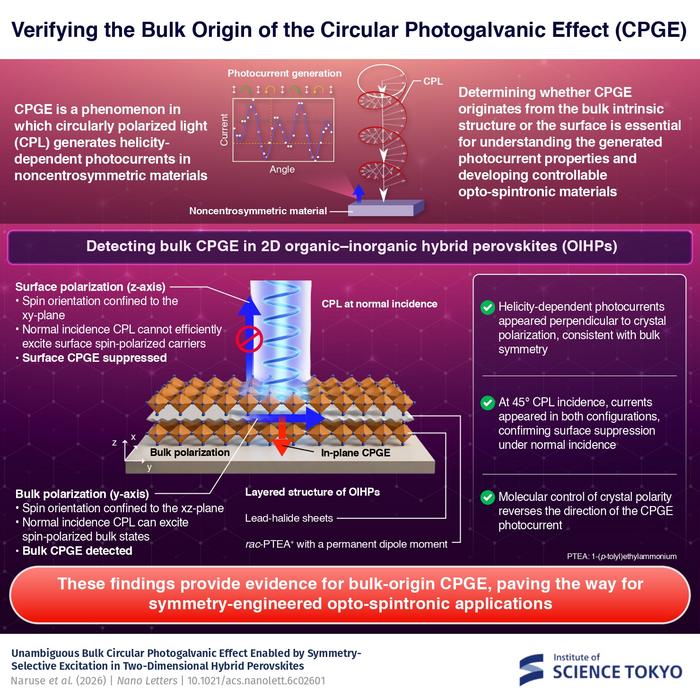
The researchers used circularly polarized light at normal incidence and found that helicity-dependent photocurrents appeared perpendicular to the crystal’s polarization but vanished when measured parallel to it, supporting a bulk origin of CPGE. @Institute of Science Tokyo The circular photogalvanic effect (CPGE), a phenomenon that generates helicity-dependent photocurrents in noncentrosymmetric materials, can originate purely from a crystal's internal structure without contribution from the...
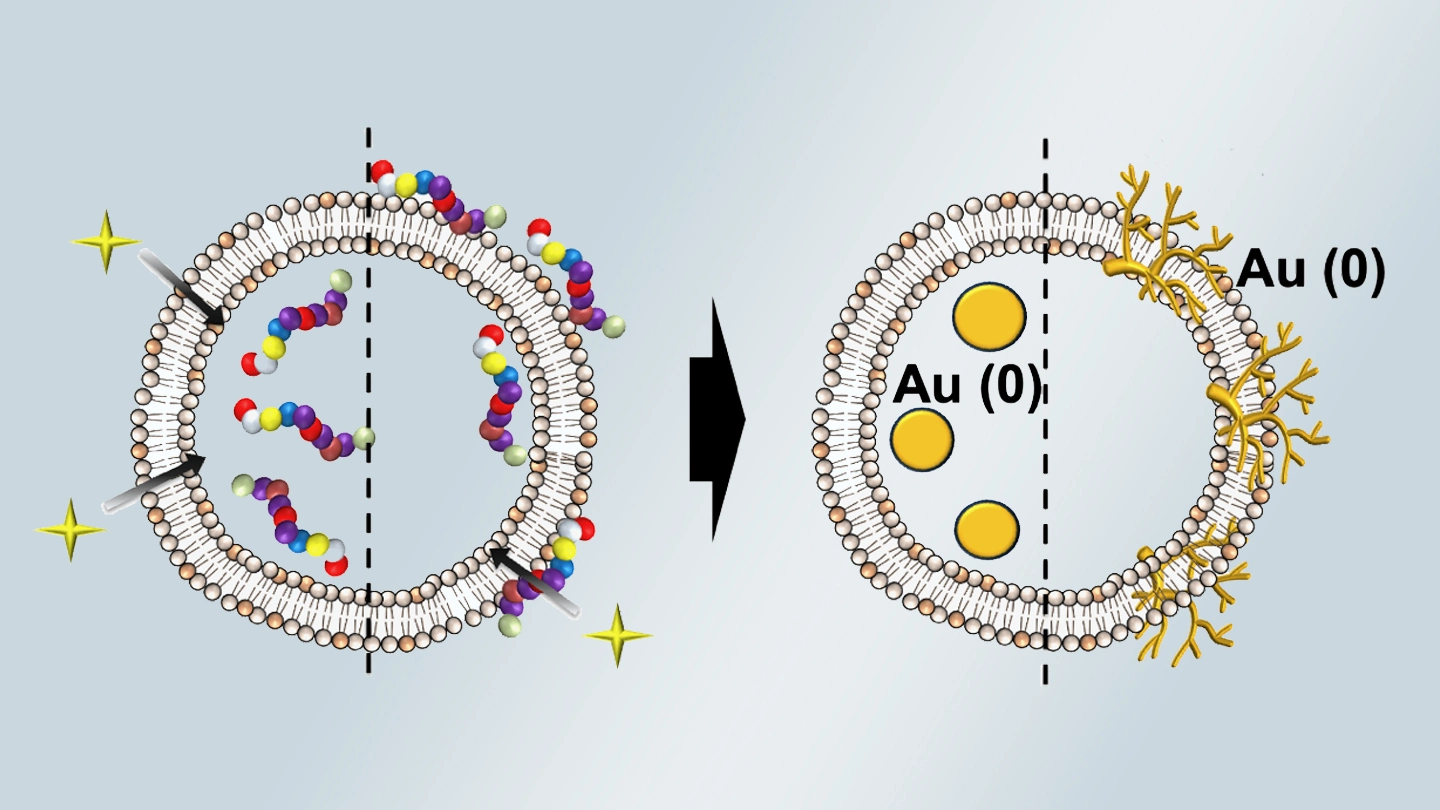
Summary of gold nanoparticle growth programming in liposome based on localization of biomineralization peptide The position of biomineralization peptides within liposomes can influence how gold nanoparticles grow, reports a research team from Institute of Science Tokyo. Peptides localized at the membrane interface promote branched structures, while those confined to the liposome interior favor spherical nanoparticles. The findings offer a new strategy for controlling nanoscale reaction...
