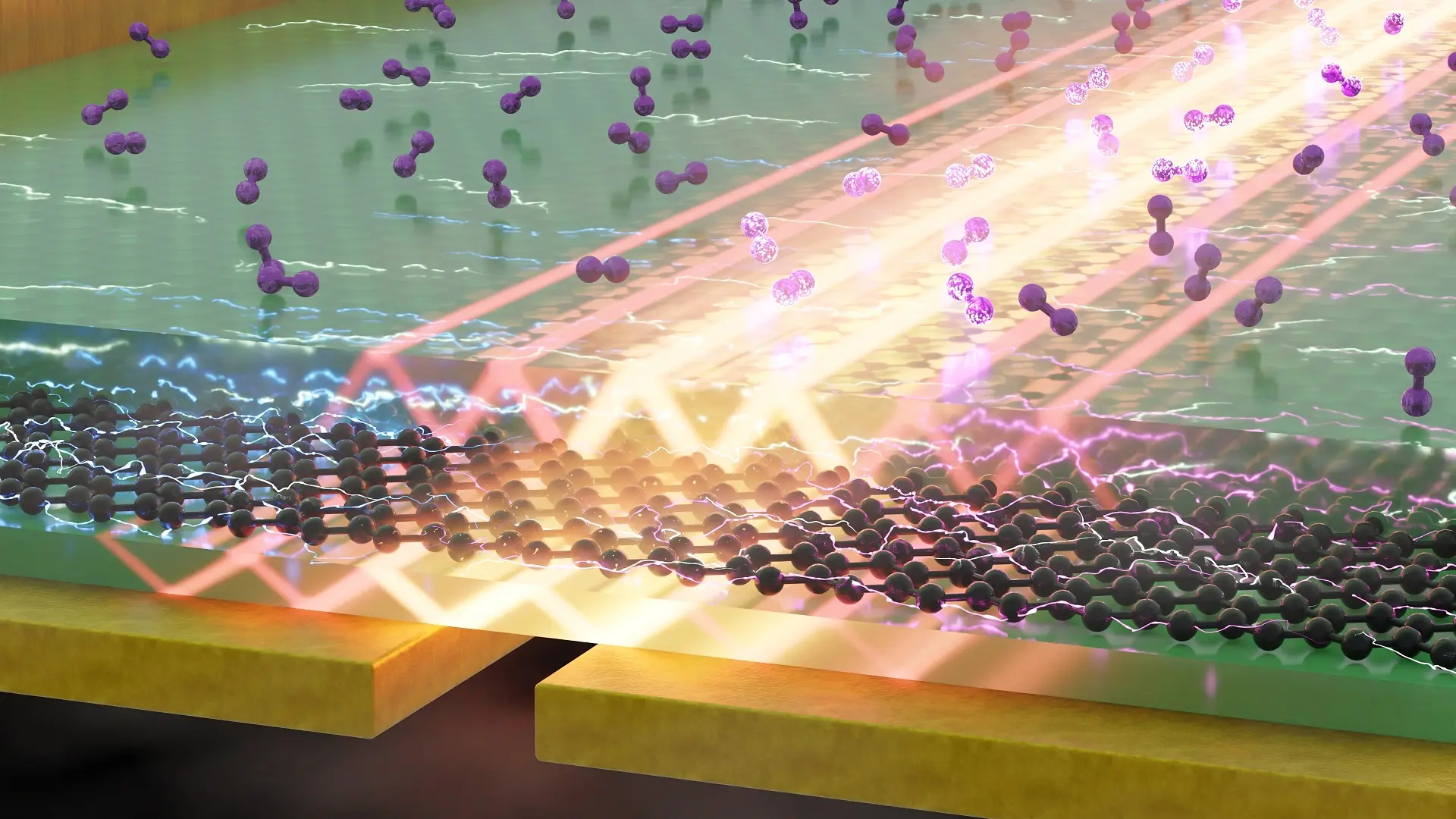
Molecules have some sort of fingerprints, unique features that can be used to differentiate them. Each type of molecule, when illuminated with the right light, vibrates at a characteristic frequency (its resonance frequency, which typically occurs at infrared frequencies) and strength. Similar to what can be done with human fingerprints, one can exploit this information to distinguish different types of molecules or gases from each other. That can also protect us from potential dangers, by identifying poisonous and dangerous substances or gases instead of criminals.
One conventional approach is infrared fingerprint spectroscopy, which uses infrared reflection or transmission spectra to identify different molecules. However, the small size of organic molecules compared to the infrared wavelength results in a weak scattering signal, making it challenging to detect small quantities of material. In recent years, this limitation has been addressed using Surface-Enhanced Infrared Absorption (SEIRA) spectroscopy. SEIRA spectroscopy leverages infrared near-field enhancement provided by rough metal surfaces or metallic nanostructure to amplify the molecular vibrational signals. The main advantage of SEIRA spectroscopy is its ability to measure and study minute material quantities.
Recently, phonon polaritons—coupled excitations of electromagnetic waves with atomic lattice vibrations—particularly hyperbolic phonon polaritons in thin layers of hexagonal boron nitride (h-BN), have emerged as promising candidates for boosting the sensitivity of SEIRA spectroscopy. "Previously, we demonstrated that phonon polaritons can be applied for SEIRA spectroscopy of nanometer-thin molecular layers and gas sensing, thanks to their long lifetimes and ultra-high field confinement," says Prof. Rainer Hillenbrand from Nanogune.
However, SEIRA spectroscopy remains a far-field technique that requires bulky equipment, such as light sources, SEIRA substrates, and typically nitrogen-cooled infrared detectors. This reliance on large instruments limits its potential for miniaturisation and on-chip applications. In parallel, "we have been investigating graphene-based infrared detectors that operate at room temperature, and we have shown that phonon polaritons can be electrically detected and can enhance detector sensitivity," adds Prof. Frank Koppens from ICFO.
By combining these two progresses, a team of researchers has now successfully demonstrated the first on-chip phononic SEIRA detection of molecular vibrations. This result was made possible through the joint experimental efforts of Nanogune and ICFO researchers, along with theoretical support from the groups of Dr. Alexey Nikitin at the Donostia International Physics Center and Prof. Luis Martín-Moreno at the Instituto de Nanociencia y Materiales de Aragón (CSIC- Universidad de Zaragoza). The researchers employed ultra-confined HPhPs to detect molecular fingerprints in nanometer-thin molecular layers directly in the photocurrent of a graphene-based detector, eliminating the need for traditional bulky IR detectors.
"One of the most exciting aspects of this approach is that this graphene-based detector opens the way towards miniaturisation," comments ICFO researcher Dr. Sebastián Castilla. He continues, "By integrating this detector with microfluidic channels, we could create a true 'lab-on-a-chip', capable of identifying specific molecules in small liquid samples—paving the way for medical diagnostics and environmental monitoring."
In a longer-term picture, Nanogune researcher and first author of the study, Dr. Andrei Bylinkin, believes that "on-chip infrared detectors operating at room temperature could enable rapid molecular identification, potentially integrated into smartphones or wearable electronics." He further believes that "this would offer a platform for compact sensitive, room-temperature infrared spectroscopy."
Reference
On-chip phonon-enhanced IR near-field detection of molecular vibrations
Andrei Bylinkin, Sebastián Castilla, Tetiana M. Slipchenko, Kateryna Domina, Francesco Calavalle, Varun-Varma Pusapati, Marta Autore, Fèlix Casanova, Luis E. Hueso, Luis Martín-Moreno, Alexey Y. Nikitin, Frank H. L. Koppens & Rainer Hillenbrand
https://www.nature.com/articles/s41467-024-53182-9
The Institute of Photonic Sciences
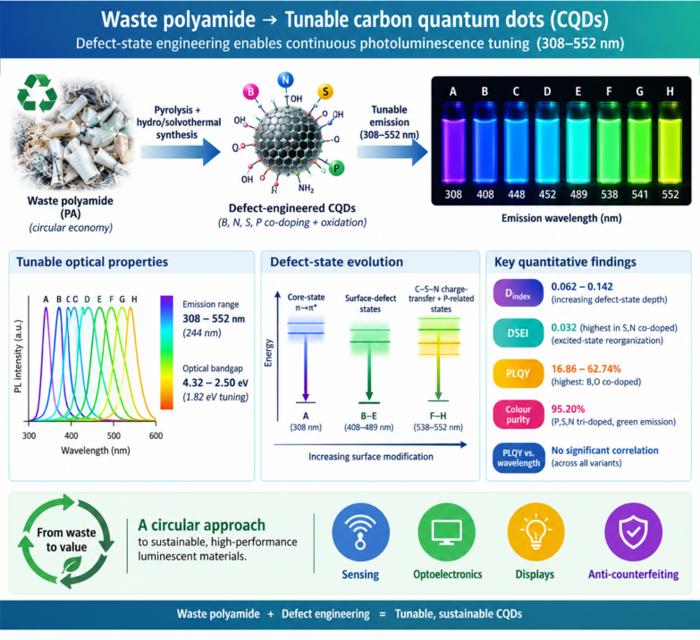
Waste polyamide-derived CQDs show continuous photoluminescence tuning from 308 to 552 nm through sequential defect-state engineering, with optical transition energies decreasing from 4.32 to 2.50 eV. @Christian Ebere Enyoh from Saitama University Carbon quantum dots (CQDs) are fluorescent carbon nanomaterials with potential applications in sensing, optoelectronics, displays, anti-counterfeiting, and environmental technologies. Their optical properties can be adjusted by modifying the carbon...
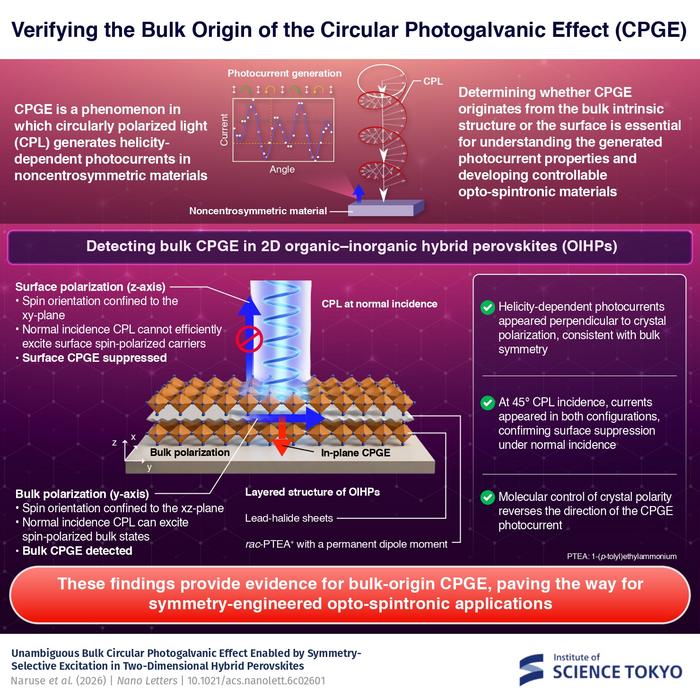
The researchers used circularly polarized light at normal incidence and found that helicity-dependent photocurrents appeared perpendicular to the crystal’s polarization but vanished when measured parallel to it, supporting a bulk origin of CPGE. @Institute of Science Tokyo The circular photogalvanic effect (CPGE), a phenomenon that generates helicity-dependent photocurrents in noncentrosymmetric materials, can originate purely from a crystal's internal structure without contribution from the...
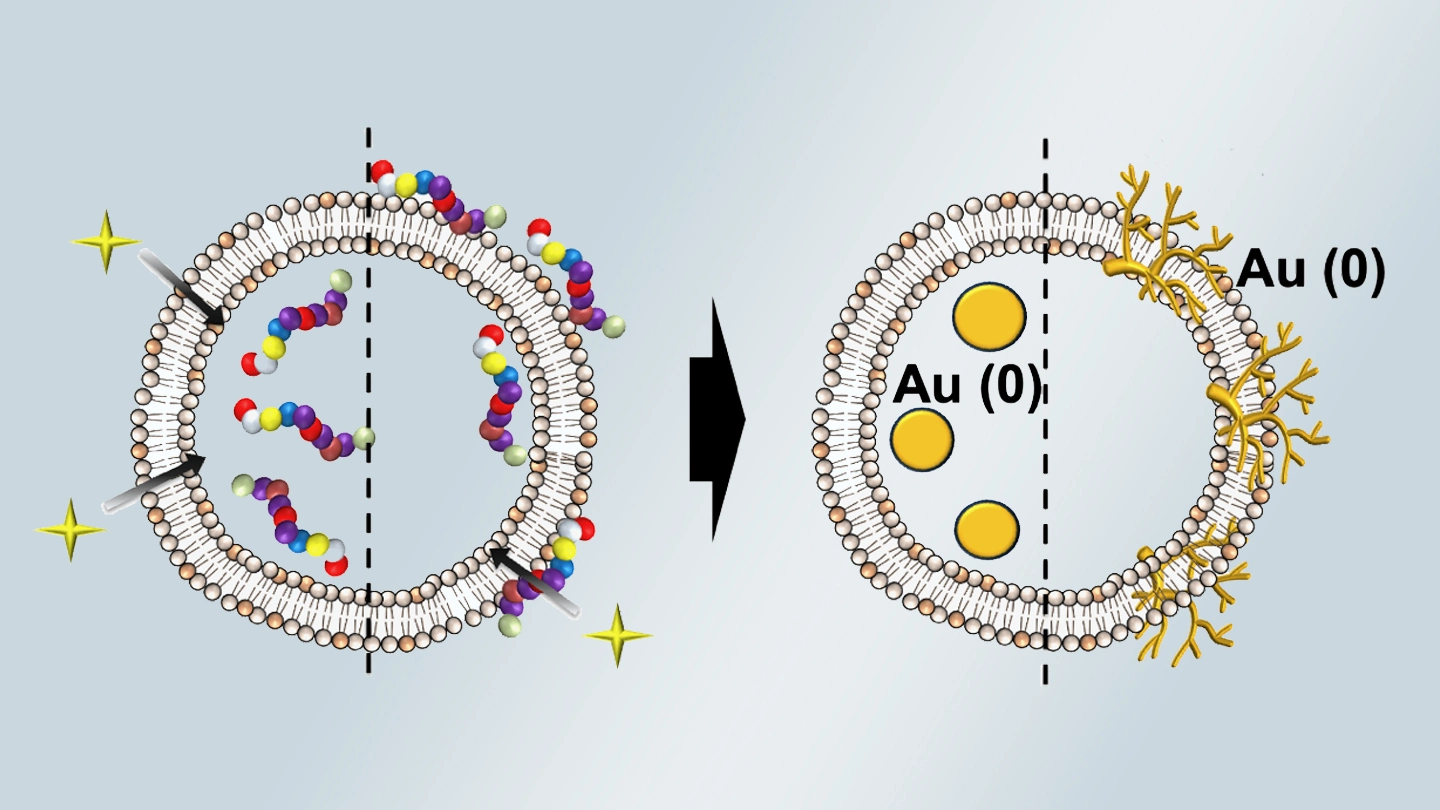
Summary of gold nanoparticle growth programming in liposome based on localization of biomineralization peptide The position of biomineralization peptides within liposomes can influence how gold nanoparticles grow, reports a research team from Institute of Science Tokyo. Peptides localized at the membrane interface promote branched structures, while those confined to the liposome interior favor spherical nanoparticles. The findings offer a new strategy for controlling nanoscale reaction...
