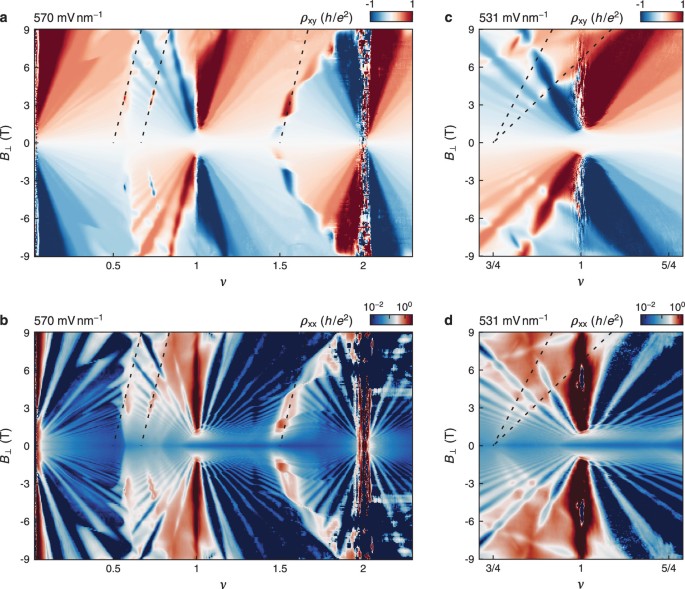
Researchers from the University of British Columbia, the University of Washington, and Johns Hopkins University have identified a new class of quantum states in a custom-engineered graphene structure. Published in Nature, the study reports the discovery of topological electronic crystals in twisted bilayer–trilayer graphene, a system created by introducing a precise rotational twist between stacked two-dimensional materials.
“The starting point for this work is two flakes of graphene, which are made up of carbon atoms arranged in a honeycomb structure. The way electrons hop between the carbon atoms determines the electrical properties of the graphene, which ends up being superficially similar to more common conductors like copper,” said Prof. Joshua Folk, a member of UBC’s Physics and Astronomy Department and the Blusson Quantum Matter Institute (UBC Blusson QMI).
“The next step is to stack the two flakes together with a tiny twist between them. This generates a geometric interference effect known as a moiré pattern: some regions of the stack have carbon atoms from the two flakes directly on top of each other, while other regions have the atoms offset,” Folks said.
“When electrons hop through this moiré pattern in the twisted stack, the electronic properties are totally changed. For example, the electrons slow way down, and sometimes they develop a twist in their motion, like the vortex in the water at the drain of a bathtub as it is draining out.”
The breakthrough discovery reported in this study was observed by an undergraduate student, Ruiheng Su, from UBC, studying a twisted graphene sample prepared by Dr. Dacen Waters, a postdoctoral researcher in the lab of Prof. Matthew Yankowitz at the University of Washington. While working on the experiment in Folk’s lab, Ruiheng discovered a unique configuration for the device where the electrons in the graphene froze into a perfectly ordered array, locked in place yet twirling in unison like ballet dancers gracefully performing stationary pirouettes. This synchronized rotation gives rise to a remarkable phenomenon where electric current flows effortlessly along the edges of the sample while the interior remains insulating because the electrons are immobilized.
Remarkably, the amount of current that flows along the edge is precisely determined by the ratio of two fundamental constants of nature—Planck’s constant and the charge of the electron. The precision of this value is guaranteed by a property of electron crystal known as topology, which describes the properties of objects that remain unchanged by modest deformations.
“Just as a donut cannot be smoothly deformed into a pretzel without first cutting it open, the circulating channel of electrons around the boundary 2D electron crystal remains undisturbed by disorder in its surrounding environment,” said Yankowitz.
“This leads to a paradoxical behaviour of the topological electronic crystal not seen in conventional Wigner crystals of the past—despite the crystal forming upon freezing electrons into an ordered array, it can nevertheless conduct electricity along its boundaries.”
An everyday example of topology is the Möbius strip—a simple yet mind-bending object. Imagine taking a strip of paper, forming it into a loop, and taping the ends together. Now, take another strip, but before joining the ends, give it a single twist. The result is a Möbius strip, a surface with just one side and one edge. Amazingly, no matter how you try to manipulate the strip, you cannot untwist it back into a normal loop without tearing it apart.
The rotation of the electrons in the crystal is analogous to the twist in the Möbius strip, and leads to the remarkable characteristic of the topological electronic crystal never before seen in the rare cases where electron crystals have been observed in the past: edges where electrons flow without resistance, describe being locked in place within the crystal itself.
The topological electron crystal is not only fascinating from a conceptual point of view but also opens up new opportunities for advancements in quantum information. These include future attempts to couple the topological electron crystal with superconductivity, forming the foundation of qubits for topological quantum computers.
Reference
Moiré-driven topological electronic crystals in twisted graphene
Ruiheng Su, Dacen Waters, Boran Zhou, Kenji Watanabe, Takashi Taniguchi, Ya-Hui Zhang, Matthew Yankowitz & Joshua Folk
https://www.nature.com/articles/s41586-024-08239-6
University of British Columbia
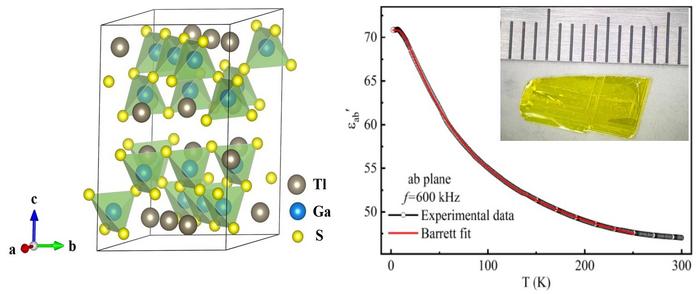
TlGaS2 single crystals show both in-plane and out-of-plane polarization, a rare combination in two-dimensional ferroelectrics that could widen options for ferroelectric transistors and non-volatile memory. Infrared spectroscopy revealed a soft phonon mode below 75 K, a signature tied to quantum ferroelectricity, along with weak structural changes across temperatures that lack clear heat-capacity signals, hinting at local rearrangements rather than conventional phase transitions.
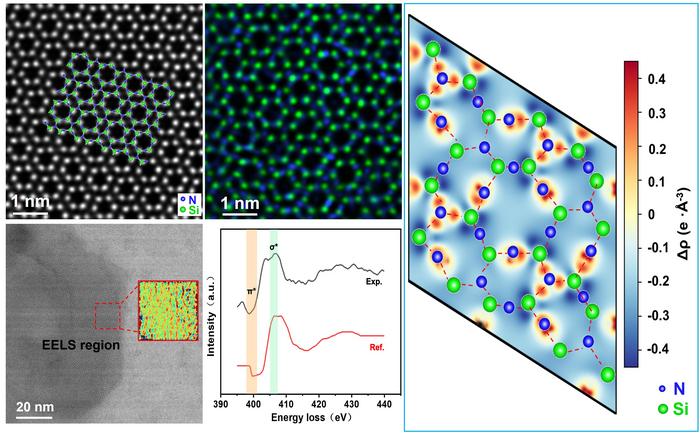
A β-Si3N4 nanolayer about 20 nm thick and continuous over several micrometers has been formed between carbon and silicon carbide without conventional oxide sintering additives, using a porous carbon framework infiltrated with molten silicon. Complementary atomic-resolution imaging resolved both silicon and nitrogen sublattices, confirming the ABAB stacking and corner-sharing tetrahedral network, while electron energy-loss spectroscopy and first-principles calculations linked the spectra to…
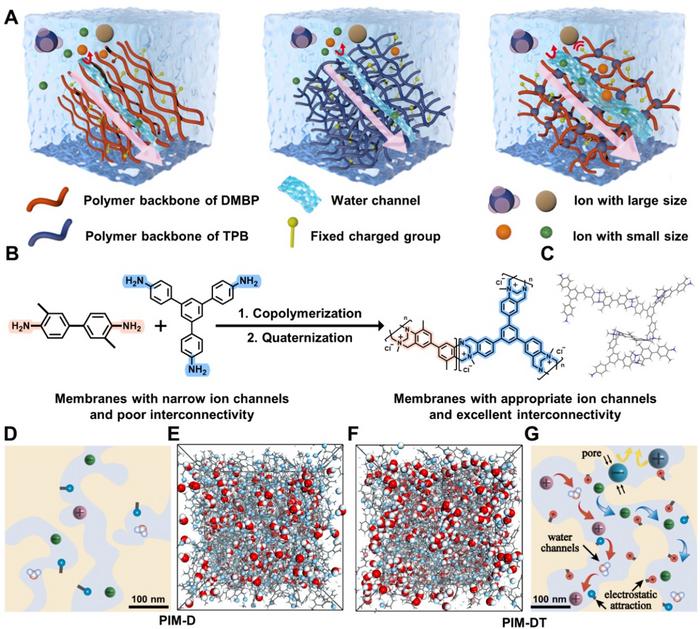
A polymer membrane with interconnected water-filled channels just 0.5 to 0.7 nanometers wide separates singly charged ions from multiply charged ones in both cationic and anionic systems. Built from Tröger's base-derived porous organic polymers, it cut the magnesium-to-lithium ratio in salt-lake brine roughly 500-fold across three electrodialysis stages, yielding 99.5 percent pure lithium carbonate, and enriched sodium chloride to 99.4 percent of ion mass from simulated seawater.
This week in nanotech
$751.8M raised
6 funding rounds · 38 deals tracked
New products
 Ti-WCMBN Nanomaterialia Featured
 Nion-compatible In Situ STEM Holders for Electrical BiasingHummingbird Scientific Featured
 Aether®Lam Research
Market insights
Last 30 days: Quantum Technologies drew the most money: $3.18B.
Money raised per month
Behind the deal
Who led Institut de Microelectronica de Barcelona (IMB-CNM, CSIC)’s $185.7M Grant?
See the investors with Insights Pro →