Researchers from the National University of Singapore (NUS) have recently achieved a significant breakthrough in the development of next-generation carbon-based quantum materials, opening new horizons for advancements in quantum electronics.
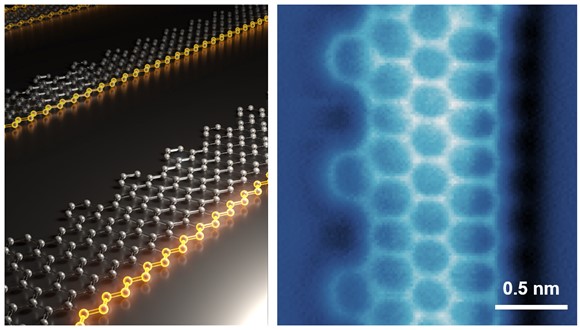
The innovation involves a novel type of graphene nanoribbon (GNR), named Janus GNR (JGNR). The material has a unique zigzag edge, with a special ferromagnetic edge state located on one of the edges. This unique design enables the realisation of one-dimensional ferromagnetic spin chain, which could have important applications in quantum electronics and quantum computing.
The research was led by Associate Professor Lu Jiong and his team from the NUS Department of Chemistry, in collaboration with international partners.
Graphene nanoribbons, which are narrow strips of nanoscale honeycomb carbon structures, exhibit remarkable magnetic properties due to the behaviour of unpaired electrons in the atoms' π-orbitals. Through atomically precise engineering of their edge structures into a zigzag arrangement, a one-dimensional spin-polarised channel can be constructed. This feature offers immense potential for applications in spintronic devices or serving as next-generation multi-qubit systems which are the fundamental building blocks of quantum computing.
Janus, the ancient Roman god of beginnings and endings, is often depicted as having two faces pointing in opposite directions representing the past and the future. The term “Janus” has been applied in materials science to describe materials that have different properties on opposite sides. JGNR has a novel structure with only one edge of the ribbon having a zigzag form, making it the world’s first one-dimensional ferromagnetic carbon chain. This design is achieved by employing a Z-shaped precursor design which introduces a periodic array of hexagon carbon rings on one of the zigzag edges, breaking the structural and spin symmetry of the ribbon.
Assoc Prof Lu said, “Magnetic graphene nanoribbons - narrow strips of graphene formed by fused benzene rings - offers tremendous potential for quantum technologies due to their long spin coherence times and the potential to operate at room temperature. Creating a one-dimensional single zigzag edge in such systems is a daunting yet essential task for realising the bottom-up assembly of multiple spin qubits for quantum technologies.”
The significant achievement is a result of close collaboration among synthetic chemists, materials scientists, and theoretical physicists, including Professor Steven G Louie from UC Berkeley in the United States, Professor Hiroshi Sakaguchi from Kyoto University in Japan and other contributing authors.
The research breakthrough was published in the scientific journal Nature on 9 January 2025.
Creating the Janus graphene nanoribbons
To produce the JGNR, the researchers initially designed and synthesised a series of special ‘Z-shape’ molecular precursors via conventional in-solution chemistry. These precursors were then used for subsequent on-surface synthesis, which is a new type of solid-phase chemical reaction performed in an ultra-clean environment. This approach allowed the researchers to precisely control the shape and structure of the graphene nanoribbons at the atomic level.
The ‘Z-shape’ design allows for the asymmetric fabrication by independently modifying one of the two branches, thereby creating a desired ‘defective’ edge, while maintaining the other zigzag edge unchanged. Moreover, adjusting the length of the modified branch enables the modulation of the width of the JGNRs. Characterisation via state-of-art scanning probe microscopy/spectroscopy and first-principles density functional theory confirms the successful fabrication of JGNRs with ferromagnetic ground state exclusively localised along the single zigzag edge.
“The rational design and on-surface synthesis of a novel class of JGNR represent a conceptual and experimental breakthrough for realising one-dimensional ferromagnetic chain. Creating such JGNRs not only expands the possibilities for precise engineering of exotic quantum magnetism and enables the assembly of robust spin arrays as new-generation qubits. Furthermore, it enables the fabrication of one-dimensional spin-polarised transport channels with tunable bandgaps, which could advance carbon-based spintronics at the one-dimensional limit,” added Assoc Prof Lu.
Reference
Janus graphene nanoribbons with localized states on a single zigzag edge
Shaotang Song, Yu Teng, Weichen Tang, Zhen Xu, Yuanyuan He, Jiawei Ruan, Takahiro Kojima, Wenping Hu, Franz J. Giessibl, Hiroshi Sakaguchi, Steven G. Louie & Jiong Lu
https://www.nature.com/articles/s41586-024-08296-x
National University of Singapore
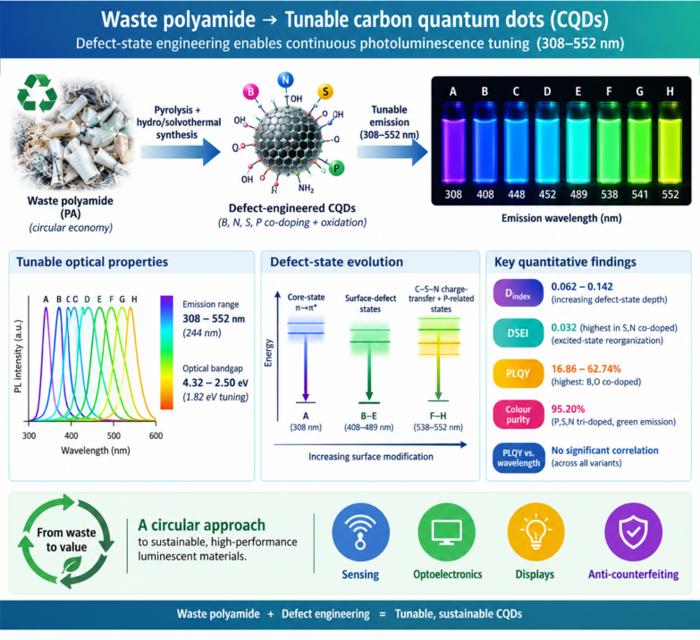
Waste polyamide-derived CQDs show continuous photoluminescence tuning from 308 to 552 nm through sequential defect-state engineering, with optical transition energies decreasing from 4.32 to 2.50 eV. @Christian Ebere Enyoh from Saitama University Carbon quantum dots (CQDs) are fluorescent carbon nanomaterials with potential applications in sensing, optoelectronics, displays, anti-counterfeiting, and environmental technologies. Their optical properties can be adjusted by modifying the carbon...
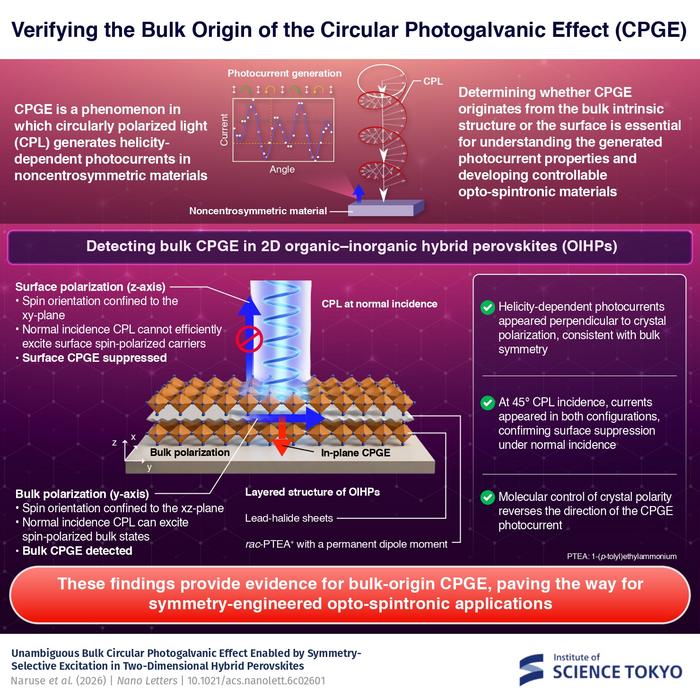
The researchers used circularly polarized light at normal incidence and found that helicity-dependent photocurrents appeared perpendicular to the crystal’s polarization but vanished when measured parallel to it, supporting a bulk origin of CPGE. @Institute of Science Tokyo The circular photogalvanic effect (CPGE), a phenomenon that generates helicity-dependent photocurrents in noncentrosymmetric materials, can originate purely from a crystal's internal structure without contribution from the...
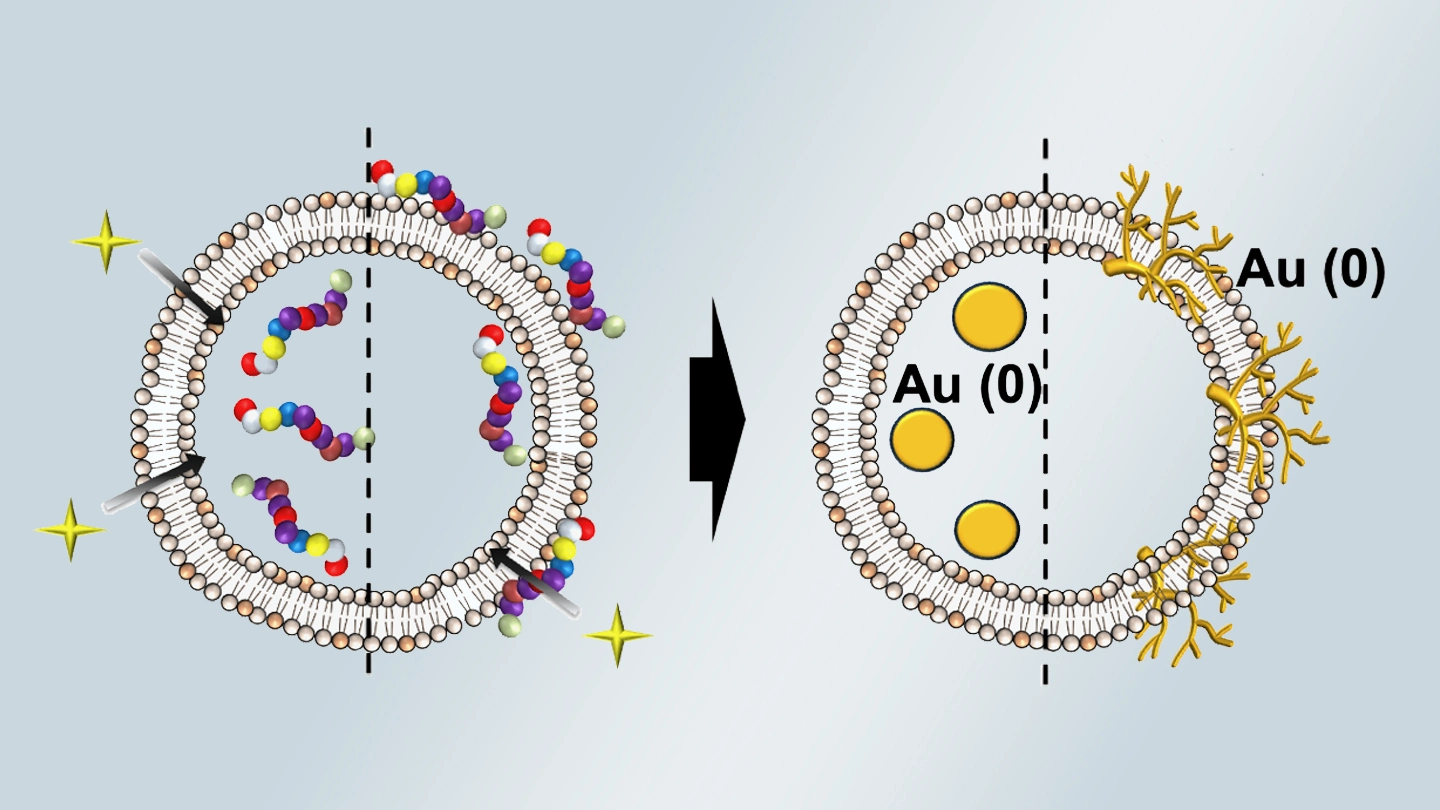
Summary of gold nanoparticle growth programming in liposome based on localization of biomineralization peptide The position of biomineralization peptides within liposomes can influence how gold nanoparticles grow, reports a research team from Institute of Science Tokyo. Peptides localized at the membrane interface promote branched structures, while those confined to the liposome interior favor spherical nanoparticles. The findings offer a new strategy for controlling nanoscale reaction...
