ONI has reported continued growth in scientific publications using its super-resolution microscopy and single-particle analysis technology, with 177 studies recorded in 2026 to date. That figure surpasses the previous annual high.
Publications increased 72% in 2025, rising from 82 in 2024 to 141 in 2025. Over the past six months, researchers have published an average of 16 papers per month using ONI technology, equivalent to nearly four publications per week. The studies span neuroscience, immuno-oncology, virology and cell biology, with findings appearing in Nature, Cell, Nature Communications and Science Advances.
Extracellular vesicle (EV) research has been a key contributor to the growth. Since the introduction of ONI's Application Kit: EV Profiler in 2021 and the launch of its second-generation EV Profiler 2 end-to-end solution in February 2024, scientific output in this area has grown substantially. EV-related publications using ONI technology increased from 26 in 2024 to 52 in 2025, reaching 87 in 2026 to date. Publications using ONI's EV Profiler kits rose from 16 in 2024 to 38 in 2025 and 62 in 2026.
The company said the figures reflect growing use of single-vesicle characterization as scientists move beyond bulk measurements to study EV heterogeneity, composition and biological function. The published research also shows growing application of ONI's technology in biomarker discovery, disease research and therapeutic development.
"The acceleration in scientific publications demonstrates the growing impact of ONI technology on life sciences research," said Corey Butler, PhD, Product Management lead at ONI. "Researchers are increasingly recognizing the importance of understanding biology at the level of individual molecules and particles. The momentum we’re seeing, particularly in extracellular vesicle research, reinforces the value of making advanced nanoscale imaging and analysis more accessible, reproducible, and scalable with ONI s automated end-to-end workflows, Aplo Flow: EV Prep and AutoEV."
ONI said it remains focused on equipping scientists with tools to measure and understand biology at the nanoscale, supporting discoveries across life sciences and therapeutic research. Its published work can be viewed in a library of scientific publications on its website.
Source: ONI (Oxford Nanoimaging) news
NanoFCM has approved RoosterBio to provide contract analytical services worldwide using the NanoAnalyzer platform. RoosterBio is the first US-based service provider approved by NanoFCM for this work.

Izon Science has released the first major update to its Pulsoid instrument. New software extends measurement down to 30 nm, and the P5T chip raises the upper limit to 210 nm.
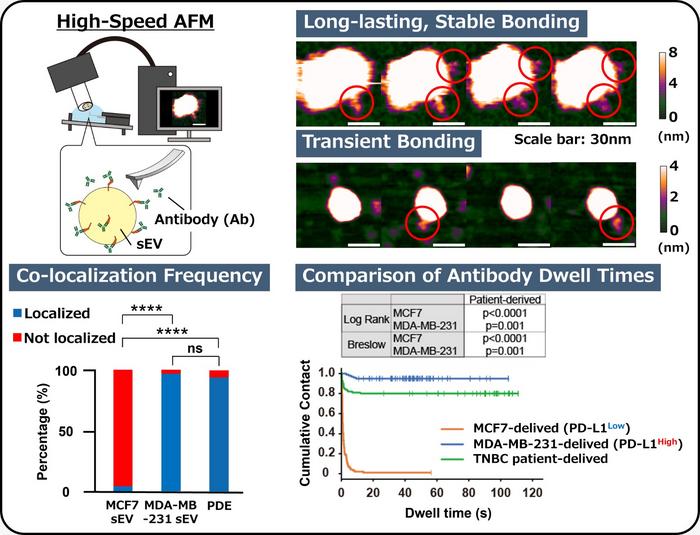
High-speed atomic force microscopy has revealed that the amount of PD-L1 on cancer-derived extracellular vesicles does not indicate how accessible the protein is to antibodies. Researchers at Kanazawa University imaged individual vesicles from two breast cancer cell lines in liquid, finding that over 80 percent of high-PD-L1 vesicles held antibodies persistently, while most low-PD-L1 vesicles showed no stable binding.
This week in nanotech
26 deals tracked
New products
 Nion-compatible In Situ STEM Holders for Electrical BiasingHummingbird Scientific Featured
 Ti-WCMBN Nanomaterialia Featured
 Aether®Lam Research
Market insights
Last 30 days: Semiconductors & Electronics was the busiest vertical: 55 of 178 events (31%).
Money raised per month