Northwestern University

The simplicity and elegance of origami, an ancient Japanese art form, has motivated researchers to explore its application in the world of materials.
New research from an interdisciplinary team, including Northwestern Engineering's Horacio Espinosa and Sridhar Krishnaswamy and the Georgia Institute of Technology's Glaucio Paulino, aims to advance the creation and understanding of such folded structures for applications ranging from soft robotics to medical devices to energy harvesters.
Inspired by origami, mechanical metamaterials -- artificial structures with mechanical properties defined by their structure rather than their composition -- have gained considerable attention because of their potential to yield deployable and highly tunable structures and materials.
What wasn't known was which structures integrate shape recoverability, pronounced directional mechanical properties, and reversible auxeticity--meaning their lateral dimensions can increase and then decrease when progressively squeezed. Though some 3D origami structures have been produced through additive manufacturing, achieving the folding properties displayed in ideal paper origami remained a challenge.
Using nanoscale effects for an origami design, the team of researchers from the McCormick School of Engineering and Georgia Tech sought to answer that question. They produced small, 3D, origami-built metamaterials, successfully retaining the best properties without resorting to artifacts to enable folding.
"The created structures constitute the smallest fabricated origami architected metamaterials exhibiting an unprecedented combination of mechanical properties," said Espinosa, the James and Nancy J. Farley Professor of Manufacturing and Entrepreneurship and professor of mechanical engineering and (by courtesy) biomedical engineering and civil and environmental engineering.
"Our work demonstrated that rational design of metamaterials, with a large degree of shape recoverability and direction-dependent stiffness and deformation, is possible using origami designs, and that origami foldability enables a state where the material initially expands and subsequently contracts laterally (reversible auxeticity)," added Espinosa, who serves as director of Northwestern's Theoretical and Applied Mechanics graduate program. "Such properties promise to influence a number of applications across a wide range of fields encompassing the nano-, micro-, and macro-scales, leveraging the intrinsic scalability of origami assemblies."
"Guided by geometry, the scaling and miniaturization of the origami metamaterial are exciting in itself and by the unprecedented multifunctionality that it naturally enables," said Paulino, the Raymond Allen Jones Chair at Georgia Tech's School of Civil and Environmental Engineering.
"Only an interdisciplinary effort combining origami design, 3D laser printing with nanoscale resolution, and in situ electron microscopy mechanical testing could reveal the unprecedented combination of properties our work demonstrated and their potential impact on future applications," added Paulino, who contributed to establishing the National Science Foundation Emerging Frontiers in Research and Innovation program named ODISSEI (Origami Design for Integration of Self-assembling Systems for Engineering Innovation).
"Just like nature has architected a wide range of structures using just a few material systems, origami allows us to engineer resilient structural components with distinct physical properties along different directions," said Krishnaswamy, professor of mechanical engineering.
"We can envision origami-based soft microrobots that are stiff along some directions to carry payloads while maintaining other degrees of flexibility for motion. Origami-metamaterials that exploit reversible auxeticity and large deformation can lead to multifunctional applications ranging from deployable microsurgical instruments and medical devices, to energy steering and harvesting," added Krishnaswamy, the director of Northwestern's Center for Smart Structures and Materials.
The study presents new avenues to be explored long term, Espinosa said.
"There are a number of possibilities," he said. "One is the fabrication of origami structures with ceramic and metallic materials, while preserving nanoscale dimensions, to exploit size effects in the mechanical response of the structures leading to superior energy dissipation per unit volume and mass. Another is the use of piezoelectric polymers, which can result in energy harvesters that can drive sensing modalities or power microsurgical tools."
Folding at the Microscale: Enabling Multifunctional 3D Origami‐Architected Metamaterials
Zhaowen Lin, Larissa S. Novelino, Heming Wei, Nicolas A. Alderete, Glaucio H. Paulino, Horacio D. Espinosa, Sridhar Krishnaswamy
Small (27 July 2020)
Contact information:
Glaucio Paulino
Georgia Tech Professor of Structural Engineering, Mechanics and Materials
glaucio.paulino@ce.gatech.edu
Phone: 404.385.3996
Paulino Group @ Georgia Institute of Technology (Georgia Tech)
Horacio D. Espinosa
Northwestern Professor of Manufacturing & Entrepreneurship
espinosa@northwestern.edu
Phone: 847-467-5989
Sridhar Krishnaswamy
Northwestern Professor of Mechanical Engineering
s-krishnaswamy@northwestern.edu
Phone: 847-491-4006
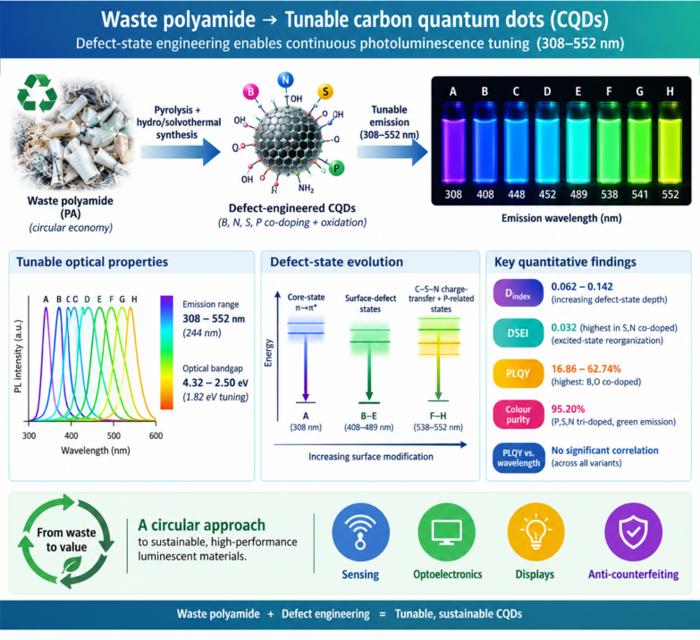
Waste polyamide-derived CQDs show continuous photoluminescence tuning from 308 to 552 nm through sequential defect-state engineering, with optical transition energies decreasing from 4.32 to 2.50 eV. @Christian Ebere Enyoh from Saitama University Carbon quantum dots (CQDs) are fluorescent carbon nanomaterials with potential applications in sensing, optoelectronics, displays, anti-counterfeiting, and environmental technologies. Their optical properties can be adjusted by modifying the carbon...
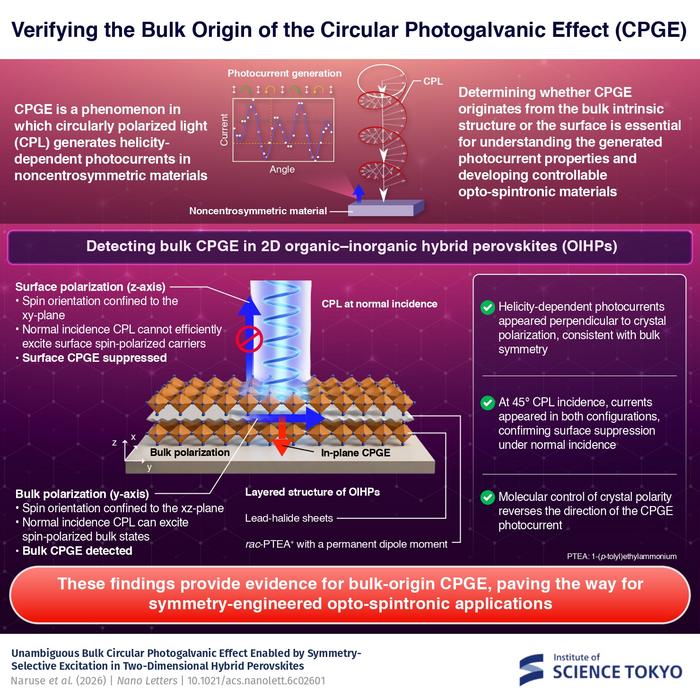
The researchers used circularly polarized light at normal incidence and found that helicity-dependent photocurrents appeared perpendicular to the crystal’s polarization but vanished when measured parallel to it, supporting a bulk origin of CPGE. @Institute of Science Tokyo The circular photogalvanic effect (CPGE), a phenomenon that generates helicity-dependent photocurrents in noncentrosymmetric materials, can originate purely from a crystal's internal structure without contribution from the...
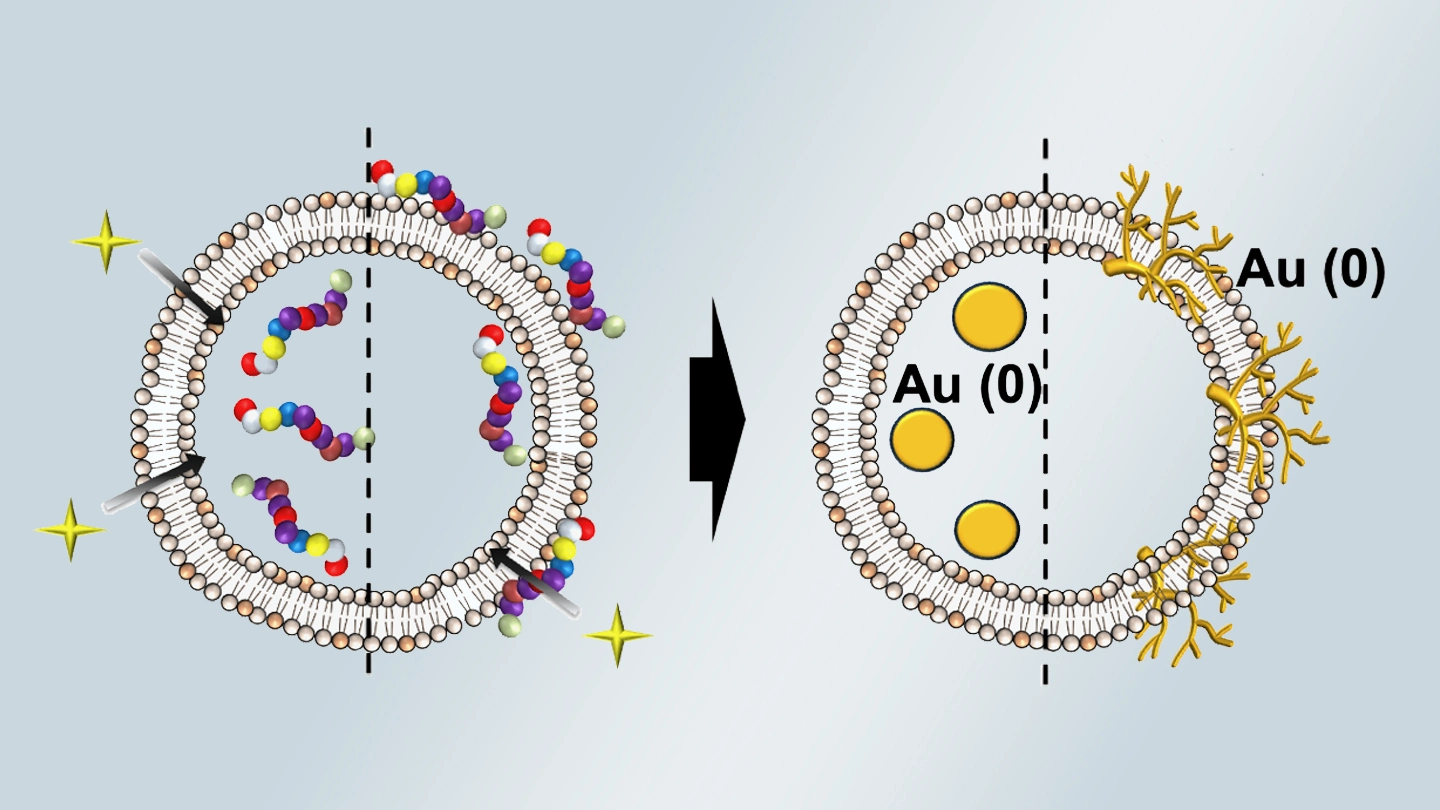
Summary of gold nanoparticle growth programming in liposome based on localization of biomineralization peptide The position of biomineralization peptides within liposomes can influence how gold nanoparticles grow, reports a research team from Institute of Science Tokyo. Peptides localized at the membrane interface promote branched structures, while those confined to the liposome interior favor spherical nanoparticles. The findings offer a new strategy for controlling nanoscale reaction...
