Peak Nano has published specifications for NanoPlex HDC, a nanolayered high-dielectric-constant film aimed at motor start capacitor designs. The company reports capacitance 1.7 to 2.1 times that of BOPP at the same thickness, with a dielectric constant of 3.7 to 4.7 under ASTM D150.
The film is rated to 105°C without derating and contains no liquid electrolyte. Published loss values are 0.5 to 1.0% at 1 kHz and 25°C, also by ASTM D150. Peak Nano says its coextrusion process can build hundreds to thousands of layers, each as thin as 25 nanometers.
Peak Nano positions HDC for burst duty rather than continuous run duty. It names hard-start kits, universal replacement start capacitors, well pump control boxes, farm and shop motors, refrigeration compressors, motor and medium-voltage start stages, and turbine ignition exciters as candidate applications. Run capacitors and power factor correction stages remain on the company's low-loss NanoPlex LDF film.
The company says the fastest path to market runs through parts a capacitor maker controls, such as hard-start kits and universal replacement start capacitors, which reach contractors without an OEM redesign. Well pump control boxes, farm and shop motors, and refrigeration compressors would follow on their own design cycles.
Peak Nano recommends that an HDC evaluation test a part against field duty profiles rather than a datasheet alone. Capacitor makers can request a NanoPlex HDC sample kit for qualification testing at peaknano.com/nanoplex/hdc.
Source: Peak Nano news
First Graphene has signed a three-year Joint Development and Commercialisation Agreement with UNITEX Composite (Ningbo) Co., Ltd to develop graphene enhanced carbon fibre composites, starting with carbon fibre prepreg.
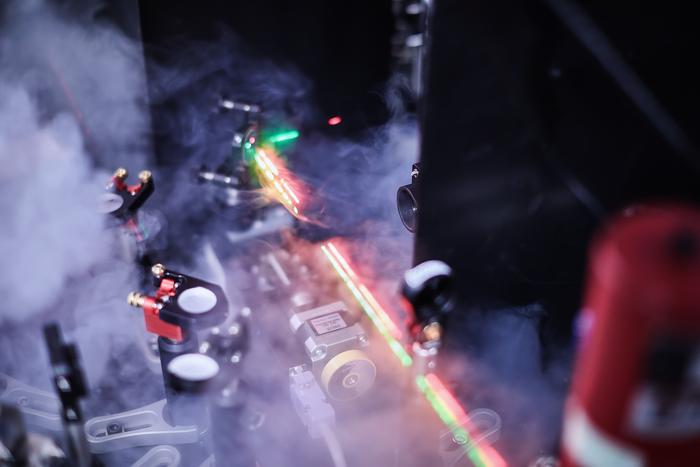
Researchers at MLU Halle-Wittenberg and the Max Planck Institute of Microstructure Physics have identified an unintended ferromagnetic interlayer that forms between ultrashort-pulse-excited Mn3Sn films and platinum, masking the chiral antiferromagnet's true properties. Curing the Mn3Sn layer before platinum deposition avoids the artefact, revealing spin-to-charge conversion at roughly 10% of platinum's efficiency.
University of Nottingham researchers and industry collaborators used SiMPore nanoporous silicon nitride TEM windows to capture and analyze exhaust particles from hydrogen and ammonia engines in a three-paper series.
This week in nanotech
$129.9M raised
6 funding rounds · 39 deals tracked
New products
 Ti-WCMBN Nanomaterialia Featured
 DLS-1 Mass Spectrometer for Fusion Gas AnalysisHiden Analytical Featured
 Discover Mapping SuiteOnto Innovation
Market insights
Last 30 days: Semiconductors & Electronics drew the most money: $547.7M.
Money raised per month