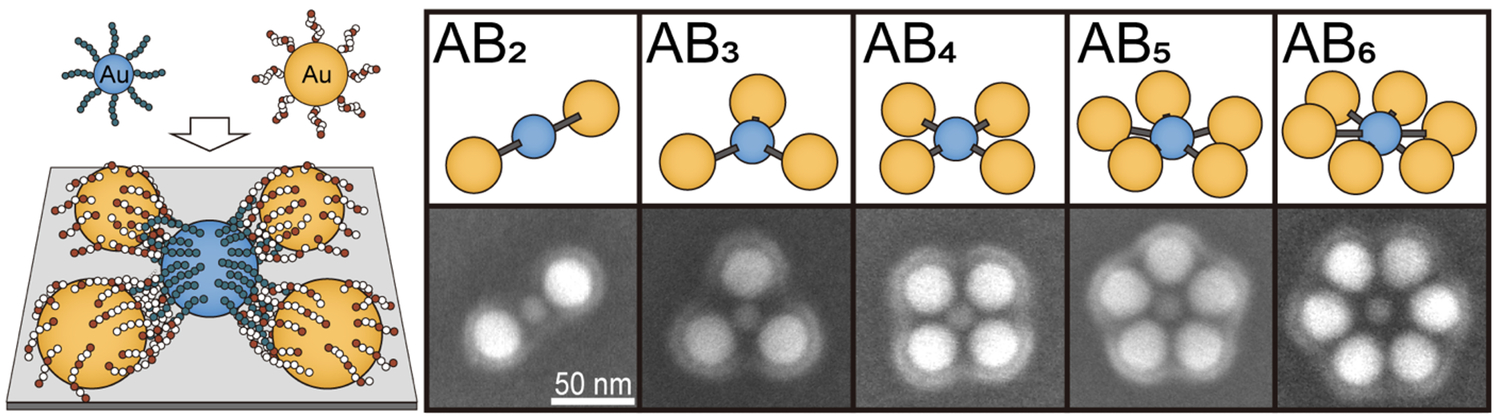
In the incredibly small world of molecules, the elementary building blocks – the atoms – join together in a very regular pattern. In contrast, in the macroscopic world with its larger particles, there is much greater disorder when particles connect. A research team at the University of Göttingen has now succeeded in achieving the same precise arrangement of atoms shown in molecules, but using nanometer-sized particles, known as “plasmonic molecules” – combinations of nanoscale metallic structures that have unique properties. The results were published in Angewandte Chemie International Edition, the journal of the German Chemical Society, which has classified the article as a "very important paper".
There is a transition area between molecular and macroscopic levels, an in-between zone called the nanometre range, where there is often a disordered aggregation of particles. Precise arrangement of nanometre-sized structures – at just one billionth of a metre – is one of the major challenges in the ongoing miniaturisation in electronics, optics and medicine. In this novel process developed by Dr Yinging Cai and Professor Philipp Vana at Göttingen University’s Institute of Physical Chemistry, the nanometre-sized particles are mixed together as in a chemical reaction and then arrange themselves completely independently into molecule-like structures.
"The approach here is to connect the particles using tailor-made polymer chains that interlock like two hands. We can control the force of this handshake via the type and length of the polymers and via the solvent used in which the reaction takes place," explains Cai. The result is plasmonic molecules, which all have the same regular arrangement and can be produced quickly in large quantities – an important prerequisite for making these compounds useful and useable for a multitude of functions in the world of nanotechnology. "By developing these plasmonic molecules, we have been able to establish chemical principles in the nanoworld that open up a whole new cosmos," says Vana. "And we may just be witnessing the birth of a new kind of plasmonic chemistry that could lead to a wealth of new nanomaterials."
Reference
2D Plasmonic Molecules via Hydrogen Bond Interaction between Polymer-Grafted Nanoparticles
Dr. Yingying Cai, Prof. Dr. Philipp Vana
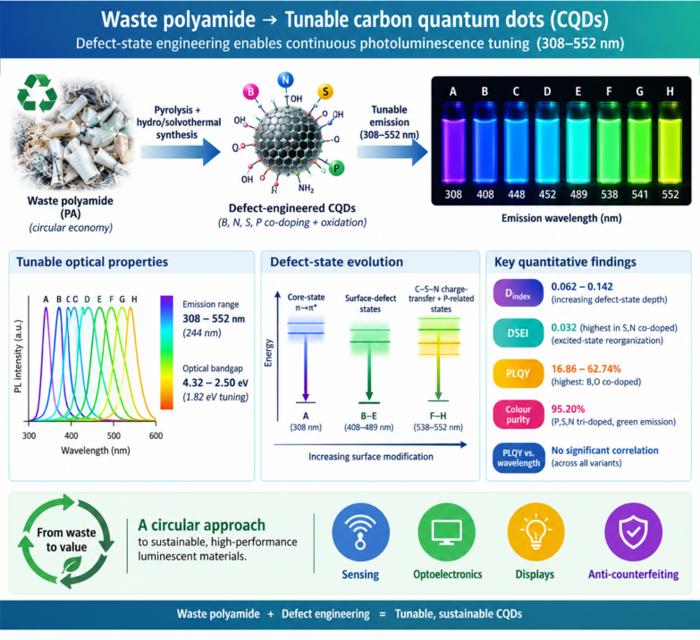
Waste polyamide-derived CQDs show continuous photoluminescence tuning from 308 to 552 nm through sequential defect-state engineering, with optical transition energies decreasing from 4.32 to 2.50 eV. @Christian Ebere Enyoh from Saitama University Carbon quantum dots (CQDs) are fluorescent carbon nanomaterials with potential applications in sensing, optoelectronics, displays, anti-counterfeiting, and environmental technologies. Their optical properties can be adjusted by modifying the carbon...
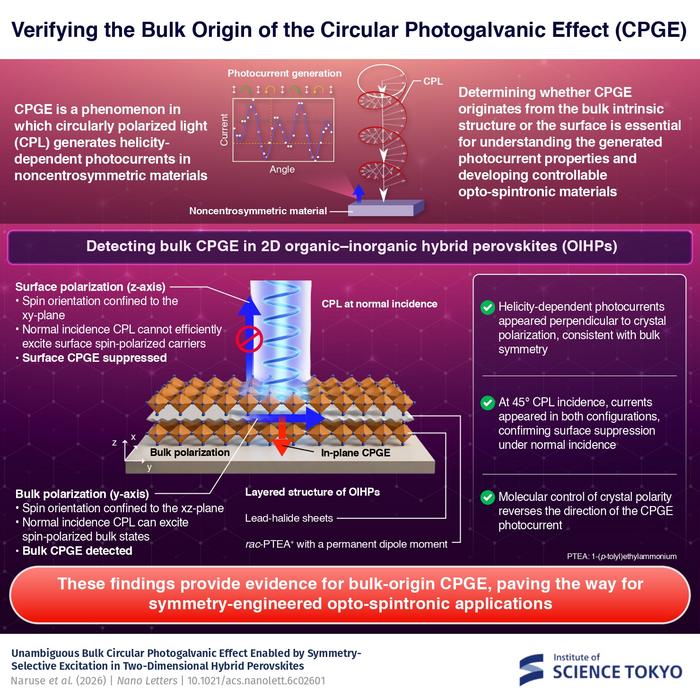
The researchers used circularly polarized light at normal incidence and found that helicity-dependent photocurrents appeared perpendicular to the crystal’s polarization but vanished when measured parallel to it, supporting a bulk origin of CPGE. @Institute of Science Tokyo The circular photogalvanic effect (CPGE), a phenomenon that generates helicity-dependent photocurrents in noncentrosymmetric materials, can originate purely from a crystal's internal structure without contribution from the...
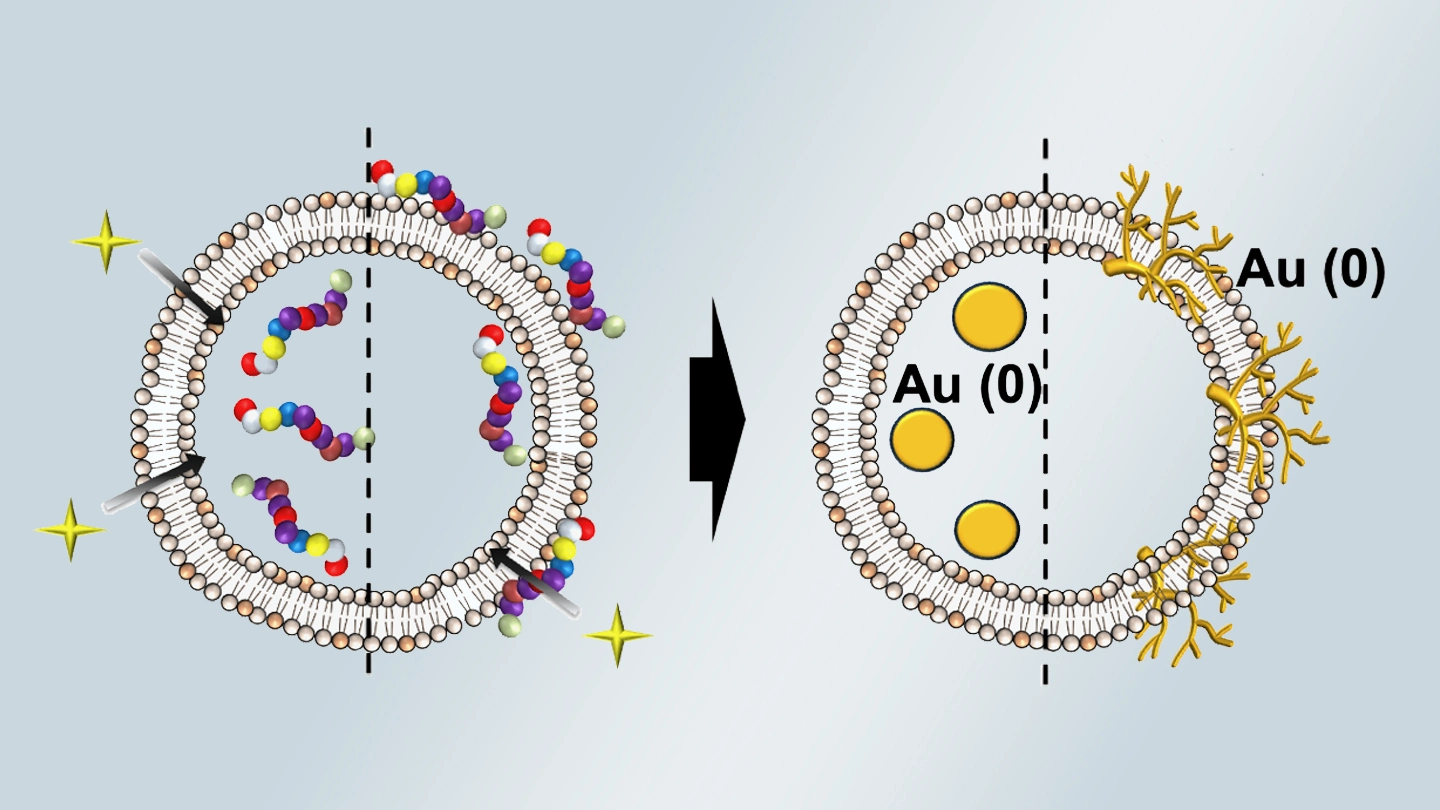
Summary of gold nanoparticle growth programming in liposome based on localization of biomineralization peptide The position of biomineralization peptides within liposomes can influence how gold nanoparticles grow, reports a research team from Institute of Science Tokyo. Peptides localized at the membrane interface promote branched structures, while those confined to the liposome interior favor spherical nanoparticles. The findings offer a new strategy for controlling nanoscale reaction...
