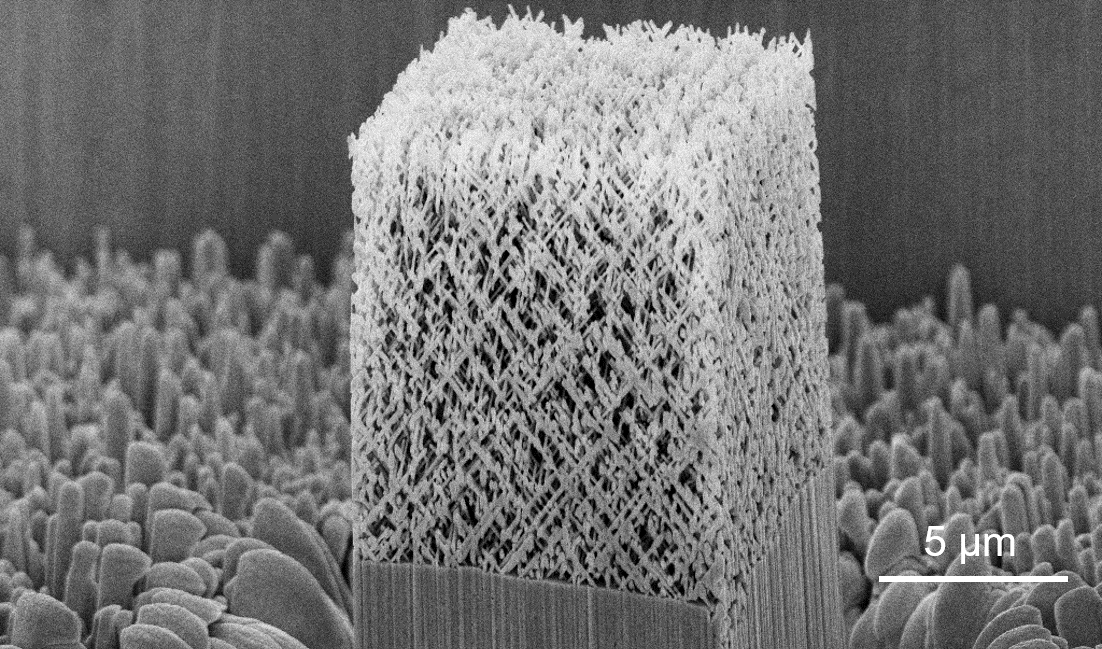
Chinese researchers have successfully fabricated mechanical metamaterials with ultra-high energy absorption capacity using the ion track technology. The results were published in Nature Communications as Editors' Highlights.
The study was conducted by the researchers from the Materials Research Center of the Institute of Modern Physics (IMP) of the Chinese Academy of Sciences (CAS) and their collaborators from Chongqing University.
Mechanical metamaterials refer to a class of composite materials with artificially designed structures, which exhibit extraordinary mechanical properties that traditional materials do not have. Among them, energy absorption mechanical metamaterials can absorb mechanical energy more efficiently, which requires the material itself to equip both high strength and high strain capacity, which, however, hardly co-exist in general.
Nanolattice is a new class of mechanical metamaterials with characteristic sizes on the nanoscale. Due to size effects, geometrical configuration, and material selection, the mechanical properties of this type of porous materials are very different from those of bulk materials. Given its even better mechanical properties with lighter weight, nanolattice is expected to bring revolutionary applications in the field of high-performance functional materials in the future.
Beam-structured nanolattice is the research focus of nanolattice metamaterials. However, it has been so challenging to fabricate metallic beam nanolattice with beam diameter less than 100 nm, and thus its mechanical properties still remain ambiguous.
In this work, based on the Heavy Ion Research Facility at Lanzhou (HIRFL), the researchers fabricated a new type of quasi-body centered cubic (quasi-BCC) beam nanolattice mechanical metamaterial with the ion track technology. The beam diameter of the quasi-BCC nanolattice can be as small as 34 nm, a record low beam diameter of mechanical metamaterials.
Besides, the researchers demonstrated that gold and copper quasi-BCC beam nanolattices have excellent energy absorption capacity and compressive strength. The experiments showed that the energy absorption capacity of the copper quasi-BCC beam nanolattice exceeds that of the previously reported beam nanolattice. The yield strength of the gold and copper quasi-BCC beam nanolattices exceeds that of the corresponding bulk materials at less than half the density of the latter.
Furthermore, the researchers revealed that the extraordinary mechanical properties are mainly due to the synergistic effect of size effects, quasi-BCC geometry, and good ductility of metals.
This study sheds light on the mechanical properties of the beam nanolattices, and applies the ion track technology as a new method for the exploration of beam nanolattice with ultra-high energy absorption capacity.
Reference
Mechanical metamaterials made of freestanding quasi-BCC nanolattices of gold and copper with ultra-high energy absorption capacity
Hongwei Cheng, Xiaoxia Zhu, Xiaowei Cheng, Pengzhan Cai, Jie Liu, Huijun Yao, Ling Zhang & Jinglai Duan
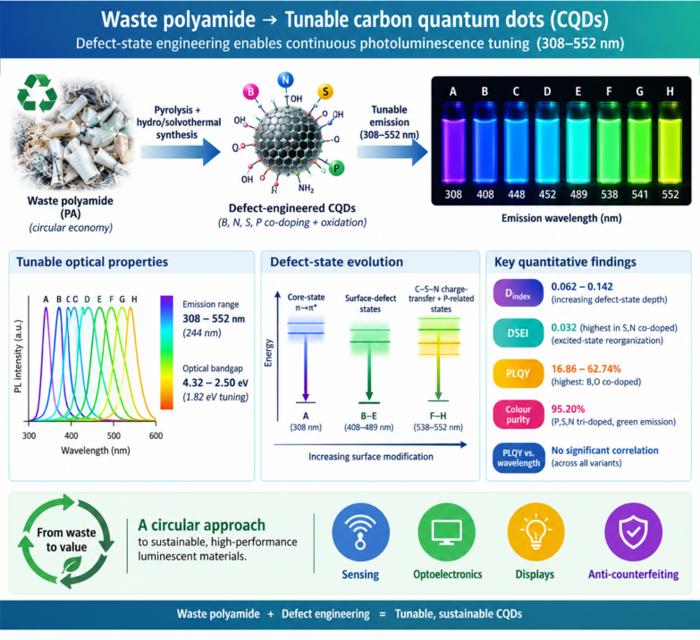
Waste polyamide-derived CQDs show continuous photoluminescence tuning from 308 to 552 nm through sequential defect-state engineering, with optical transition energies decreasing from 4.32 to 2.50 eV. @Christian Ebere Enyoh from Saitama University Carbon quantum dots (CQDs) are fluorescent carbon nanomaterials with potential applications in sensing, optoelectronics, displays, anti-counterfeiting, and environmental technologies. Their optical properties can be adjusted by modifying the carbon...
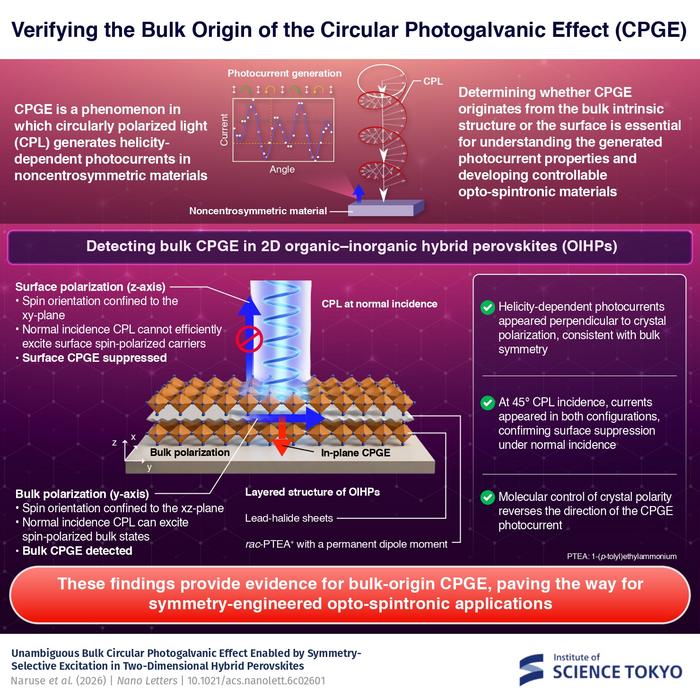
The researchers used circularly polarized light at normal incidence and found that helicity-dependent photocurrents appeared perpendicular to the crystal’s polarization but vanished when measured parallel to it, supporting a bulk origin of CPGE. @Institute of Science Tokyo The circular photogalvanic effect (CPGE), a phenomenon that generates helicity-dependent photocurrents in noncentrosymmetric materials, can originate purely from a crystal's internal structure without contribution from the...
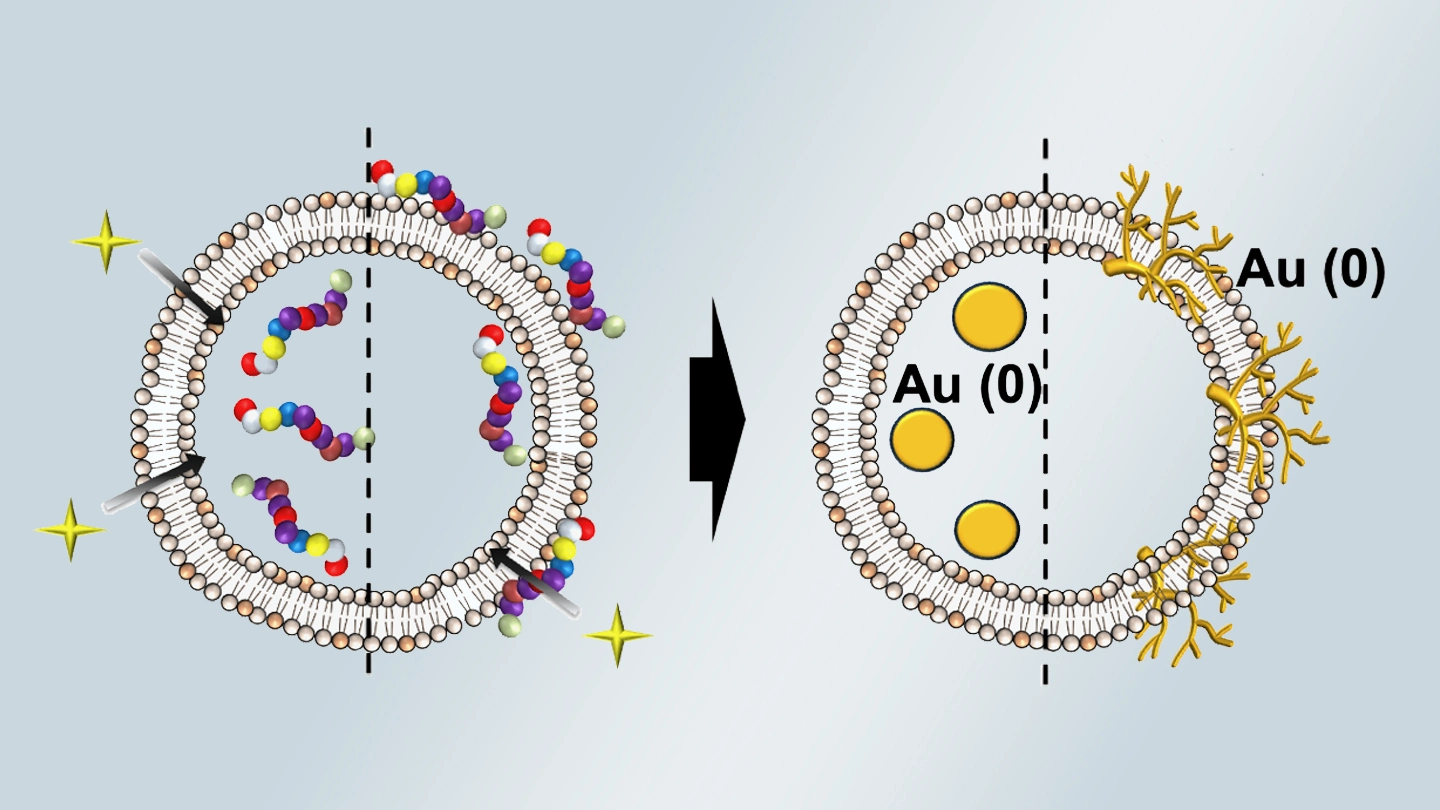
Summary of gold nanoparticle growth programming in liposome based on localization of biomineralization peptide The position of biomineralization peptides within liposomes can influence how gold nanoparticles grow, reports a research team from Institute of Science Tokyo. Peptides localized at the membrane interface promote branched structures, while those confined to the liposome interior favor spherical nanoparticles. The findings offer a new strategy for controlling nanoscale reaction...
