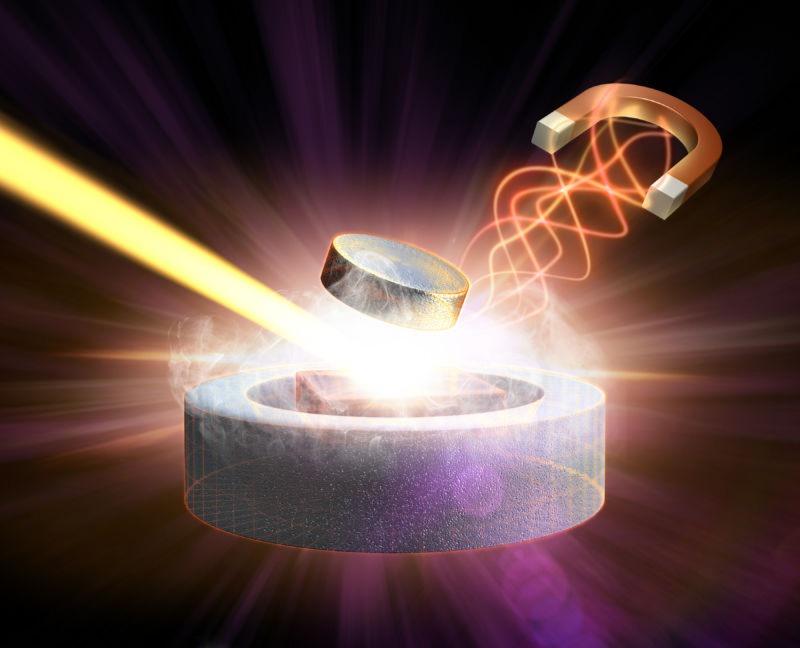
A group of researchers from Pisa, Jyväskylä, San Sebastian and MIT have demonstrated how a heterostructure consisting of superconductors and magnets can be used to create uni-directional current like that found in semiconductor diodes.
These novel superconductor diodes, however, operate at much lower temperatures than their semiconductor counterparts and are therefore useful in quantum technologies.
Electronics for quantum technology
Most of our everyday electronic appliances, such as radios, logic components or solar panels, rely on diodes where current can flow primarily in one direction. Such diodes rely on the electronic properties of semiconductor systems which cease to work at the ultralow sub-Kelvin temperatures required in tomorrow’s quantum technology. Superconductors are metals whose electrical resistivity is usually zero but, when contacted with other metals, can exhibit high contact resistance.
This can be understood from the energy gap, which indicates a forbidden region for electronic excitations that form in superconductors. It resembles the energy gap in semiconductors but is typically much smaller. While the presence of such a gap has been known for decades, the diode-like feature has not been previously observed, because it requires breaking the usually robust symmetry of the contact’s current–voltage characteristics. The new work demonstrates how this symmetry can be broken with the help of a ferromagnetic insulator suitably placed in the junction. Since a big part of today’s research on quantum technologies is based on superconducting materials operating at ultralow temperatures, this innovation is readily available for them.
Power of collaboration
The research finding was made as part of the SUPERTED project, which is being funded under the EU’s Future and Emerging Technologies (FET Open). This project aims at creating the world’s first superconducting thermoelectric detector of electromagnetic radiation, based on superconductor/magnet heterostructures. “Actually, finding the diode functionality was a pleasant surprise, a consequence of the thorough characterization of SUPERTED samples,” explains Elia Strambini, from Istituto Nanoscienze – CNR and Scuola Normale Superiore (SNS) in Pisa, who made the initial discovery.
Francesco Giazotto, from Istituto Nanoscienze – CNR and SNS and who led the experimental efforts, says: “I believe this finding is promising for several tasks in quantum technology, such as current rectification or current limiting.” SUPERTED coordinator Tero Heikkilä, from the University of Jyväskylä, worked on the theory behind the effect: “This finding showed the power of collaboration between different types of researchers, from materials science to superconducting electronics and theory. Without European support such collaboration would not take place.”
Reference
Superconducting spintronic tunnel diode
E. Strambini, M. Spies, N. Ligato, S. Ilić, M. Rouco, Carmen González-Orellana, Maxim Ilyn, Celia Rogero, F. S. Bergeret, J. S. Moodera, P. Virtanen, T. T. Heikkilä & F. Giazotto
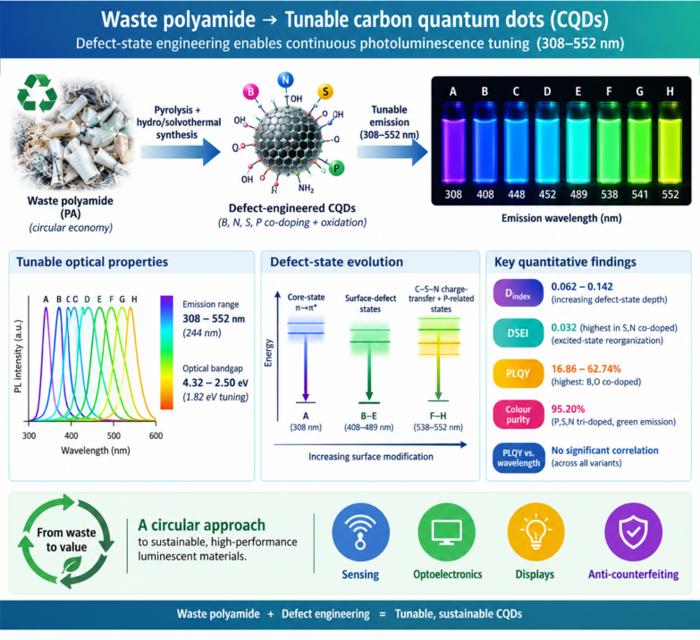
Waste polyamide-derived CQDs show continuous photoluminescence tuning from 308 to 552 nm through sequential defect-state engineering, with optical transition energies decreasing from 4.32 to 2.50 eV. @Christian Ebere Enyoh from Saitama University Carbon quantum dots (CQDs) are fluorescent carbon nanomaterials with potential applications in sensing, optoelectronics, displays, anti-counterfeiting, and environmental technologies. Their optical properties can be adjusted by modifying the carbon...
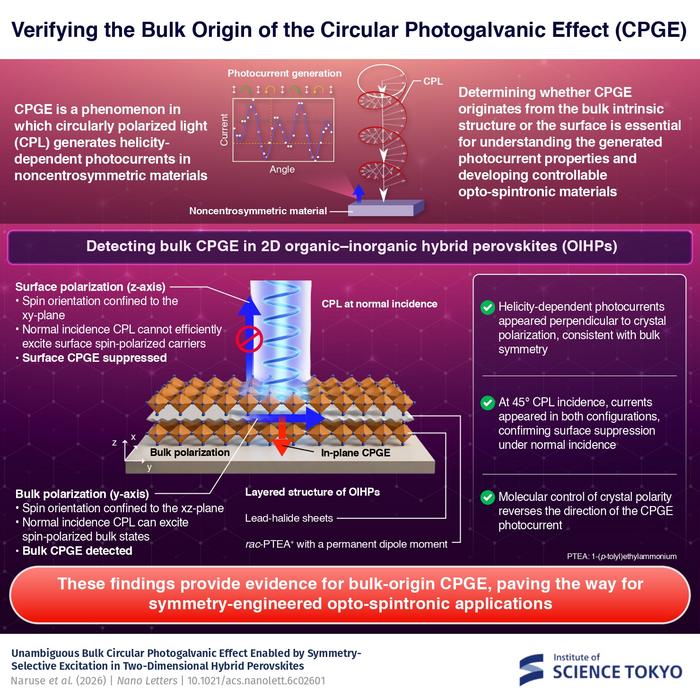
The researchers used circularly polarized light at normal incidence and found that helicity-dependent photocurrents appeared perpendicular to the crystal’s polarization but vanished when measured parallel to it, supporting a bulk origin of CPGE. @Institute of Science Tokyo The circular photogalvanic effect (CPGE), a phenomenon that generates helicity-dependent photocurrents in noncentrosymmetric materials, can originate purely from a crystal's internal structure without contribution from the...
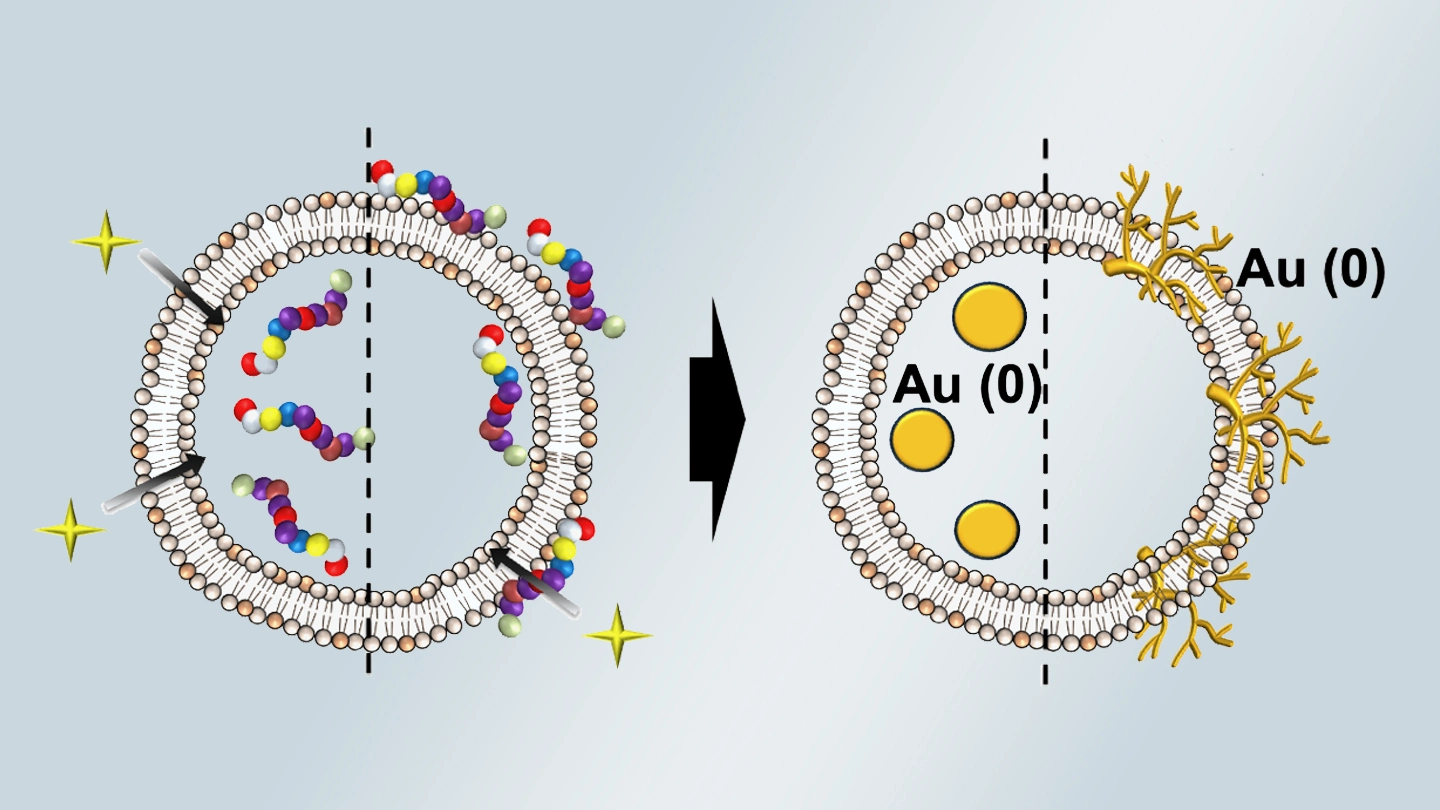
Summary of gold nanoparticle growth programming in liposome based on localization of biomineralization peptide The position of biomineralization peptides within liposomes can influence how gold nanoparticles grow, reports a research team from Institute of Science Tokyo. Peptides localized at the membrane interface promote branched structures, while those confined to the liposome interior favor spherical nanoparticles. The findings offer a new strategy for controlling nanoscale reaction...
