Elhuyar Fundazioa
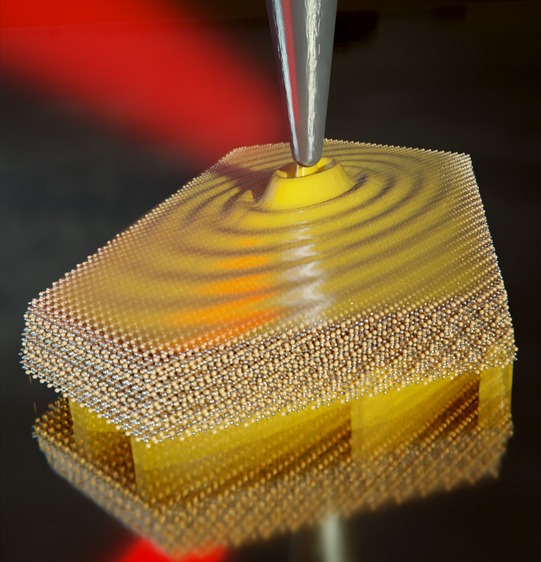
An international team of scientists from the Basque research center CIC nanoGUNE, Shanghai University for Science and Technology, Fudan University (Shanghai), Brno University of Technology, University of the Basque Country, Materials Physics Center (CSIC-UPV/EHU), Donostia International Physics Center and the Max Planck Institute for Chemical Physics of Solids (Dresden) has imaged and analyzed THz waves that propagate in form of plasmon polaritons along thin anisotropic semiconductor platelets with wavelengths reduced by up to 65 times compared to THz waves in free space. What´s even more intriguing is that the wavelengths vary with the direction of propagation. Such THz waves can be applied for probing fundamental material properties at the nanometer scale and pave the way to the development of ultra-compact on-chip THz devices. The work has been published in Nature Materials.
Polaritons are hybrid states of light and matter that arise from the coupling of light with matter excitations. Plasmon and phonon polaritons are among the most prominent examples, formed by the coupling of light to collective electron oscillations and crystal lattice vibrations, respectively. They play a crucial role in various applications, from sub-diffraction optical spectroscopy and ultrasensitive chemical sensors to ultracompact modulators for communication applications. In thin layers, polaritons can propagate with wavelengths up to 100 times shorter than the corresponding photon wavelength, allowing for manipulation of light on a much smaller scale than previously possible with conventional photonic devices.
While most of these ultra-confined polaritons have been observed in form of phonon polaritons in the mid-infrared spectral range, the researchers focused on plasmon polaritons, as these can exist in much broader spectral ranges. “On the other hand, plasmon polaritons often suffer from large damping, resulting in short propagation lengths. This has been challenging the observation of ultra-confined plasmon polaritons in real space”, says Shu Chen, first author of the publication.
Using a THz nanoscope (more precisely, a THz scattering-type scanning near-field optical microscope, s-SNOM) in Rainer Hillenbrand´s lab at CIC nanoGUNE (San Sebastian, Spain), Chen studied thin platelets of the low-symmetry crystal silver telluride (Ag2Te; Hessite) and obtained the first real-space images of THz plasmon polaritons, whose wavelengths are up to 65 times reduced compared to the photon wavelength and vary with the propagation direction.
“Silver telluride is a narrow bandgap semiconductor with a relatively high mobile electron concentration, which makes this material plasmonic at THz frequencies”, says Pengliang Leng, equally contributing first author, who fabricated the platelets in Faxian Xiu´s lab at Fudan University (Shanghai, China). “Because of the low-symmetry monoclinic crystal structure, the effective electron mass is strongly anisotropic along the platelet surface, which explains the anisotropic plasmon polariton propagation”, adds Faxian Xiu.
The researchers also demonstrated that the relative propagation lengths of the THz polaritons can be significantly increased by coupling them with their mirror image in an adjacent metal substrate. “Because of this coupling, so-called acoustic plasmon polaritons are formed”, explains Andrea Konečná from Brno University (Czech Republic), who theoretically modelled the acoustic polaritons. “Most important, the anisotropy of the polariton propagation is qualitatively preserved, and the long relative propagation lengths allowed us to unambiguously verify that the polaritons propagate with elliptical wavefronts”, adds Rainer Hillenbrand from nanoGUNE, who led the work.
The long relative propagation lengths of the elliptical acoustic plasmon polaritons finally allowed the researchers to determine the in-plane anisotropic effective electron mass, establishing a unique method for the nanoscale measurement of directional effective carrier masses at room temperature.
Beyond exploring fundamental materials properties in conventional and novel quantum materials, ultra-confined in-plane anisotropic acoustic plasmon polaritons may lead to ultra-compact on-chip THz applications. The strong field concentration in the gap between the polaritonic layer and metal surface may be exploited for field-enhanced molecular sensing or for boosting (ultra)strong THz light–matter coupling with molecules, classical 2D electron gases or quantum materials.
Reference
Real-space observation of ultraconfined in-plane anisotropic acoustic terahertz plasmon polaritons
S. Chen, P. L. Leng, A. Konečná, E. Modin, M. Gutierrez-Amigo, E. Vicentini, B. Martín-García, M. Barra-Burillo, I. Niehues, C. Maciel Escudero, X. Y. Xie, L. E. Hueso, E. Artacho, J. Aizpurua, I. Errea, M. G. Vergniory, A. Chuvilin, F. X. Xiu & R. Hillenbrand
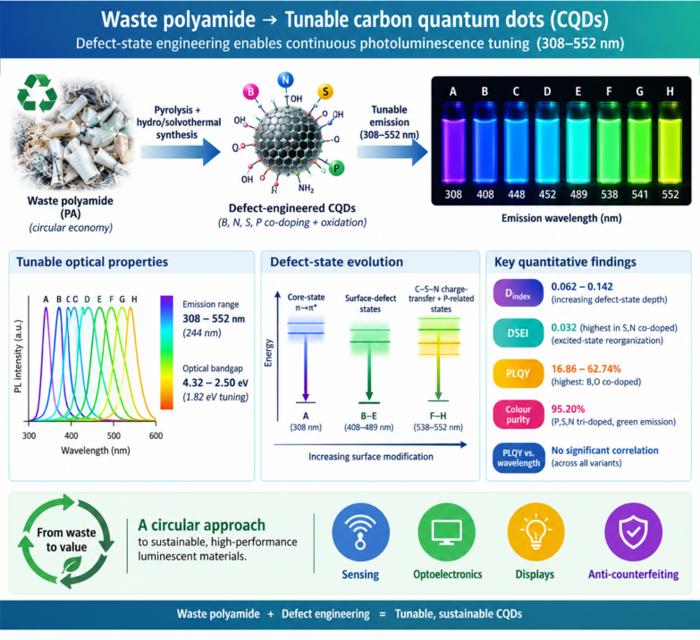
Waste polyamide-derived CQDs show continuous photoluminescence tuning from 308 to 552 nm through sequential defect-state engineering, with optical transition energies decreasing from 4.32 to 2.50 eV. @Christian Ebere Enyoh from Saitama University Carbon quantum dots (CQDs) are fluorescent carbon nanomaterials with potential applications in sensing, optoelectronics, displays, anti-counterfeiting, and environmental technologies. Their optical properties can be adjusted by modifying the carbon...
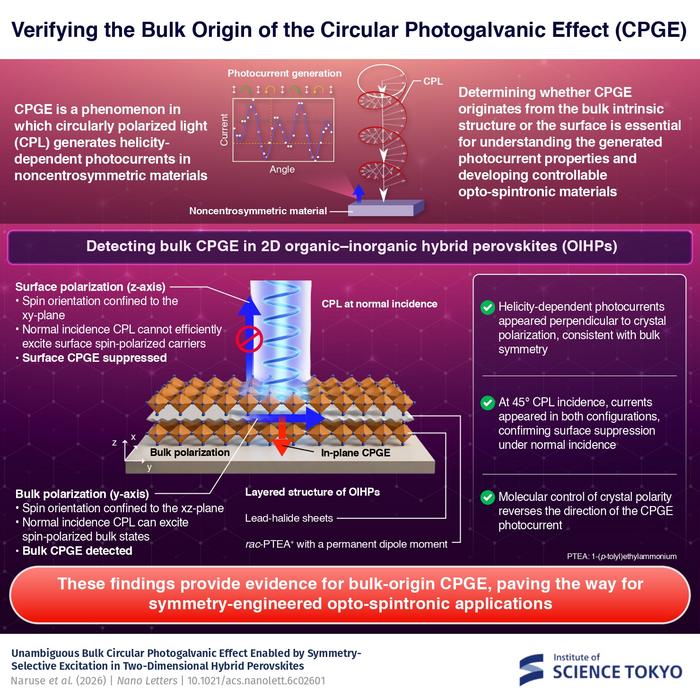
The researchers used circularly polarized light at normal incidence and found that helicity-dependent photocurrents appeared perpendicular to the crystal’s polarization but vanished when measured parallel to it, supporting a bulk origin of CPGE. @Institute of Science Tokyo The circular photogalvanic effect (CPGE), a phenomenon that generates helicity-dependent photocurrents in noncentrosymmetric materials, can originate purely from a crystal's internal structure without contribution from the...
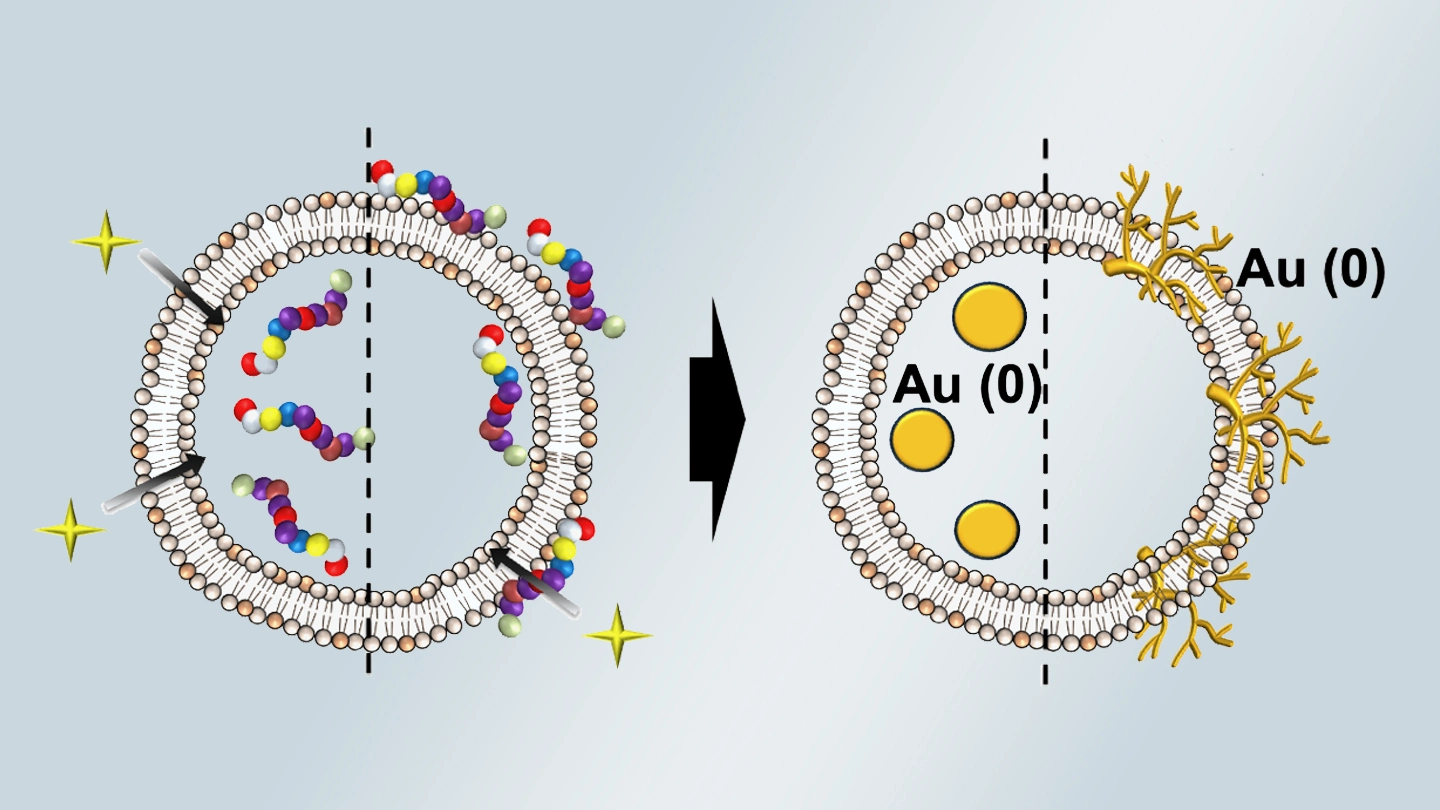
Summary of gold nanoparticle growth programming in liposome based on localization of biomineralization peptide The position of biomineralization peptides within liposomes can influence how gold nanoparticles grow, reports a research team from Institute of Science Tokyo. Peptides localized at the membrane interface promote branched structures, while those confined to the liposome interior favor spherical nanoparticles. The findings offer a new strategy for controlling nanoscale reaction...
