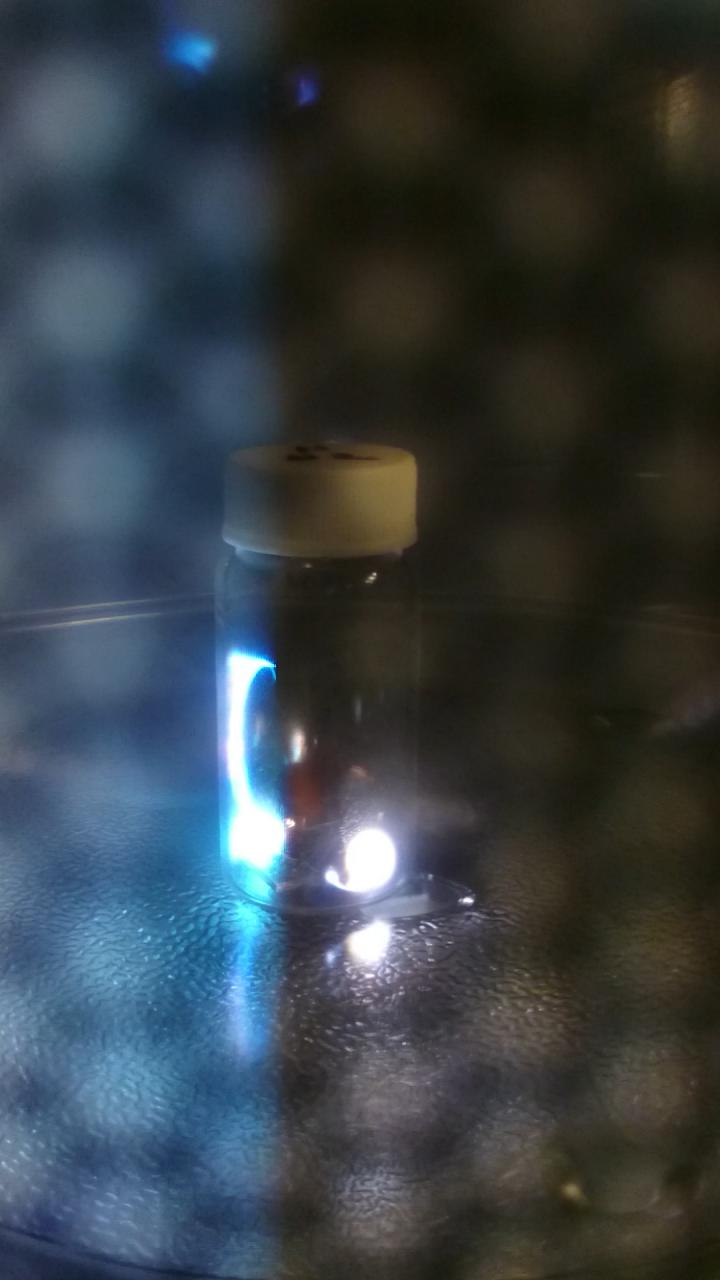
Using copper foil, glass containers and a conventional household microwave oven, University of Wyoming researchers have demonstrated that pulverized coal powder can be converted into higher-value nano-graphite.
The discovery is another step forward in the effort to find alternative uses for Wyoming's Powder River Basin coal, at a time when demand for coal to generate electricity is declining due to concerns about climate change.
In a paper published in the journal Nano-Structures & Nano-Objects, the UW researchers report that they created an environment in a microwave oven to successfully convert raw coal powder into nano-graphite, which is used as a lubricant and in items ranging from fire extinguishers to lithium ion batteries. This "one-step method with metal-assisted microwave treatment" is a new approach that could represent a simple and relatively inexpensive coal-conversion technology.
"This method provides a new route to convert abundant carbon sources to high-value materials with ecological and economic benefits," wrote the research team, led by Associate Professor TeYu Chien, in UW's Department of Physics and Astronomy.
Others involved in the project were Professor Jinke Tang, in the Department of Physics and Astronomy; Associate Professor Brian Leonard, in the Department of Chemistry; Professor Maohong Fan, in the Department of Petroleum Engineering and the School of Energy Resources; graduate students Rabindra Dulal, of Nepal, Joann Hilman, of Laramie, Wyo., Chris Masi, of Syracuse, N.Y., and Teneil Schumacher, of Buffalo, Wyo.; and postdoctoral researchers Gaurab Rimal, of Nepal, and Bang Xu, of China.
While previous research has shown that microwaves can be used to reduce the moisture content of coal and remove sulfur and other minerals, most such methods require specific chemical pretreatment of the coal. In their experiment, the UW researchers simply ground raw Powder River Basin coal into powder.
That powder was then placed on copper foil and sealed in glass containers with a gas mixture of argon and hydrogen, before being placed in a microwave oven. A conventional microwave oven was chosen because of convenience and because it provided the desired levels of radiation.
"By cutting the copper foil into a fork shape, the sparks were induced by the microwave radiation, generating an extremely high temperature of more than 1,800 degrees Fahrenheit within a few seconds," says Masi, lead author of the paper. "This is why you shouldn't place a metal fork inside a microwave oven."
The sparks caused by the microwaves generated the high temperatures necessary to transform the coal powder into polycrystalline graphite, with the copper foil and hydrogen gas also contributing to the process.
While the experiment included microwave durations ranging from 3 to 45 minutes, the optimal duration was found to be 15 minutes.
The researchers say this new method of coal conversion could be refined and performed at a larger scale to yield both a higher quality and quantity of nano-graphite materials.
"Finite graphite reserves and environmental concerns for the graphite extraction procedures make this method of converting coal to graphite a great alternative source of graphite production," the scientists wrote.
Contact
TeYu Chien
Department of Physics & Astronomy
University of Wyoming
tchien@uwyo.edu
Reference
Converting raw coal powder into polycrystalline nano-graphite by metal-assisted microwave treatment
Christoffer A.Masi, Teneil A. Schumacher, Joann Hilman, Rabindra Dulal, Gaurab Rimal, Bang Xu, Brian Leonard, Jinke Tang, Maohong Fan and TeYu Chien
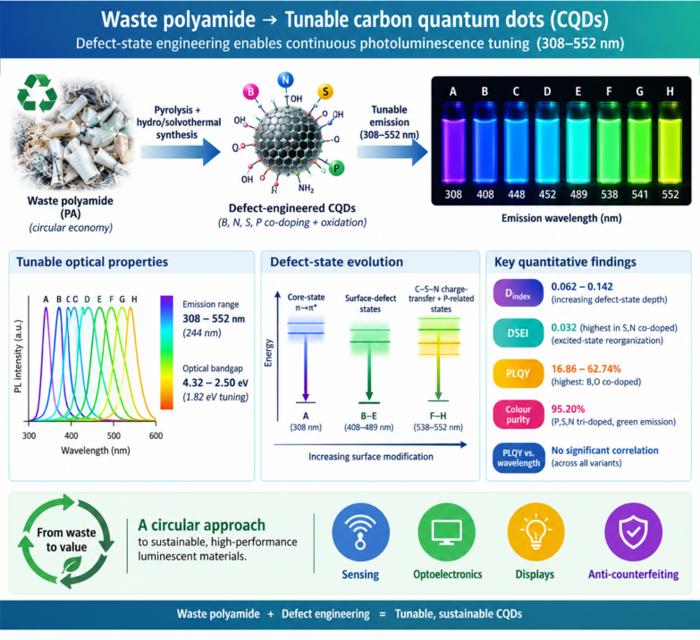
Waste polyamide-derived CQDs show continuous photoluminescence tuning from 308 to 552 nm through sequential defect-state engineering, with optical transition energies decreasing from 4.32 to 2.50 eV. @Christian Ebere Enyoh from Saitama University Carbon quantum dots (CQDs) are fluorescent carbon nanomaterials with potential applications in sensing, optoelectronics, displays, anti-counterfeiting, and environmental technologies. Their optical properties can be adjusted by modifying the carbon...
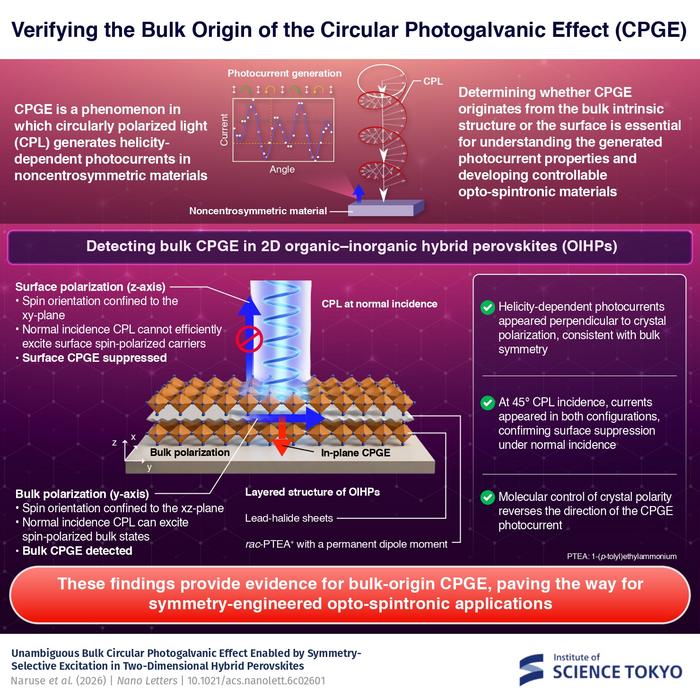
The researchers used circularly polarized light at normal incidence and found that helicity-dependent photocurrents appeared perpendicular to the crystal’s polarization but vanished when measured parallel to it, supporting a bulk origin of CPGE. @Institute of Science Tokyo The circular photogalvanic effect (CPGE), a phenomenon that generates helicity-dependent photocurrents in noncentrosymmetric materials, can originate purely from a crystal's internal structure without contribution from the...
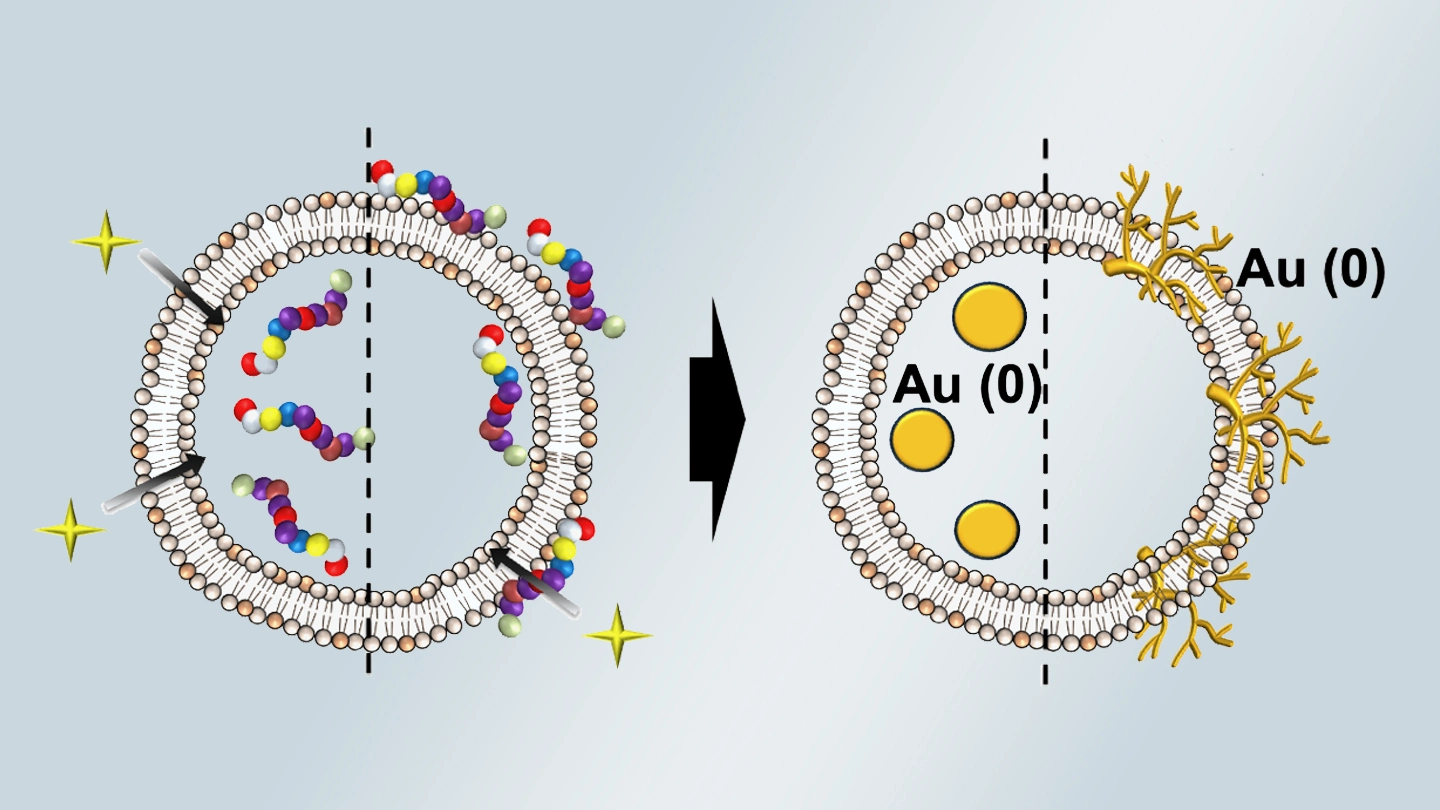
Summary of gold nanoparticle growth programming in liposome based on localization of biomineralization peptide The position of biomineralization peptides within liposomes can influence how gold nanoparticles grow, reports a research team from Institute of Science Tokyo. Peptides localized at the membrane interface promote branched structures, while those confined to the liposome interior favor spherical nanoparticles. The findings offer a new strategy for controlling nanoscale reaction...
