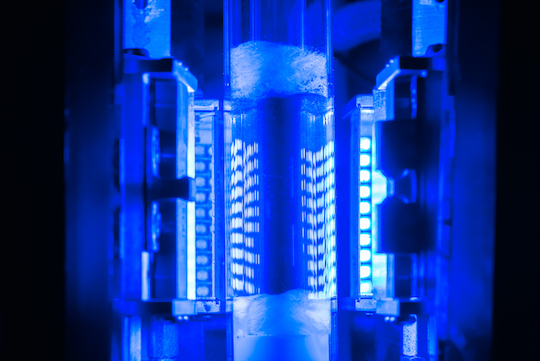
Rice University researchers have engineered a key light-activated nanomaterial for the hydrogen economy. Using only inexpensive raw materials, a team from Rice’s Laboratory for Nanophotonics, Syzygy Plasmonics Inc. and Princeton University’s Andlinger Center for Energy and the Environment created a scalable catalyst that needs only the power of light to convert ammonia into clean-burning hydrogen fuel.
@ Rice University
The research was published in the journal Science.
The research follows government and industry investment to create infrastructure and markets for carbon-free liquid ammonia fuel that will not contribute to greenhouse warming. Liquid ammonia is easy to transport and packs a lot of energy, with one nitrogen and three hydrogen atoms per molecule. The new catalyst breaks those molecules into hydrogen gas, a clean-burning fuel, and nitrogen gas, the largest component of Earth’s atmosphere. And unlike traditional catalysts, it doesn’t require heat. Instead, it harvests energy from light, either sunlight or energy-stingy LEDs.
The pace of chemical reactions typically increases with temperature, and chemical producers have capitalized on this for more than a century by applying heat on an industrial scale. The burning of fossil fuels to raise the temperature of large reaction vessels by hundreds or thousands of degrees results in an enormous carbon footprint. Chemical producers also spend billions of dollars each year on thermocatalysts — materials that don’t react but further speed reactions under intense heating.
“Transition metals like iron are typically poor thermocatalysts,” said study co-author Naomi Halas of Rice. “This work shows they can be efficient plasmonic photocatalysts. It also demonstrates that photocatalysis can be efficiently performed with inexpensive LED photon sources.”
“This discovery paves the way for sustainable, low-cost hydrogen that could be produced locally rather than in massive centralized plants,” said Peter Nordlander, also a Rice co-author.
The best thermocatalysts are made from platinum and related precious metals like palladium, rhodium and ruthenium. Halas and Nordlander spent years developing light-activated, or plasmonic, metal nanoparticles. The best of these are also typically made with precious metals like silver and gold.
Following their 2011 discovery of plasmonic particles that give off short-lived, high-energy electrons called “hot carriers,” they discovered in 2016 that hot-carrier generators could be married with catalytic particles to produce hybrid “antenna-reactors,” where one part harvested energy from light and the other part used the energy to drive chemical reactions with surgical precision.
Halas, Nordlander, their students and collaborators have worked for years to find non-precious metal alternatives for both the energy-harvesting and reaction-speeding halves of antenna reactors. The new study is a culmination of that work. In it, Halas, Nordlander, Rice alumnus Hossein Robatjazi, Princeton engineer and physical chemist Emily Carter, and others show that antenna-reactor particles made of copper and iron are highly efficient at converting ammonia. The copper, energy-harvesting piece of the particles captures energy from visible light.
“In the absence of light, the copper-iron catalyst exhibited about 300 times lower reactivity than copper-ruthenium catalysts, which is not surprising given that ruthenium is a better thermocatalyst for this reaction,” said Robatjazi, a Ph.D. alumnus from Halas’ research group who is now chief scientist at Houston-based Syzygy Plasmonics. “Under illumination, the copper-iron showed efficiencies and reactivities that were similar to and comparable with those of copper-ruthenium.
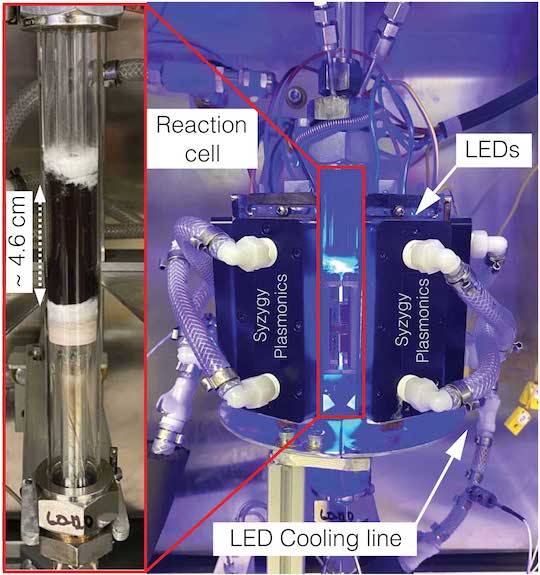
Syzygy has licensed Rice’s antenna-reactor technology, and the study included scaled-up tests of the catalyst in the company’s commercially available, LED-powered reactors. In laboratory tests at Rice, the copper-iron catalysts had been illuminated with lasers. The Syzygy tests showed the catalysts retained their efficiency under LED illumination and at a scale 500 times larger than the lab setup.
“This is the first report in the scientific literature to show that photocatalysis with LEDs can produce gram-scale quantities of hydrogen gas from ammonia,” Halas said. “This opens the door to entirely replace precious metals in plasmonic photocatalysis.”
“Given their potential for significantly reducing chemical sector carbon emissions, plasmonic antenna-reactor photocatalysts are worthy of further study,” Carter added. “These results are a great motivator. They suggest it is likely that other combinations of abundant metals could be used as cost-effective catalysts for a wide range of chemical reactions.”
Reference
Earth-abundant photocatalyst for H2 generation from NH3 with light-emitting diode illumination
Yigao Yuan, Linan Zhou, Hossein Robatjazi, Junwei Lucas Bao, Jingyi Zhou, Aaron Bayles, Lin Yuan, Minghe Lou, Minhan Lou, Suman Khatiwada, Emily A. Carter, Peter Nordlander, Naomi J. Halas

Silver nanoparticles with diameters of ~10 nm deliver the best performance as electrocatalysts. The silver particles are sprayed onto the electrode together with a conductive carbon powder. The ideal mixture consists of 20 per cent by mass silver and 80 per cent by mass carbon powder. This image was taken using a transmission electron microscope (TEM). © HZB Via electrolysis, CO₂ can be reduced to CO, a raw material for further chemical products such as fuels. Within the GreenQuest Project,...

A flexible metal–organic framework developed by researchers from Institute of Science Tokyo enables the structural determination of large "beyond rule of 5" molecules from microgram-scale samples. Using APF-40 as a crystalline sponge, the researchers determined the structures of 12 pharmaceutical-related molecules, including the 899 Da drug molecule doramectin and trace ivermectin derivatives. The method could aid drug discovery, natural products research, and the characterization of rare...
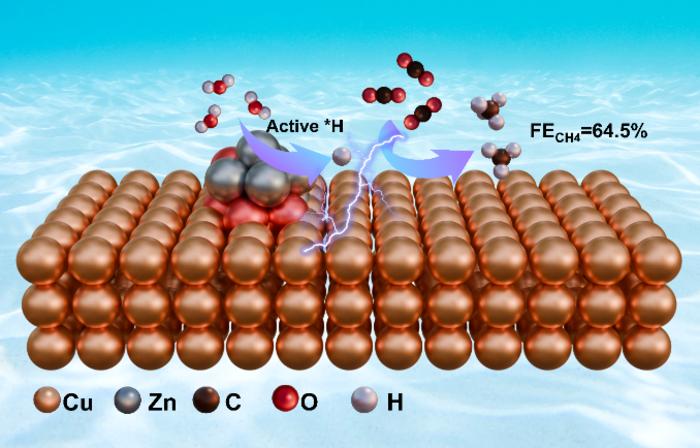
image: CuZn800@C was constructed via solvothermal method and utilizes the high-temperature volatility of zinc to prepare through calcination at different temperatures, which displays a high methane Faradaic efficiency of 64.5% and a remarkable partial current density of -551.3 mA/cm2 at -1.7 V vs. RHE, along with excellent stability. Zn and Cu form a tandem reaction system. Zn sites promote water splitting to provide protons, while Cu sites reduce the energy barrier for *CO hydrogenation....






