Rice University
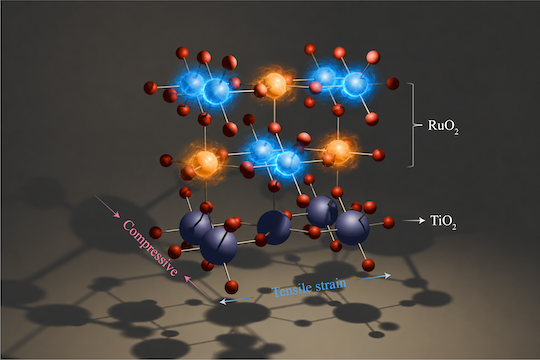
Recently, the field of magnetics has been proposed a new class of magnetism called altermagnetism, which could allow for advances in miniaturizing and improving RAM architecture in computers. Rice University’s Ming Yi, together with collaborators Bharat Jalan of the University of Minnesota and Milan Radovic of the Paul Scherrer Institute, recently published a paper in Science Advances showing that the quantum material ruthenium dioxide potentially displays this new altermagnetism in its ultrathin film form in which the material is prepared as a very thin slice only a few atomic layers thick.
“Ruthenium dioxide was one of the first materials to be proposed as an altermagnetic candidate, but studies on its bulk form didn’t return evidence of magnetism,” said Yi, an associate professor of physics and astronomy. “Our research shows that its ultrathin form, on the other hand, may be the key in making it magnetic.”
To determine the material’s magnetic state, the team measured the spin texture of ruthenium dioxide in its ultrathin film form. Spin texture tells researchers how the magnetic moments of a material — the spins of its electrons — arrange themselves in space, which in turn reveals the type of magnetism, if any, the material has. This measurement is done via a technique called spin-resolved angle-resolved photoemission spectroscopy.
“After analyzing our measurements, including informing our interpretation with theoretical calculations, we found that, in our experimental conditions, the ruthenium dioxide shows spin textures consistent with unconventional magnetism,” said Yichen Zhang, the first author on the paper and a recent Rice graduate. “This suggests that bulk and ultrathin ruthenium dioxide, under the right conditions, may have distinctly different magnetic properties.”
The right conditions to produce altermagnetism-like spins included putting the electron structure of the ultrathin ruthenium dioxide under pressure, called lattice strain. Without the strain, such as in the natural bulk form, the electron spins did not exhibit signs of altermagnetism.
“The strain-dependent nature suggests that we may be able to use lattice strain as a tuning knob to induce or control altermagnetism,” Zhang said. “This could be extremely useful when thinking about next-generation spintronics and RAM architectures.”
The study also brings more insight into the complexity of understanding and describing quantum materials. Ruthenium dioxide has been the subject of a long and complex scientific debate, as physicists worked to understand what its bulk form magnetic state was before arriving at the consensus of no magnetism.
“This work shows just how complex these questions can be,” Yi said. “The high quality material prep and the careful measurement protocol were critical to our observation of the correct electron spin properties. The results required careful analysis of spin-resolved angle-resolved photoemission spectroscopy. Through this, we were able to determine not only the magnetic state symmetries but a potential way to manipulate it in next-generation quantum materials.”
Reference
Observation of mirror-odd and mirror-even spin texture in ultrathin epitaxially strained RuO2 films
Yichen Zhang, Seung Gyo Jeong, Luca Buiarelli, Seungjun Lee, Yucheng Guo, Jiaqin Wen, Hang Li, Sreejith Nair, In Hyeok Choi, Zheng Ren, Ziqin Yue, Jounghoon Hyun, Tieqiong Zhang, Alexei Fedorov, Sung-Kwan Mo, Hojoon Lim, Adrian Hunt, Iradwikanari Waluyo, Junichiro Kono, Ján Minár, Jong Seok Lee, Tony Low, Turan Birol, Rafael M. Fernandes, Milan Radovic, Bharat Jalan, Ming Yi
Science Advances | 29 Jul 2026 | Vol 12, Issue 31
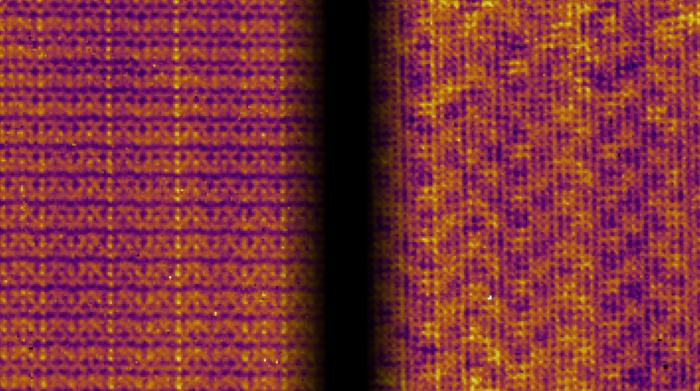
Researchers at OIST and Hiroshima University have shown that a small magnetic field switches the graphene-like quantum material CeTe₃ between competing electronic patterns — striped and checkerboard. Scanning tunneling microscopy revealed the transformation near absolute zero, driven by electronic frustration coupled to magnetism. The findings, published in Nature Communications, offer a new strategy for controlling collective electronic states in quantum materials with potential applications in
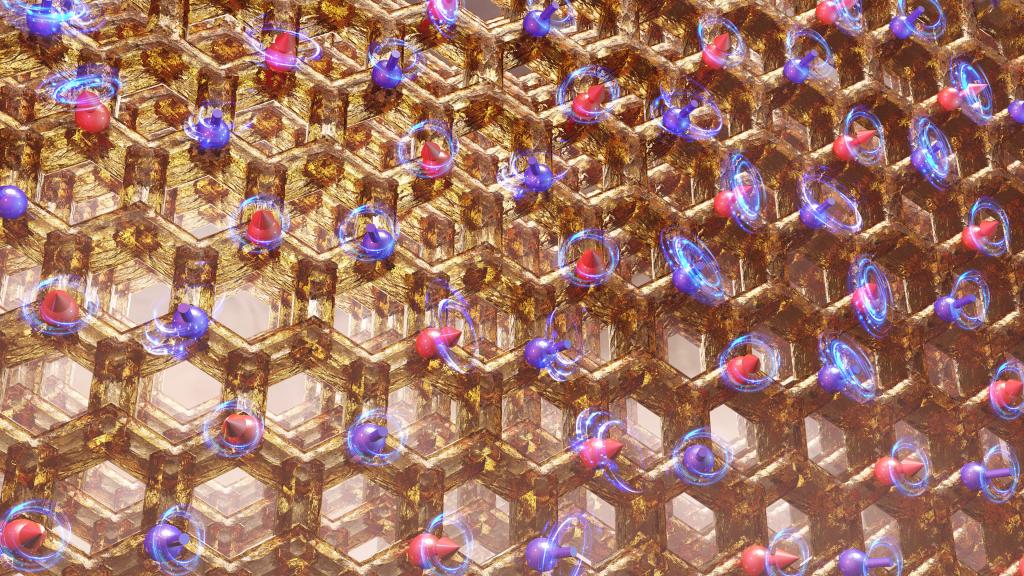
ORNL scientists design a magnetic material as a stepping stone toward revealing new quantum phenomena.
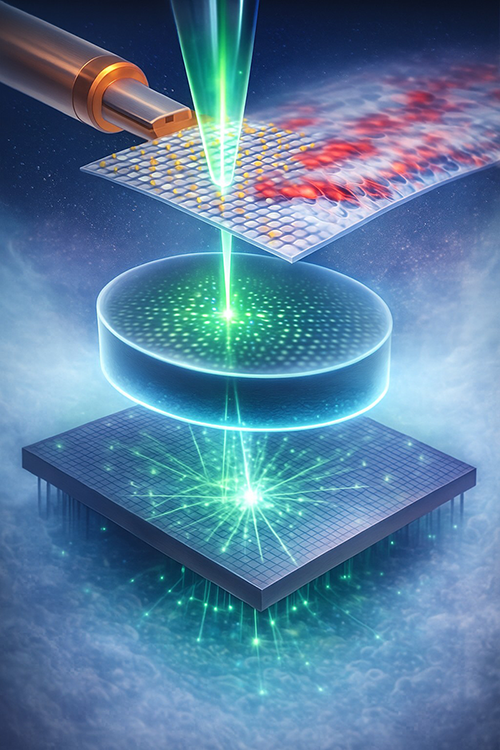
Electronic order in quantum materials often emerges not uniformly, but through subtle and complex patterns that vary from place to place. One prominent example is the charge density wave (CDW), an ordered state in which electrons arrange themselves into periodic patterns at low temperatures. Although CDWs have been studied for decades, how their strength and spatial coherence evolve across a phase transition has remained largely inaccessible experimentally. Now, a team led by Professor Yongso...
