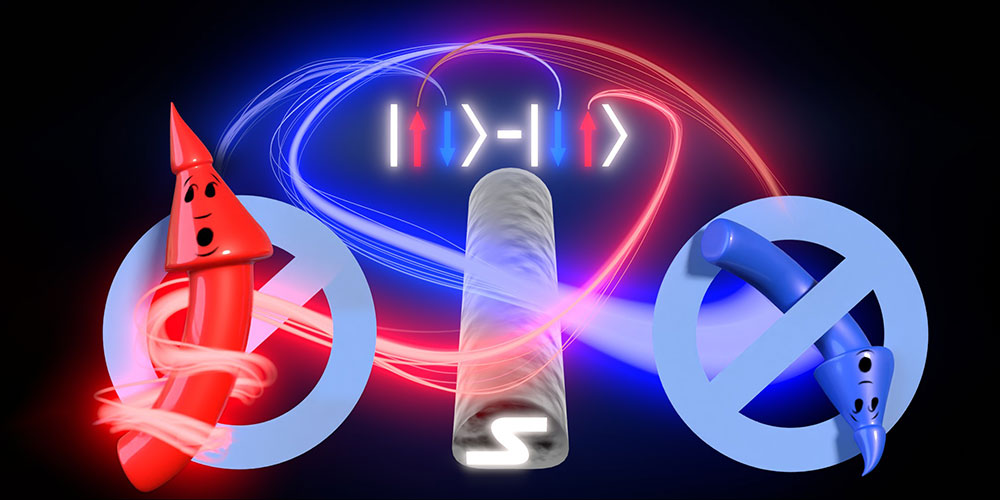
The entanglement between two particles is among those phenomena in quantum physics that are hard to reconcile with everyday experiences. If entangled, certain properties of the two particles are closely linked, even when far apart. Albert Einstein described entanglement as a “spooky action at a distance”. Research on entanglement between light particles (photons) was awarded this year's Nobel Prize in Physics.
Two electrons can be entangled as well – for example in their spins. In a superconductor, the electrons form so-called Cooper pairs responsible for the lossless electrical currents and in which the individual spins are entangled.
For several years, researchers at the Swiss Nanoscience Institute and the Department of Physics at the University of Basel have been able to extract electron pairs from a superconductor and spatially separate the two electrons. This is achieved by means of two quantum dots – nanoelectronic structures connected in parallel, each of which only allows single electrons to pass.
Opposite electron spins from Cooper pairs
The team of Prof. Dr. Christian Schönenberger and Dr. Andreas Baumgartner, in collaboration with researchers led by Prof. Dr. Lucia Sorba from the Istituto Nanoscienze-CNR and the Scuola Normale Superiore in Pisa have now been able to experimentally demonstrate what has long been expected theoretically: electrons from a superconductor always emerge in pairs with opposite spins.
Using an innovative experimental setup, the physicists were able to measure that the spin of one electron points upwards when the other is pointing downwards, and vice versa. “We have thus experimentally proven a negative correlation between the spins of paired electrons,” explains project leader Andreas Baumgartner.
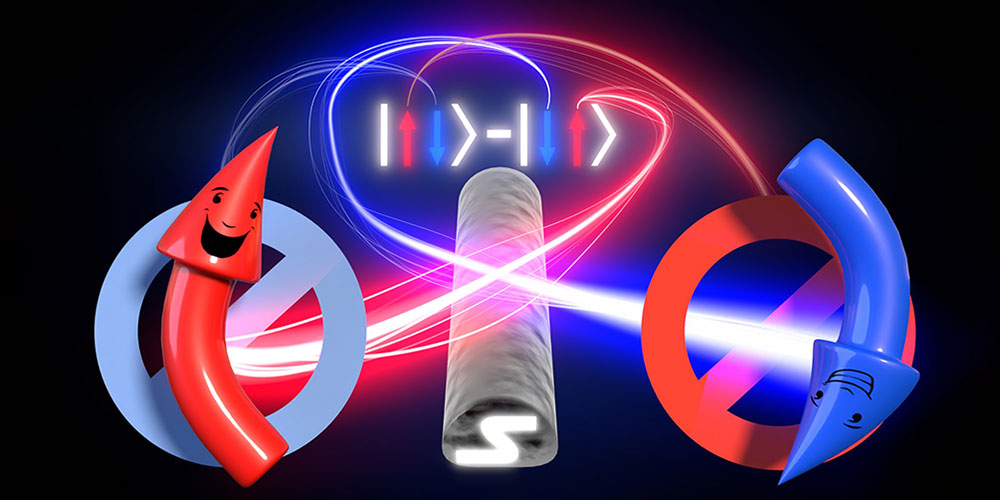
The researchers achieved this by using a spin filter they developed in their laboratory. Using tiny magnets, they generated individually adjustable magnetic fields in each of the two quantum dots that separate the Cooper pair electrons. Since the spin also determines the magnetic moment of an electron, only one particular type of spin is allowed through at a time.
“We can adjust both quantum dots so that mainly electrons with a certain spin pass through them,” explains first author Dr. Arunav Bordoloi. “For example, an electron with spin up passes through one quantum dot and an electron with spin down passes through the other quantum dot, or vice versa. If both quantum dots are set to pass only the same spins, the electric currents in both quantum dots are reduced, even though an individual electron may well pass through a single quantum dot.”
“With this method, we were able to detect such negative correlations between electron spins from a superconductor for the first time,” Andreas Baumgartner concludes. “Our experiments are a first step, but not yet a definitive proof of entangled electron spins, since we cannot set the orientation of the spin filters arbitrarily – but we are working on it.”
The research, which was recently published in Nature, is considered an important step toward further experimental investigations of quantum mechanical phenomena, such as the entanglement of particles in solids, which is also a key component of quantum computers.
Reference
Spin cross-correlation experiments in an electron entangler
Arunav Bordoloi, Valentina Zannier, Lucia Sorba, Christian Schönenberger & Andreas Baumgartner
https://www.nature.com/articles/s41586-022-05436-z
University of Basel
Quantinuum reported third quarter 2026 financial results and raised its 2026 revenue outlook after landing its largest cloud agreement. The company also unveiled a roadmap for its Nexus developer platform.
IonQ reported record third quarter revenue of $173.8 million, up 336 percent year over year, and raised full year 2026 guidance to $505 to $515 million on 110 percent quantum computing growth. Backlog more than doubled to $1.2 billion, with demand led by Superion 256 system deployments, including NVIDIA's first on-premise quantum computer. The company also advanced to Stage C of DARPA's Quantum Benchmarking Initiative and acquired Elisity to extend quantum security.
IonQ announced a partnership with QuantumCT, Connecticut's statewide quantum initiative, which will purchase access to IonQ's trapped-ion quantum computers for state organizations. The contract includes more than 150 hours of cloud runtime.
This week in nanotech
$10.2M raised
2 funding rounds · 18 deals tracked
New products
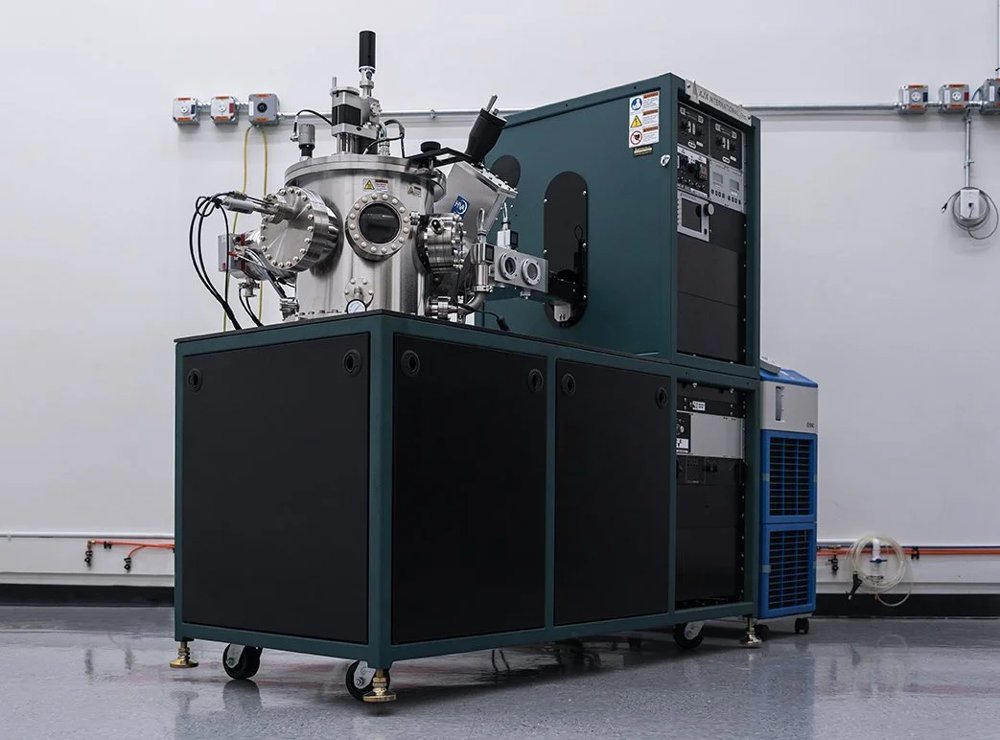 Orion Sputtering Deposition SystemsAJA International Featured
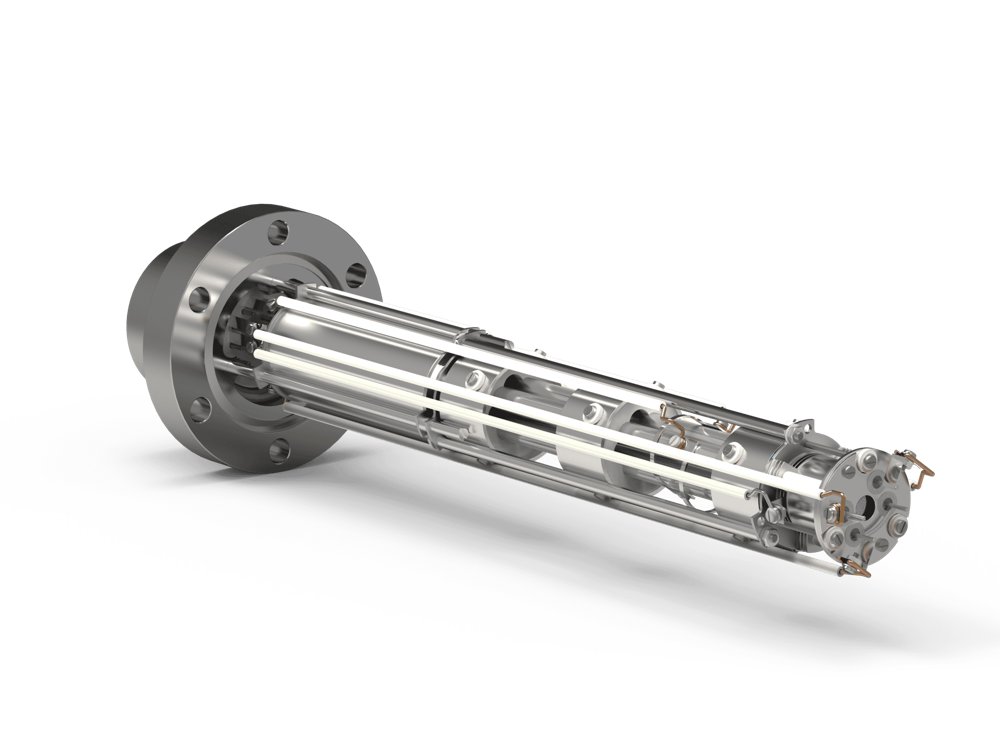 DLS-1 Mass Spectrometer for Fusion Gas AnalysisHiden Analytical Featured
 Hold Down & Release Mechanisms (HDRM) REACT – 5KN, 15KN and 35KN space qualified resettable mechanismsARQUIMEA
Market insights
Last 30 days: Quantum Technologies was the busiest vertical: 52 of 174 events (30%).
Money raised per month