Stretching alters the electronic properties of graphene. @ Swiss Nanoscience Institute, University of Basel
The electronic properties of graphene can be specifically modified by stretching the material evenly, say researchers at the University of Basel. These results open the door to the development of new types of electronic components.
Graphene consists of a single layer of carbon atoms arranged in a hexagonal lattice. The material is very flexible and has excellent electronic properties, making it attractive for numerous applications - electronic components in particular.
Researchers led by Professor Christian Schönenberger at the Swiss Nanoscience Institute and the Department of Physics at the University of Basel have now studied how the material's electronic properties can be manipulated by mechanical stretching. In order to do this, they developed a kind of rack by which they stretch the atomically thin graphene layer in a controlled manner, while measuring its electronic properties.
Sandwiches on the rack
The scientists first prepared a "sandwich" comprising a layer of graphene between two layers of boron nitride. This stack of layers, furnished with electrical contacts, was placed on a flexible substrate.
The researchers then applied a force to the center of the sandwich from below using a wedge. "This enabled us to bend the stack in a controlled way, and to elongate the entire graphene layer," explained lead author Dr. Lujun Wang.
"Stretching the graphene allowed us to specifically change the distance between the carbon atoms, and thus their binding energy," added Dr. Andreas Baumgartner, who supervised the experiment.
Altered electronic states
The researchers first calibrated the stretching of the graphene using optical methods. They then used electrical transport measurements to study how the deformation of the graphene changes the electronic energies. The measurements need to be performed at minus 269°C for the energy changes to become visible.
"The distance between the atomic nuclei directly influences the properties of the electronic states in graphene," said Baumgartner, summarizing the results. "With uniform stretching, only the electron velocity and energy can change. The energy change is essentially the 'scalar potential' predicted by theory, which we have now been able to demonstrate experimentally."
These results could lead, for example, to the development of new sensors or new types of transistors. In addition, graphene serves as a model system for other two-dimensional materials that have become an important research topic worldwide in recent years.
Reference
Global strain-induced scalar potential in graphene devices
Lujun Wang, Andreas Baumgartner, Péter Makk, Simon Zihlmann, Blesson Sam Varghese, David I. Indolese, Kenji Watanabe, Takashi Taniguchi & Christian Schönenberger
https://www.nature.com/articles/s42005-021-00651-y
Contact
Prof. Dr. Christian Schönenberger
Director
Professor
Faculty of Philosophy and Natural Sciences
Department of Physics
Swiss Nanoscience Institute
christian.schoenenberger@unibas.ch
+41 61 207 36 90
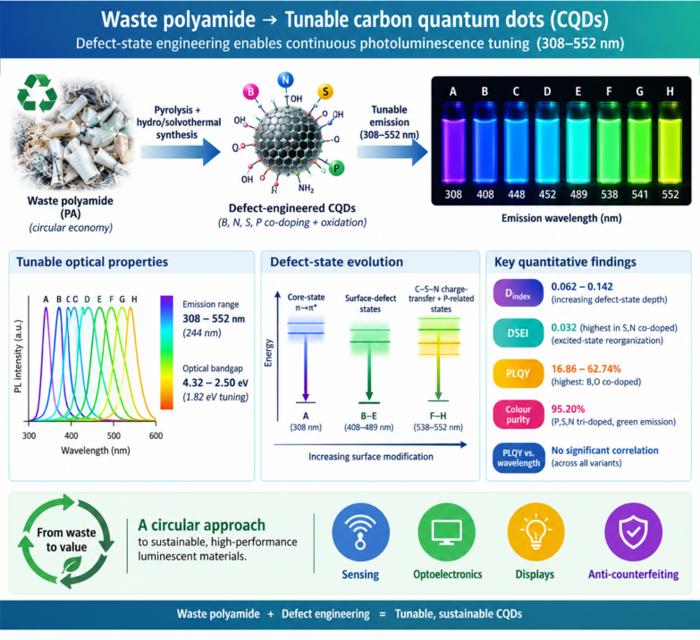
Waste polyamide-derived CQDs show continuous photoluminescence tuning from 308 to 552 nm through sequential defect-state engineering, with optical transition energies decreasing from 4.32 to 2.50 eV. @Christian Ebere Enyoh from Saitama University Carbon quantum dots (CQDs) are fluorescent carbon nanomaterials with potential applications in sensing, optoelectronics, displays, anti-counterfeiting, and environmental technologies. Their optical properties can be adjusted by modifying the carbon...
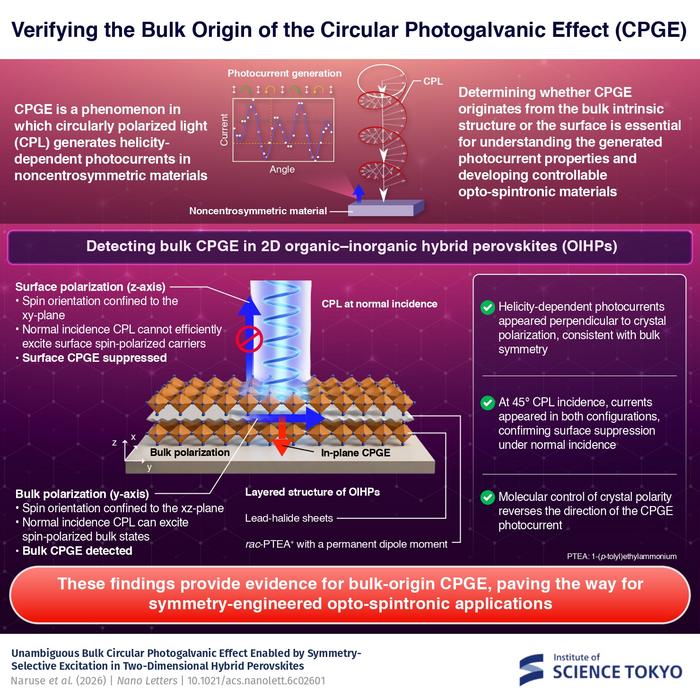
The researchers used circularly polarized light at normal incidence and found that helicity-dependent photocurrents appeared perpendicular to the crystal’s polarization but vanished when measured parallel to it, supporting a bulk origin of CPGE. @Institute of Science Tokyo The circular photogalvanic effect (CPGE), a phenomenon that generates helicity-dependent photocurrents in noncentrosymmetric materials, can originate purely from a crystal's internal structure without contribution from the...
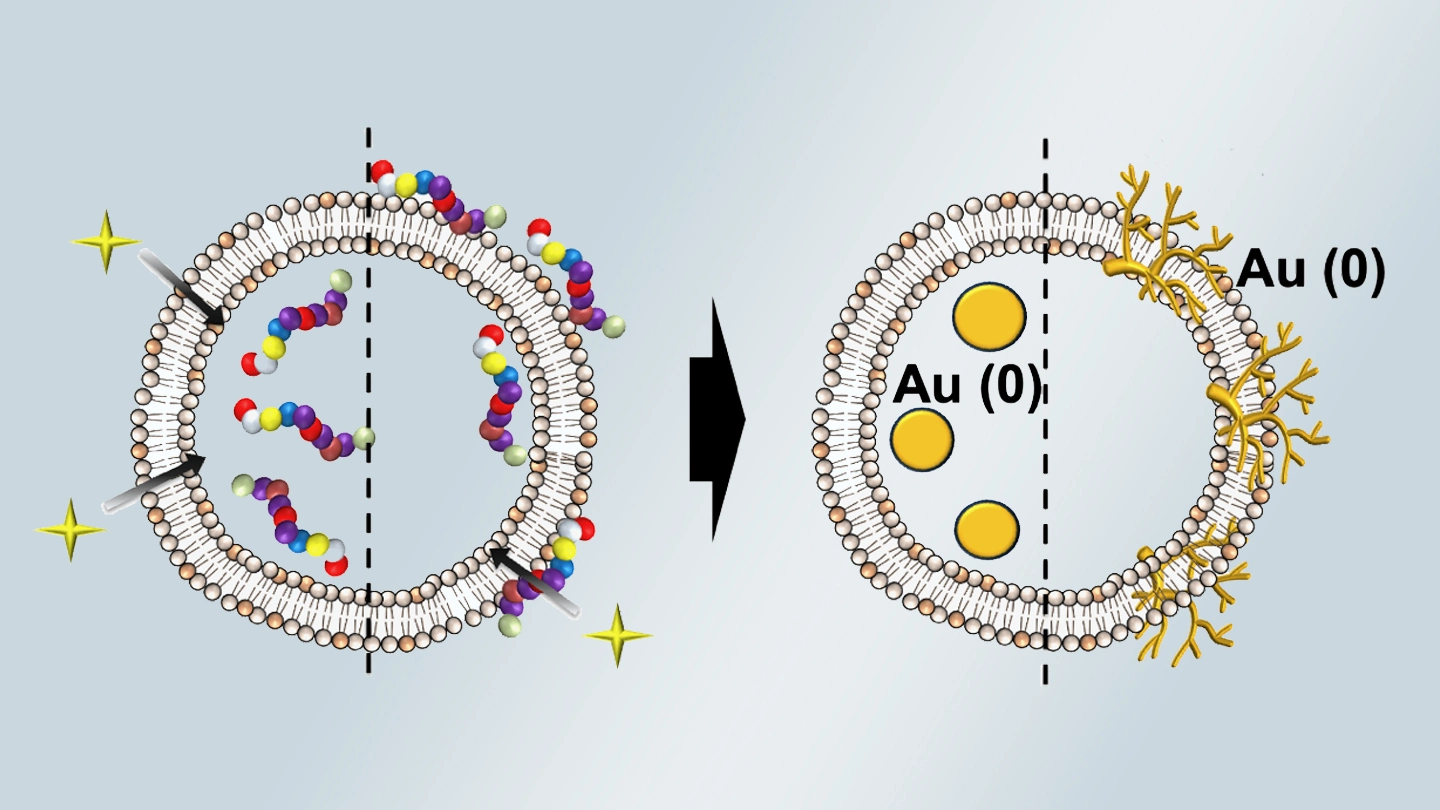
Summary of gold nanoparticle growth programming in liposome based on localization of biomineralization peptide The position of biomineralization peptides within liposomes can influence how gold nanoparticles grow, reports a research team from Institute of Science Tokyo. Peptides localized at the membrane interface promote branched structures, while those confined to the liposome interior favor spherical nanoparticles. The findings offer a new strategy for controlling nanoscale reaction...
