
Scientists in the University of Maryland (UMD)'s Department of Materials Science and Engineering (MSE) have reinvented a 26,000-year-old manufacturing process into an innovative approach to fabricating ceramic materials that has promising applications for solid-state batteries, fuel cells, 3D printing technologies, and beyond.
Ceramics are widely used in batteries, electronics, and extreme environments--but conventional ceramic sintering (part of the firing process used in the manufacture of ceramic objects) often requires hours of processing time. To overcome this challenge, a Maryland research team has invented an ultrafast high-temperature sintering method that both meets the needs of modern ceramics and fosters the discovery of new material innovations.
The study, led by Liangbing Hu, Herbert Rabin Distinguished Professor of the A. James Clark School of Engineering and director of the Center for Materials Innovation at UMD, was published on the May 1 cover of Science. Chengwei Wang, an assistant research scientist in Hu's group, served as first author on the study.
Conventional sintering techniques require a long processing time--it takes hours for a furnace to heat up, then several hours more to 'bake' the ceramic material--which is particularly problematic in the development of electrolytes for solid-state batteries. Alternative sintering technologies (such as microwave-assisted sintering, spark plasma sintering, and flash sintering) are limited for a variety of reasons, often because they are material-specific and/or expensive.
The Maryland team's new method of ultrafast high-temperature sintering offers high heating and high cooling rates, an even temperature distribution, and sintering temperatures of up to 3,000 degrees Celsius. Combined, these processes require less than 10 seconds of total processing time--more than 1,000 times faster than the traditional furnace approach of sintering.
"With this invention, we 'sandwiched' a pressed green pellet of ceramic precursor powders between two strips of carbon that quickly heated the pellet through radiation and conduction, creating a consistent high-temperature environment that forced the ceramic powder to solidify quickly," Hu said. "The temperature is high enough to sinter basically any ceramic material. This patented process can be extended to other membranes beyond ceramics."
The study was conducted through close collaboration with Yifei Mo (associate professor, UMD), J.C Zhao (professor and department chair, UMD), Howard Wang (visiting research professor, UMD), Jian Luo (professor, UC San Diego), Xiaoyu Zheng (assistant professor, UCLA), and Bruce Dunn (professor and department chair, UCLA).
"Ultrafast high-temperature sintering represents a breakthrough in ultrafast sintering technologies, not only because of its general applicability to a broad range of functional materials, but also due to a great potential of creating non-equilibrium bulk materials via retaining or generating extra defects," said Luo.
The rapid sintering technology is being commercialized through HighT-Tech LLC, a UMD spinoff company with a focus on a range of high temperature technologies
"This new method solves the key bottleneck problem in computation and AI-guided materials discovery," said Mo. "We've enabled a new paradigm for materials discovery with an unprecedented accelerated pace."
"We are delighted to see the pyrolysis time reduced from tens of hours to a few seconds, preserving the fine 3D-printed structures after fast sintering," Zheng said.
A general method to synthesize and sinter bulk ceramics in seconds
C Wang, W Ping, Q Bai, H Cui, R Hensleigh, R Wang, A H Brozena, Z Xu, J Dai, Y Pei, C Zheng, G Pastel, J Gao, X Wang, H Wang, J Zhao, B Yang, X Zheng, J Luo, Y Mo, B Dunn, L Hu
Science (2020) Vol. 368, Issue 6490, pp. 521-526
DOI: 10.1126/science.aaz7681
Contact information:
Chengwei Wang
UMD Assistant Research Scientist
vcwang123@gmail.com
Liangbing (Bing) Hu
UMD Professor
binghu@umd.edu
Phone: 301-405-9303
Bing Research Group - Materials Innovation & Manufacturing (MIM)
University of Maryland (UMD)
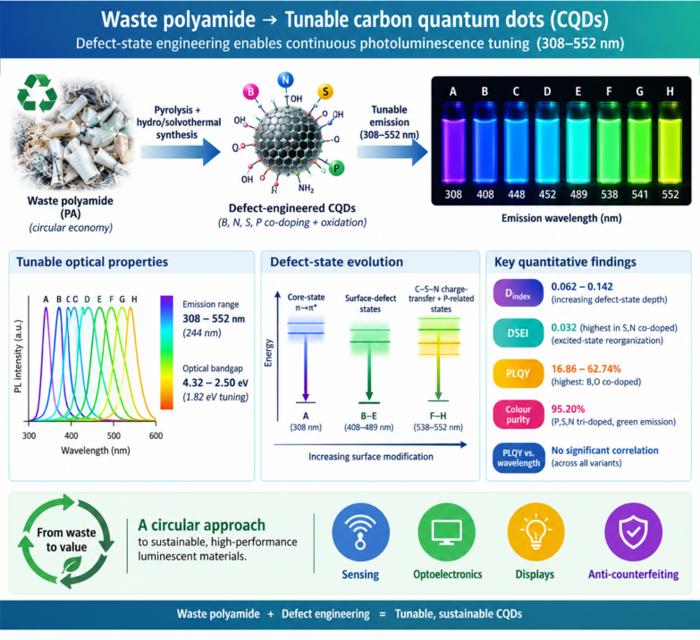
Waste polyamide-derived CQDs show continuous photoluminescence tuning from 308 to 552 nm through sequential defect-state engineering, with optical transition energies decreasing from 4.32 to 2.50 eV. @Christian Ebere Enyoh from Saitama University Carbon quantum dots (CQDs) are fluorescent carbon nanomaterials with potential applications in sensing, optoelectronics, displays, anti-counterfeiting, and environmental technologies. Their optical properties can be adjusted by modifying the carbon...
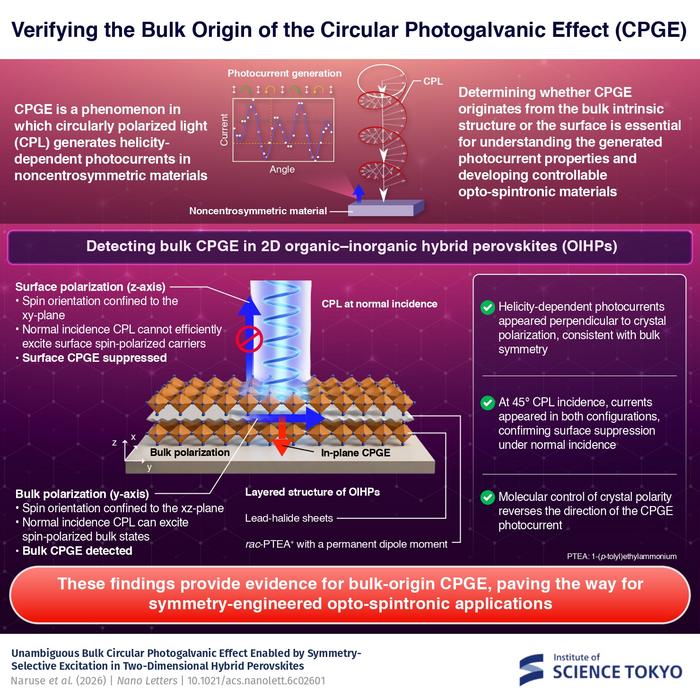
The researchers used circularly polarized light at normal incidence and found that helicity-dependent photocurrents appeared perpendicular to the crystal’s polarization but vanished when measured parallel to it, supporting a bulk origin of CPGE. @Institute of Science Tokyo The circular photogalvanic effect (CPGE), a phenomenon that generates helicity-dependent photocurrents in noncentrosymmetric materials, can originate purely from a crystal's internal structure without contribution from the...
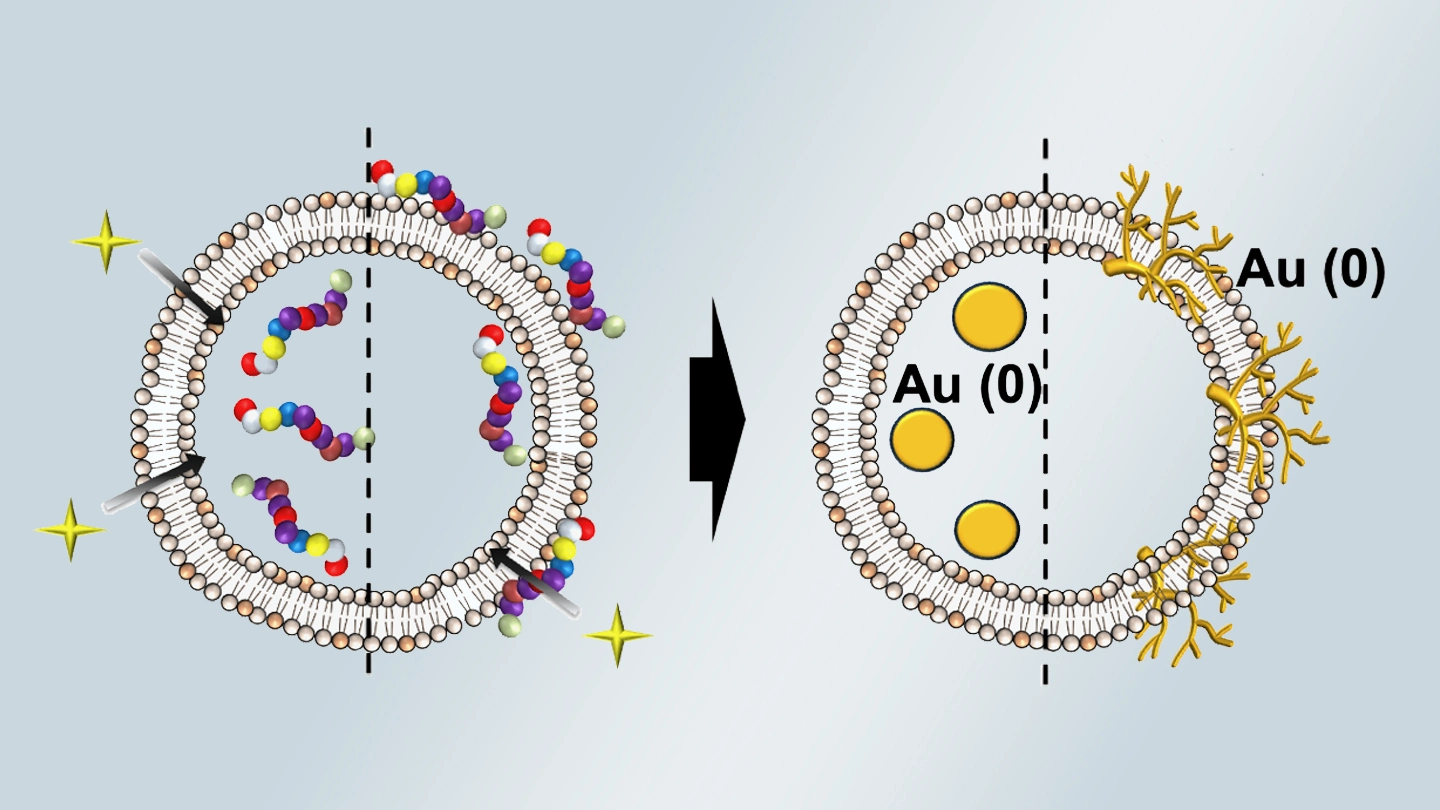
Summary of gold nanoparticle growth programming in liposome based on localization of biomineralization peptide The position of biomineralization peptides within liposomes can influence how gold nanoparticles grow, reports a research team from Institute of Science Tokyo. Peptides localized at the membrane interface promote branched structures, while those confined to the liposome interior favor spherical nanoparticles. The findings offer a new strategy for controlling nanoscale reaction...
