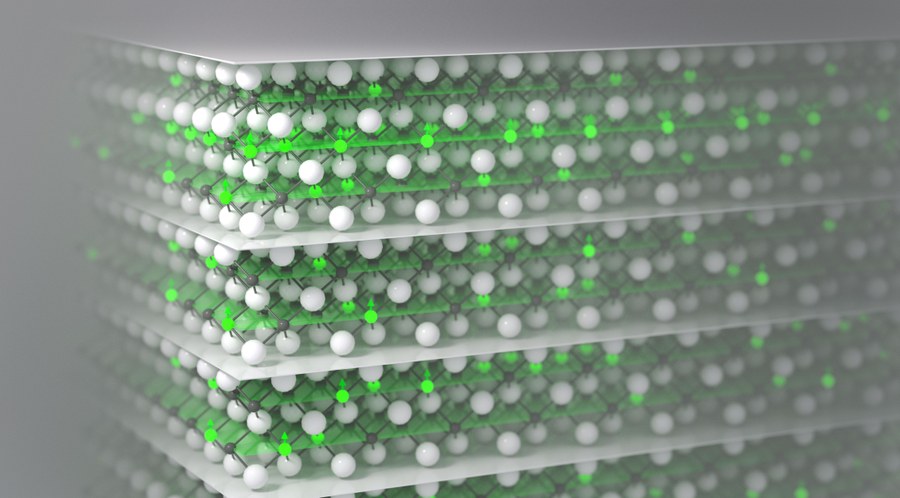
Magnetic topological insulators are an exotic class of materials that conduct electrons without any resistance at all and so are regarded as a promising breakthrough in materials science. Researchers from the Cluster of Excellence ct.qmat in Würzburg and Dresden have achieved a significant milestone in the pursuit of energy-efficient quantum technologies by designing the ferromagnetic topological insulator MnBi6Te10 from the manganese bismuth telluride family. The amazing thing about this quantum material is that its ferromagnetic properties only occur when some atoms swap places, introducing antisite disorder. The findings have been published in the journal Advanced Science.
Harbingers of new technology
In 2019, an international research team headed by materials chemist Anna Isaeva, at that time a junior professor at ct.qmat (Complexity and Topology in Quantum Matter), caused a stir by fabricating the world’s first antiferromagnetic topological insulator – manganese bismuth telluride (MnBi2Te4). This remarkable material has its own internal magnetic field, paving the way for new kinds of electronic components that can store information magnetically and transport it on the surface without any resistance. This could revolutionize computers by making them more sustainable and energy-efficient. Since then, researchers around the globe have been actively studying various aspects of this promising quantum material, eager to unlock its full potential.
Milestone achieved with MnBi6Te10
Based on the previously discovered MnBi2Te4, a team from ct.qmat has now engineered a topological insulator with ferromagnetic properties known as MnBi6Te10. In ferromagnetic materials, the individual manganese atoms are magnetically aligned in parallel, meaning that all their magnetic moments point in the same direction. By contrast, in its antiferromagnetic predecessor, MnBi2Te4, only the magnetic moments within a single layer of the material are aligned in this way. The slight change in the crystal’s chemical composition has a major impact, as the ferromagnetic topological insulator MnBi6Te10 exhibits a stronger and more robust magnetic field than its antiferromagnetic predecessor. “We managed to fabricate the quantum material MnBi6Te10 such that it becomes ferromagnetic at 12 Kelvin. Although this temperature of –261 degrees Celsius is still far too low for computer components, this is the first step on the long journey of development,” explains Professor Vladimir Hinkov from Würzburg. It was his group who discovered that the material’s surface exhibits ferromagnetic properties, enabling it to conduct current without any loss, whereas its interior doesn’t share this characteristic.
Race for the miracle material
The ct.qmat research team wasn’t alone in aiming to create a ferromagnetic topological insulator in the laboratory. “Following the remarkable success of MnBi2Te4, researchers worldwide began searching for more candidates for magnetic topological insulators. In 2019, four different groups synthesized MnBi6Te10, but it was only in our lab that this extraordinary material displayed ferromagnetic properties,” explains Isaeva, now a professor of experimental physics at the University of Amsterdam.
Antisite disorder in the atomic structure
When the Dresden-based materials chemists led by Isaeva painstakingly figured out how to produce the crystalline material in a process akin to detective work, they made an astonishing discovery. It turned out that some atoms needed to be repositioned from their original atomic layer, meaning they had to leave their native arrangement in the crystal. “The distribution of manganese atoms across all crystal layers causes the surrounding manganese atoms to rotate their magnetic moment in the same direction. The magnetic order becomes contagious,” explains Isaeva. “Atomic antisite disorder, the phenomenon seen in our crystal, is usually considered disruptive in chemistry and physics. Ordered atomic structures are easier to calculate and better understood – yet they don’t always yield the desired result,” adds Hinkov. “This very disorder is the critical mechanism that enables MnBi6Te10 to become ferromagnetic,” emphasizes Isaeva.
Collaborative network for cutting-edge research
ct.qmat scientists from the two universities TU Dresden and JMU Würzburg as well as from the Leibniz-Institut für Festkörper- und Werkstoffforschung (IFW) in Dresden collaborated on this groundbreaking research. The crystals were prepared by a team of materials chemists headed by Isaeva (TU Dresden). Subsequently, the samples’ bulk ferromagnetism was detected at IFW, where Dr. Jorge I. Facio also developed a comprehensive theory explaining both the ferromagnetism of MnBi6Te10 characterized by antisite disorder and its antiferromagnetic counterparts. Hinkov’s team at JMU Würzburg conducted the vital surface measurements.
The researchers are currently working to achieve ferromagnetism at considerably higher temperatures. They’ve already made initial progress, reaching around 70 Kelvin. Simultaneously, the ultra-low temperatures at which the exotic quantum effects manifest need to be increased, as lossless current conduction only starts at 1 to 2 Kelvin.
Reference
Intermixing-Driven Surface and Bulk Ferromagnetism in the Quantum Anomalous Hall Candidate MnBi6Te10
Abdul-Vakhab Tcakaev, Bastian Rubrecht, Jorge I. Facio, Volodymyr B. Zabolotnyy, Laura T. Corredor, Laura C. Folkers, Ekaterina Kochetkova, Thiago R. F. Peixoto, Philipp Kagerer, Simon Heinze, Hendrik Bentmann, Robert J. Green, Pierluigi Gargiani, Manuel Valvidares, Eugen Weschke, Maurits W. Haverkort, Friedrich Reinert, Jeroen van den Brink, Bernd Büchner, Anja U. B. Wolter, Anna Isaeva, Vladimir Hinkov
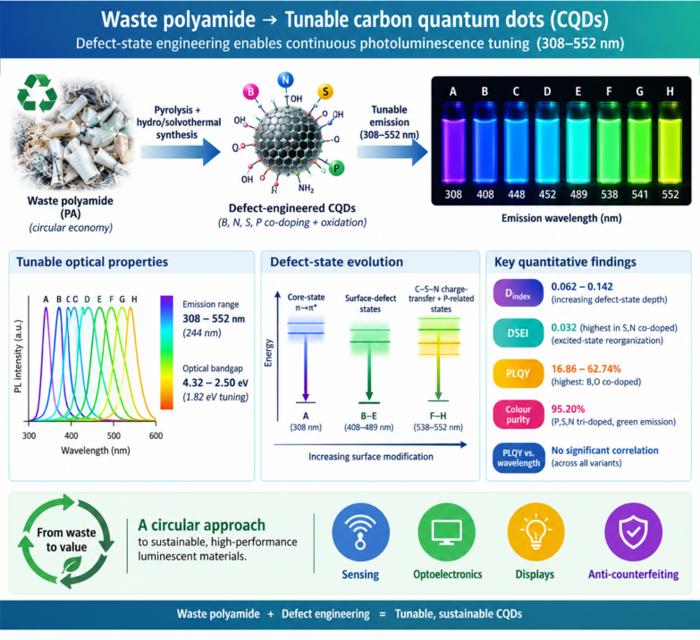
Waste polyamide-derived CQDs show continuous photoluminescence tuning from 308 to 552 nm through sequential defect-state engineering, with optical transition energies decreasing from 4.32 to 2.50 eV. @Christian Ebere Enyoh from Saitama University Carbon quantum dots (CQDs) are fluorescent carbon nanomaterials with potential applications in sensing, optoelectronics, displays, anti-counterfeiting, and environmental technologies. Their optical properties can be adjusted by modifying the carbon...

The researchers used circularly polarized light at normal incidence and found that helicity-dependent photocurrents appeared perpendicular to the crystal’s polarization but vanished when measured parallel to it, supporting a bulk origin of CPGE. @Institute of Science Tokyo The circular photogalvanic effect (CPGE), a phenomenon that generates helicity-dependent photocurrents in noncentrosymmetric materials, can originate purely from a crystal's internal structure without contribution from the...
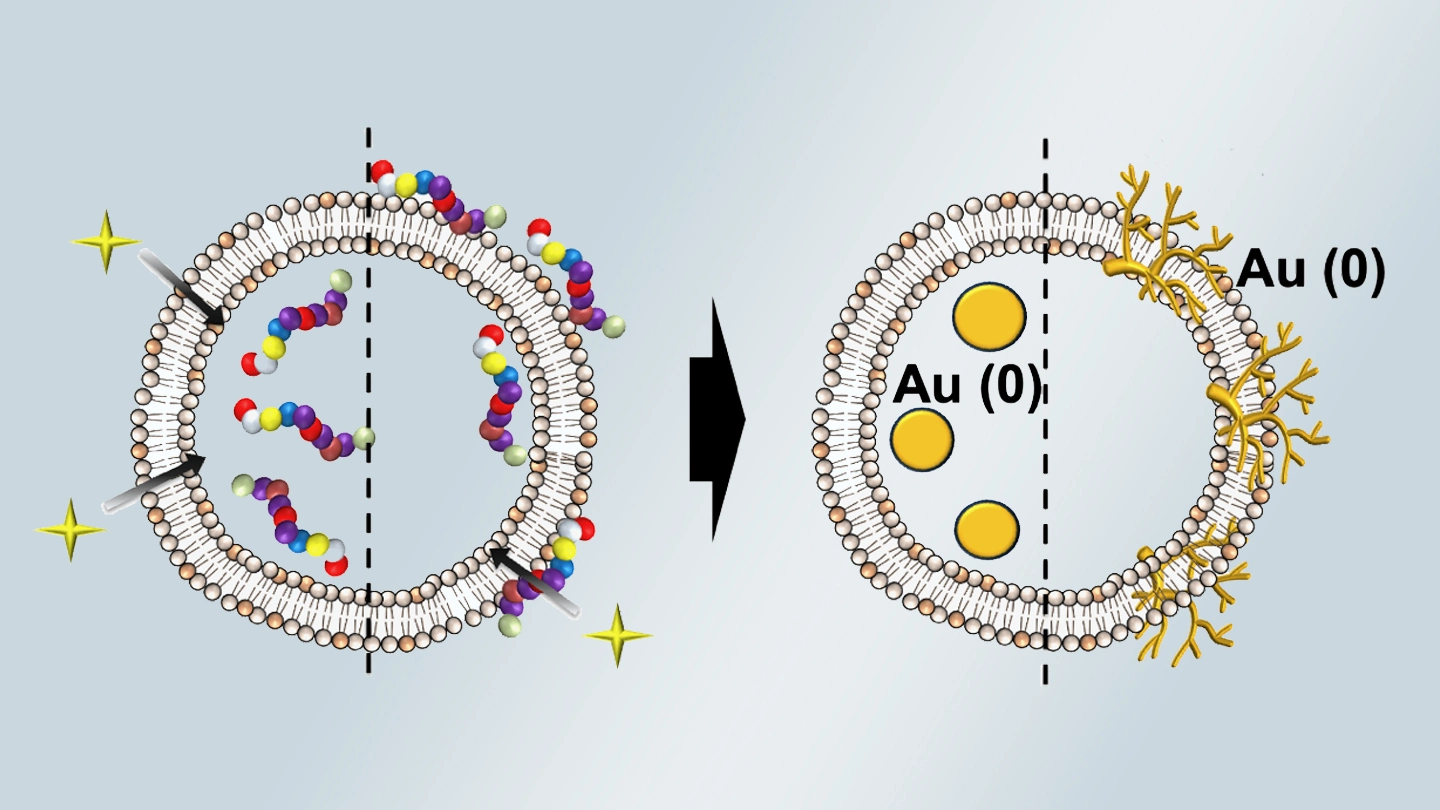
Summary of gold nanoparticle growth programming in liposome based on localization of biomineralization peptide The position of biomineralization peptides within liposomes can influence how gold nanoparticles grow, reports a research team from Institute of Science Tokyo. Peptides localized at the membrane interface promote branched structures, while those confined to the liposome interior favor spherical nanoparticles. The findings offer a new strategy for controlling nanoscale reaction...
