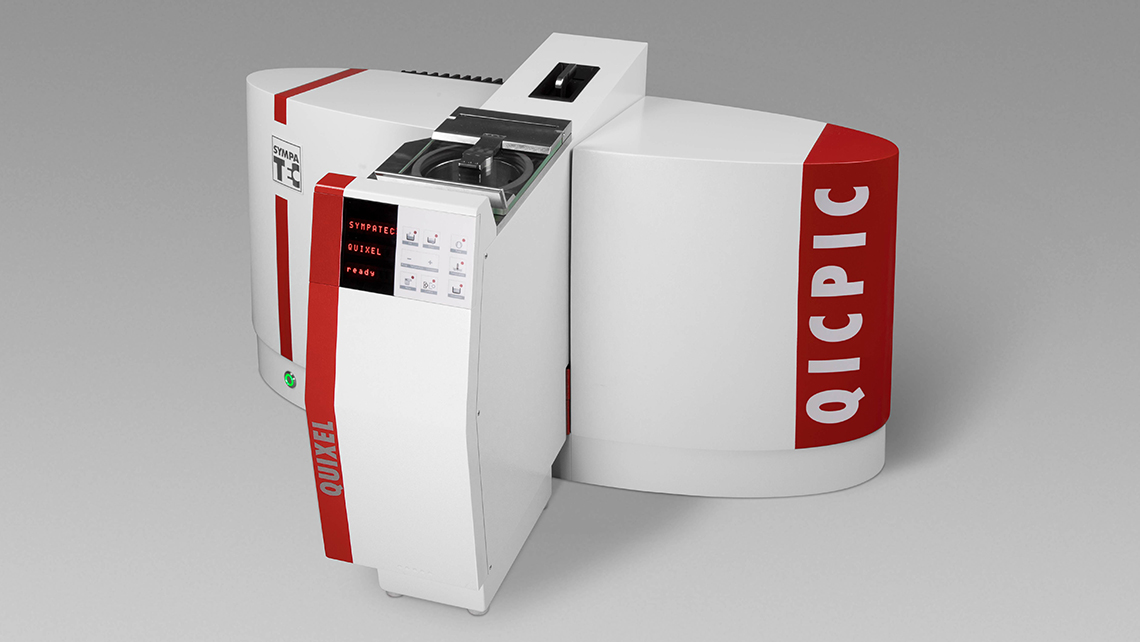
Sympatec GmbH has launched the QICPIC/S series, a new generation of its QICPIC dynamic image analysis sensor for particle size and shape characterisation. The company says the series offers a new high-resolution camera, an increased frame rate, and optimised software and data handling.
The new camera technology offers up to 20 megapixels. A frame rate of up to 950 frames per second doubles the measurable sample volume compared to its predecessor. The entire measuring range from 0.5 µm to 34,000 µm is now covered by up to four precision optics, instead of the six lenses required by the predecessor model. Dry measurements below 1 µm become achievable, the company says.
Sympatec has also introduced QUIXEL/S, a version of its wet dispersion system developed for QICPIC/S. It covers a measuring range from under 1 µm to 3,500 µm and is available in two versions, with 2 mm or 6 mm stainless steel flow cuvettes with FKM gaskets and, optionally, FFKM gaskets for aggressive liquids. A heating option and special top lids with automated additive supply are optionally available.
According to the company, full backward compatibility ensures that measurement results from QICPIC/S remain fully comparable with those of earlier QICPIC models. Proven principles, such as modular, product-specific dispersion and the analysis of individual particles, remain unchanged.
Source: Sympatec GmbH news
AIST and HORIBA, Ltd. have jointly established the HORIBA Institute for Particle Analysis in AIST TSUKUBA (HIPAA) under the National Metrology Institute of Japan, AIST. HIPAA has conducted operations since February 1, 2021.
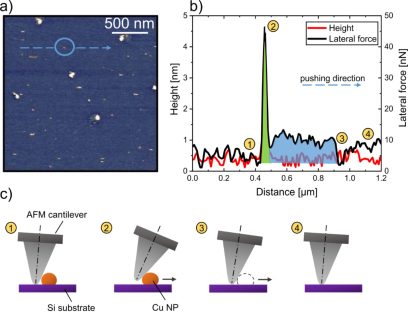
Researchers used NANOSENSORS Uniqprobe qp-CONT AFM probes to manipulate individual copper nanoparticles on silicon and estimate nanoparticle-substrate adhesion from force and displacement data.
Penn State's Materials Research Institute is launching a solution with the Institute for Computational and Data Sciences for automated, high-speed transfer of data from all MCL electron microscopes directly to ICDS.