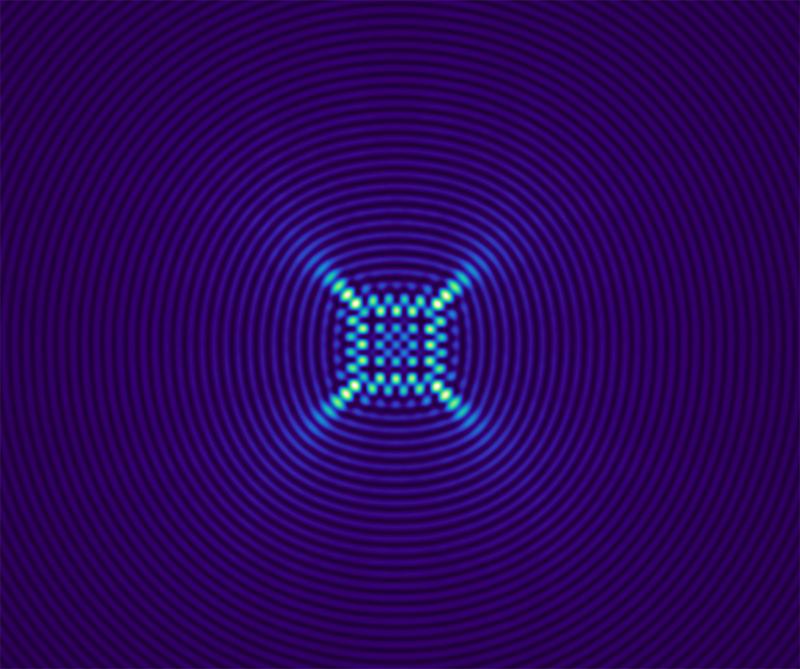
An international research team with Prof. Cornelia Denz from the Institute of Applied Physics at the University of Münster develop for the first time light fields using caustics that do not change during propagation. With the new method, the physicists cleverly exploit light structures that can be seen in rainbows or when light is transmitted through drinking glasses.
Modern applications as high resolution microsopy or micro- or nanoscale material processing require customized laser beams that do not change during propagation.
This represents an immense challenge since light typically broadens during propagation, a phenomenon known as diffraction. So-called propagation-invariant or non-diffracting light fields therefore do not seem possible at first glance.
If it were possible to produce them, they would enable new applications such as light disk microscopy or laser-based cutting, milling or drilling with high aspect ratios.
An international research team from the Universities of Birmingham, Marseille and Münster has now succeeded for the first time to create arbitrary nondiffracting beams.
"We implement an approach inspired by nature, in which any desired intensity structure can be specified by its boundaries," explains one of the authors of the study, Prof. Cornelia Denz from the Institute of Applied Physics at the University of Münster.
The authors cleverly exploit light structures that can be seen in rainbows or when light is transmitted through drinking glasses: spectacular ray structures named caustics. They are bright focus lines that overlap, and thereby building networks that can be exploited for nondiffracting propagation.
The team developed a method to use these caustics as a basis for the generation of arbitrary structures, and has thus created an intelligent manipulation of ray propagation.
In this way, countless new types of laser beams can be formed on the micrometer scale, opening up completely new perspectives in optical materials processing, multidimensional signal transmission or advanced high resolution imaging.
Only some years ago it was possible to realize a few light fields that exhibit these non-diffracting properties, even though the theoretical idea is older: Concentric ring structures like the Bessel beam could be produced in a propagation-invariant way.
The theory predicts a whole class of beams whose transverse shape is generated on elliptical or parabolic trajectories and represent natural solutions of the wave equation.
Although there has long been a need for such customized light beams with these properties, they have hardly been produced experimentally because the invariance of the transverse intensity structure must be maintained during propagation.
The study results of the team were recently published in the journal "Nature Communications".
Funding:
The study received financial support from the National Science Foundation, the Excellence Initiative of the University of Aix-Marseille and the Universities of Bristol, Birmingham and Münster.
Reference:
Shaping caustics into propagation invariant light. Nature Communications
A. Zannotti, C. Denz, M. A. Alonso, M. R. Dennis (2020)
DOI: 10.1038/s41467-020-17439-3
Contact:
Wissenschaftliche Ansprechpartner:
Westfälische Wilhelms-Universität Münster
Institute of Applied Physics
Prof. Cornelia Denz
Tel. 0251 / 83-335-17 (directly)
Tel. 0251 / 83-335-18 (Secretariat)
E-mail: denz@uni-muenster.de
Research group Prof. Cornelia Denz at Münster University
Research group of Prof. Miguel Alonso, University of Aix-Marseille
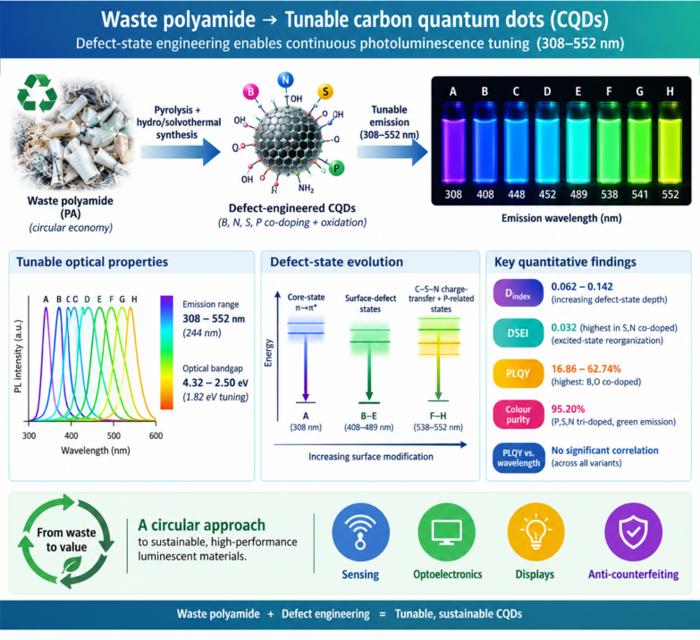
Waste polyamide-derived CQDs show continuous photoluminescence tuning from 308 to 552 nm through sequential defect-state engineering, with optical transition energies decreasing from 4.32 to 2.50 eV. @Christian Ebere Enyoh from Saitama University Carbon quantum dots (CQDs) are fluorescent carbon nanomaterials with potential applications in sensing, optoelectronics, displays, anti-counterfeiting, and environmental technologies. Their optical properties can be adjusted by modifying the carbon...
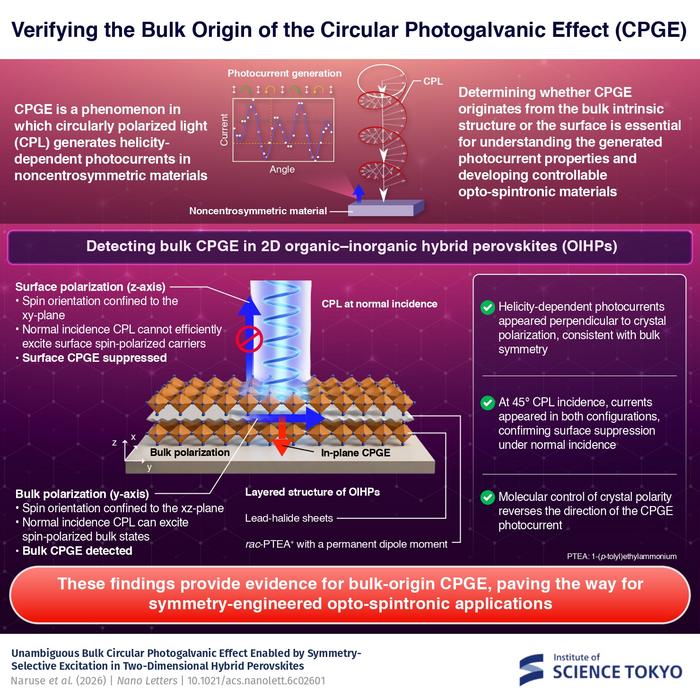
The researchers used circularly polarized light at normal incidence and found that helicity-dependent photocurrents appeared perpendicular to the crystal’s polarization but vanished when measured parallel to it, supporting a bulk origin of CPGE. @Institute of Science Tokyo The circular photogalvanic effect (CPGE), a phenomenon that generates helicity-dependent photocurrents in noncentrosymmetric materials, can originate purely from a crystal's internal structure without contribution from the...
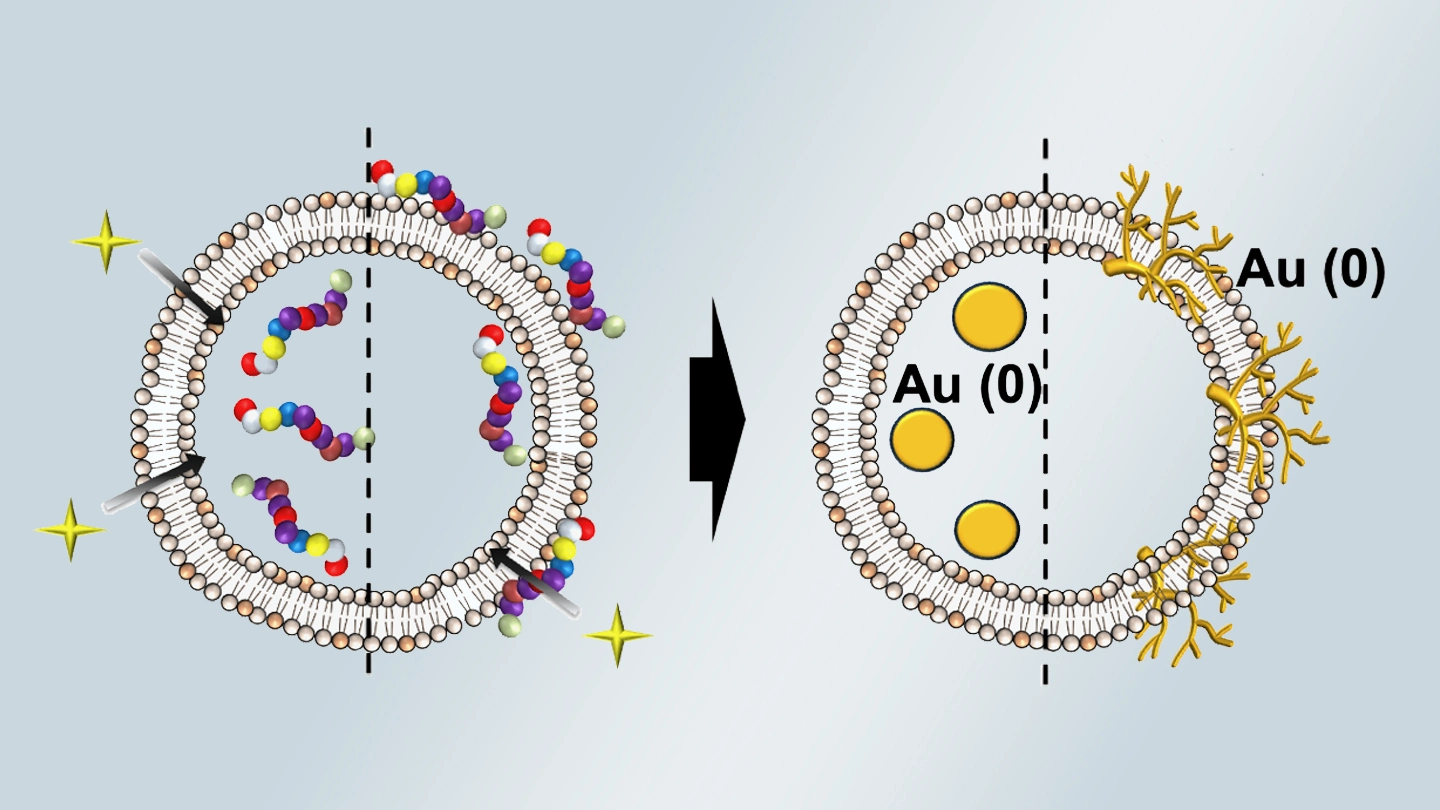
Summary of gold nanoparticle growth programming in liposome based on localization of biomineralization peptide The position of biomineralization peptides within liposomes can influence how gold nanoparticles grow, reports a research team from Institute of Science Tokyo. Peptides localized at the membrane interface promote branched structures, while those confined to the liposome interior favor spherical nanoparticles. The findings offer a new strategy for controlling nanoscale reaction...
