Harvard University
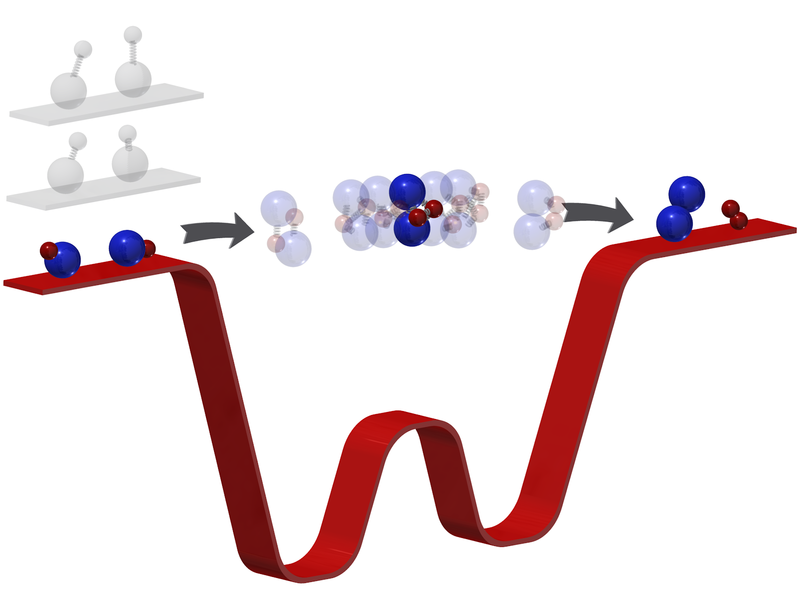
The coldest chemical reaction in the known universe took place in what appears to be a chaotic mess of lasers. The appearance deceives: Deep within that painstakingly organized chaos, in temperatures millions of times colder than interstellar space, Kang-Kuen Ni achieved a feat of precision. Forcing two ultracold molecules to meet and react, she broke and formed the coldest bonds in the history of molecular couplings.
"Probably in the next couple of years, we are the only lab that can do this," said Ming-Guang Hu, a postdoctoral scholar in the Ni lab and first author on their paper published today in Science. Five years ago, Ni, the Morris Kahn Associate Professor of Chemistry and Chemical Biology and a pioneer of ultracold chemistry, set out to build a new apparatus that could achieve the lowest temperature chemical reactions of any currently available technology. But they couldn't be sure their intricate engineering would work.
Now, they not only performed the coldest reaction yet, they discovered their new apparatus can do something even they did not predict. In such intense cold -- 500 nanokelvin or just a few millionths of a degree above absolute zero -- their molecules slowed to such glacial speeds, Ni and her team could see something no one has been able to see before: the moment when two molecules meet to form two new molecules. In essence, they captured a chemical reaction in its most critical and elusive act.
Chemical reactions are responsible for literally everything: breathing, cooking, digesting, creating energy, pharmaceuticals, and household products like soap. So, understanding how they work at a fundamental level could help researchers design combinations the world has never seen. With an almost infinite number of new combinations possible, these new molecules could have endless applications from more efficient energy production to new materials like mold-proof walls and even better building blocks for quantum computers.
In her previous work, Ni used colder and colder temperatures to work this chemical magic: forging molecules from atoms that would otherwise never react. Cooled to such extremes, atoms and molecules slow to a quantum crawl, their lowest possible energy state. There, Ni can manipulate molecular interactions with utmost precision. But even she could only see the start of her reactions: two molecules go in, but then what? What happened in the middle and the end was a black hole only theories could try to explain.
Chemical reactions occur in just millionths of a billionth of a second, better known in the scientific world as femtoseconds. Even today's most sophisticated technology can't capture something so short-lived, though some come close. In the last twenty years, scientists have used ultra-fast lasers like fast-action cameras, snapping rapid images of reactions as they occur. But they can't capture the whole picture. "Most of the time," Ni said, "you just see that the reactants disappear and the products appear in a time that you can measure. There was no direct measurement of what actually happened in these chemical reactions." Until now.
Ni's ultracold temperatures force reactions to a comparatively numbed speed. "Because [the molecules] are so cold," Ni said, "now we kind of have a bottleneck effect." When she and her team reacted two potassium rubidium molecules -- chosen for their pliability -- the ultracold temperatures forced the molecules to linger in the intermediate stage for microseconds. Microseconds -- mere millionths of a second -- may seem short, but that's millions of times longer than usual and long enough for Ni and her team to investigate the phase when bonds break and form, in essence, how one molecule turns into another.
With this intimate vision, Ni said she and her team can test theories that predict what happens in a reaction's black hole to confirm if they got it right. Then, her team can craft new theories, using actual data to more precisely predict what happens during other chemical reactions, even those that take place in the mysterious quantum realm.
Already, the team is exploring what else they can learn in their ultracold test bed. Next, for example, they could manipulate the reactants, exciting them before they react to see how their heightened energy impacts the outcome. Or, they could even influence the reaction as it occurs, nudging one molecule or the other. "With our controllability, this time window is long enough, we can probe," Hu said. "Now, with this apparatus, we can think about this. Without this technique, without this paper, we cannot even think about this."
Direct observation of bimolecular reactions of ultracold KRb molecules
M.-G. Hu, Y. Liu, D. D. Grimes, Y.-W. Lin, A. H. Gheorghe, R. Vexiau, N. Bouloufa-Maafa, O. Dulieu, T. Rosenband, K.-K. Ni
Science (2019) 366 (6469): 1111
Contact information:
Kang-Kuen Ni
Harvard Associate Professor of Chemistry and Chemical Biology and of Physics
ni@chemistry.harvard.edu
Phone: 617-496-3199
Ni Group - Ultracold Molecular Chemistry and Physics Lab

Silver nanoparticles with diameters of ~10 nm deliver the best performance as electrocatalysts. The silver particles are sprayed onto the electrode together with a conductive carbon powder. The ideal mixture consists of 20 per cent by mass silver and 80 per cent by mass carbon powder. This image was taken using a transmission electron microscope (TEM). © HZB Via electrolysis, CO₂ can be reduced to CO, a raw material for further chemical products such as fuels. Within the GreenQuest Project,...

A flexible metal–organic framework developed by researchers from Institute of Science Tokyo enables the structural determination of large "beyond rule of 5" molecules from microgram-scale samples. Using APF-40 as a crystalline sponge, the researchers determined the structures of 12 pharmaceutical-related molecules, including the 899 Da drug molecule doramectin and trace ivermectin derivatives. The method could aid drug discovery, natural products research, and the characterization of rare...
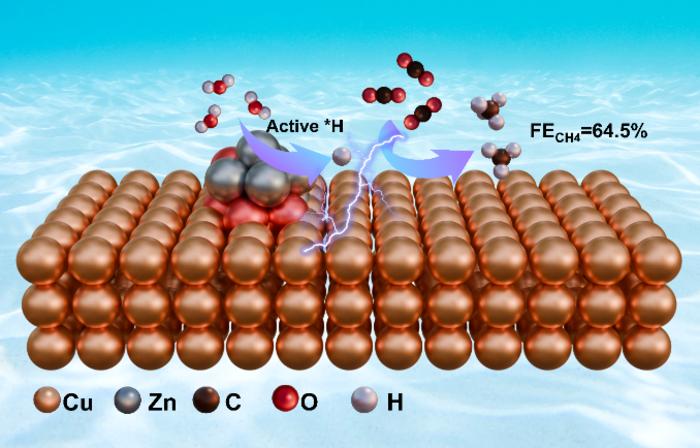
image: CuZn800@C was constructed via solvothermal method and utilizes the high-temperature volatility of zinc to prepare through calcination at different temperatures, which displays a high methane Faradaic efficiency of 64.5% and a remarkable partial current density of -551.3 mA/cm2 at -1.7 V vs. RHE, along with excellent stability. Zn and Cu form a tandem reaction system. Zn sites promote water splitting to provide protons, while Cu sites reduce the energy barrier for *CO hydrogenation....






